Sunday, January 25, 2015

Urgent! Indiana Genealogy Department In Danger

Taking the advice of Amy Johnson Crow of No Story Too Small, I wrote the following letter to my local representative:

I am writing to you as an Indiana resident, a high school student, and as one who would be affected by the proposed state budget for 2015.  I am very interested in genealogy and the history of the state of Indiana.  For a number of years, I have participated in the 4-H genealogy project, along with many other young Hoosiers.   By engaging in genealogy research, I’ve felt more connected to the history of our state, learning aspects of history I would never have come across in my history curriculum.  

As I understand, House Bill 1001 would cut funds for the Indiana State Library and eliminate the Genealogy Department as well.   This redistribution of funds, if it takes effect, will be a huge loss for genealogists like myself.   In researching my family, I have requested information from the Indiana State Library, and they have been very helpful.  The Indianapolis Public Library has already made it known that they will not spend resources on maintaining a genealogy collection.   Many records have not been digitized.  For a small portion of the budget, the history of the people of Indiana can be preserved and kept safe. 

The Indiana State Library and the Genealogy Department are not just valuable resources to Indiana residents.  Many researchers come from out of state to view unique records at the state library, generating revenue for our state through their travel expenses.

Indiana’s bicentennial is next year.  With such an important anniversary as this, there should be an effort made in regard to showcasing and making accessible our state’s history.   How would that happen if the Indiana State Library funding is cut and the Genealogy Department is eliminated?

Please vote to restore funding for the Indiana State Library and the Genealogy Department.  We must preserve our history for generations to come.

Sincerely,

Brenna G.

Please consider contacting a representative and expressing your opinion on the proposed budget.  

Friday, January 23, 2015

52 Ancestors 2015: #4 Mary Ann Williamson, Who Knitted Her Way To Indianapolis

"Old Woman Knitting a Sock" by Ivan Khrutsky
Source: Wikimedia Commons
Polly [as Mary Ann was also called] decided to go to Indianapolis to trade one day.  So she climbed on her little mule with her knitting.  She rode and she rode and she knitted and she knitted.  Finally, she met a soldier and asked, "How much farther is Indianapolis?"  He answered, "You passed through Indianapolis two miles back!!"

I found this humorous story in One Man's Family, written by Olive Lewis Kolb.  The tale is attributed to Mary Ann's son, Stephen Theodore Worland.

Mary Ann Williamson was born on October 20, 1811 in Kentucky.  (My 4th great grandmother and I share a birthday and a fondness for knitting!)  I don't have any information about her parents. According to Kolb, she may have been an adopted child.

On March 4, 1833, Mary Ann married Stephen Dominic Worland in Marion County, Indiana.  Stephen came from a Catholic family with deep roots in the history of early Maryland.  By 1840, the Worlands had settled in Shelby County, Indiana.  Mary Ann was the mother of 12 children, the oldest of which was my 3rd great grandfather, John William Worland.  Sadly, Mary Ann's three youngest children did not live past infancy.

Sometime between 1859-1860, the Worlands moved to Millwood, Missouri.  At the outbreak of the Civil War, Missouri was divided on the issue of slavery.  By 1863, conditions there were tumultuous and unstable. The Worlands decided to move back to Indiana.  Tilson Vincent Worland, Mary Ann's grandson, recounted the Worland family's return to Indiana from Missouri:

I have heard my father, Stephen Theodore, tell of the trip back to Indiana.  The womenfolk returned by train, but grandfather [Stephen Dominic Worland] and his six sons drove through bringing six horses. They ferried the Missouri and Mississippi Rivers and followed the old National Trail from St. Louis through Terre Haute, Indiana, to Indianapolis.  It took a week to travel from St. Louis to Terre Haute and they never saw the sun all week.  They had a dog, and after reaching Indiana ... the dog disappeared and several weeks later showed up at the old Missouri home.  How the dog crossed the Mississippi and Missouri Rivers on his return home is still a mystery.   (One Man's Family by Olive Lewis Kolb, pages 1044-1045.)

In 1879, two of Mary Ann's children, 43 year-old Sarah Ann Oefelein and 35 year-old George Tilson Worland, died within the space of two months.  I wonder if there was an epidemic of some kind in Shelby County, Indiana at that time.

Mary Ann Williamson Worland died on December 23, 1894 at the home of her son Stephen and was buried next to her husband at St. Vincent de Paul Catholic Cemetery in Waldron, Shelby County, Indiana.

Thursday, January 15, 2015

52 Ancestors 2015: #3 Margaret Richinson, Dour Indeed

Margaret Richinson Mull, c. 1860.
From In Old Kentucky, Vol. 3 by Wm. DePrez Inlow
Judging by this picture, my 5th great grandmother Margaret Richinson appears to be a tough, strong woman.  And I am not the only one to think so.  In his book In Old Kentucky, William DePrez Inlow says of Margaret's portrait,  "She seems to be dour, dour indeed!"  

Margaret Richinson has also been a tough woman to research! I don't know her parent's names -- in fact, I'm not even sure whether her maiden name is Richinson or Richardson.  I don't know the county of her birth or exactly when she was married, and she died before death records were kept in the county where she died.

I have pieced together a few details of Margaret's life. She was born on the third day of January, 1805 in New Jersey, to a family of Scottish descent. Like many families of the early 19th century, Margaret's family moved west.  She met and married Jacob Mull in Ohio, most likely in Warren County.

The Mulls had four children born between 1824 and 1831: Catherine (my 4th great grandmother), George, Cyrus, and Mary Ann.  July 16, 1835 had to be one of the saddest days of Margaret's life.  Her oldest son, George Mull, died at the age of seven.

Margaret's husband Jacob died on June 5, 1861.  Although I assume she went to live with one of her children, I can't find Margaret in the 1870 census.  According to Findagrave, Margaret died on April 21, 1872 and is buried at the Manilla Cemetery in Manilla, Indiana.

Wednesday, January 14, 2015

52 Ancestors 2015: #2 Arnold Livers, Page of the Backstairs

England Coat of Arms, 1660-1689, used by James II
Image from Wikipedia Creative Commons
Arnold Livers was a devoted partisan of James II, the last Catholic King of England.  When this unfortunate monarch was dethroned through the plottings of his newphew and his son-in-law, William of Orange, Mr. Livers fled to Maryland and became the proprietor of a large estate.  So deep was his attachment to the Stuart-King, that he swore he would name his first child "James."  As the first born proved to be a girl, and the loyal father insisted upon the promised name, the priest who baptized the child latinized the appellation, and hence the singular name "Jacoba."  (Character Glimpses of Most Reverend William Henry Elder, D.D., William Henry Elder, published 1911)

The story of Arnold Livers' escape from England is told in many histories in various forms.  In one version, Arnold's daughter, Jacoba Clementina, was born in England rather than Maryland, and Arnold carried her in his arms as he fled England.

Another tradition states that Arnold took an English wife when he was quite young, perhaps as young as 15 or 16.  When he made his escape from England, he left behind his wife and their two sons.  Years later, after learning that the English wife had died, Arnold married an American woman.  This wife, Hellen Gordon, went to Flanders to retrieve Arnold's two English sons because Arnold was afraid to go himself.

I have also read reports that Arnold escaped with only the clothes on his back, and that those very clothes -- his uniform, buckles, and buttons -- have been preserved and handed down in the family.  If this part of the story is true, I'd really like to see them!

There are so many stories told about my 6th great grandfather; it is difficult to determine which are truth and which are legend.  However, the following is generally accepted as truth.

Arnold Van Leeuwers (anglicized to Livers) was born in 1669 in East Flanders, Belgium.  As a youth, Arnold was a "page of the backstairs" in the royal Stuart household.  The most important duty of the page of the backstairs was to guard access to the royal family's private rooms.  Other duties included serving meals, assisting with dressing, and looking after the bedchamber apartments.

After fleeing England, he arrived in Maryland in 1699, where he became an indentured servant working as a tailor for six years. Arnold was then naturalized in Annapolis, Maryland in 1704.  Once he had earned his freedom, he settled on the Charles River near Upper Marlborough in Prince George's County, Maryland.  Arnold also purchased land in nearby Frederick County, between present day Thurmont and Emmitsburg.

Arnold Livers had three American wives: Hellen Gordon, Mary Ann Drane, and Helena Eleanor.  I am descended from Rachael Livers, who is the daughter of Arnold and Mary Ann Drane.  Rachael, the youngest of Arnold's American children, was born in 1741, when her father was 71 years old.

On June 11, 1751, Arnold Livers died in Prince George's County, Maryland at the age of 81.

Tuesday, January 13, 2015

52 Ancestors 2015: #1 Susan Driskill, Civil War Widow

File:Love's Melancholy by Constant Mayer 1866.jpg
"Love's Melancholy" by Constant Mayer, 1866
Public Domain from Wikipedia Commons
On August 18, 1862, Susan Driskill Latham's life was changed forever. Her husband of nearly 22 years, the father of her seven children, died from typhoid fever in a military hospital in Nashville, Tennessee.

Susan H. Driskill was born in 1827 in Kentucky.  At the age of 17, she married James Harvey Latham on September 25, 1844 in Clarksville, Tennessee.  They settled in Todd County, Kentucky, where they lived at the time the 1850 census was taken. Sometime between 1854 and 1856, the Lathams moved to Greeneville, Muhlenberg County, Kentucky.

James and Susan had nine children; seven of them survived childhood.  Two year-old Cordelia and baby Stephen, just 11 days old, died from scarlet fever in 1856. James and Susan's youngest child, Harvey Edward Latham, was born less than a month before his father was mustered in with his regiment on October 10, 1861.

It is doubtful that James Harvey Latham ever saw his wife or children again -- he died less than a year later. On the day of his death, he was quickly buried at the Nashville City Cemetery, then was later re-interred at the Nashville National Cemetery.  It does not seem likely that Susan would have been able to visit her husband's grave.  She had young children to care for, Nashville was over 100 miles away, and wartime made it unsafe to travel.

At the start of the Civil War, Kentucky was one of the neutral "border states", split in two over the issues of slavery and seccession.  Since it was a strategically important stronghold to both the North and South, Kentucky saw many fierce battles, many of them not far from where the Lathams lived. Perhaps this explains why Susan Latham and her seven childen moved to Hamilton County, Illinois between 1863 and 1864.

On October 12, 1864, Susan married Edmund Hawthorn, a widower, in Hamilton County.  She was 37; he was 51.  Edmund became the guardian for Susan's younger children, and his signature appears on the marriage license for my third great grandfather, John Wesley Latham.  Edmund and Susan had one daughter, Ida, who was born on June 13, 1867.  Susan's three oldest children (George, John, and Sophronia) were married and lived nearby -- and Susan now had three grandchildren.

Then, on November 20, 1869, Edmund Hawthorn died in Logansport, Illinois.  Susan was widowed twice by the time she was 42 years old.  But what happened to Susan after Edmund Hawthorn died? Unfortunately, I don't know.  Susan Hawthorn appears in the 1870 census with her four youngest children, but I haven't been able to find her in any records after that.  Perhaps she married a third time, or maybe she died before the 1880 census was taken.

Recently, I was able to connect with a cousin partly because of this blog!  She read my post on James Harvey Latham and visited his grave in Nashville a few weeks ago.  I have wanted to visit his grave myself for a long time, and it would be even more meaningful now that I know about Susan.

Wednesday, December 31, 2014

52 Ancestors: #52 Fanny Gowdy and an American Romance in Paris

 Fanny Alice Gowdy
The Saint Paul Globe, 1903
Back of the prosaic announcement that Robert E. Mansfield, Consul at Valapariso, Chile, has petitioned his department at Washington for a transfer to France ... is an interesting little romance.  Consul Mansfield is in love.  And the object of his affection is ... Miss Fanny Gowdy, daughter of the United States Consul General in Paris.  

What is more, Miss Gowdy is also in love -- with Mr. Mansfield. And here Uncle Sam, after allowing them to be together for a long time, has separated them almost as far as he possibly could.  No wonder Mr. Mansfield wants to get back to France, and Miss Gowdy is anxious that he should be there.  ("Four New American Romances," The Saint Paul Globe, Saint Paul, Minnesota, 6 Dec 1903, page 30.)

The courtship of Fanny Gowdy and Robert Mansfield was a favorite topic in the gossip columns of many newspapers across the country and abroad.  It is not surprising; they were both young, attractive, and accomplished.

Fanny Alice Gowdy was born on March 6, 1870, in Arlington, Rush County, Indiana, to John K. Gowdy and Eve Eliza Gordon.   She was raised as an only child, since her brother died two weeks after she was born. In 1887, 17-year-old Fanny graduated from Rushville High School as valedictorian of her class with special honors in elocution and literature.  She went on to study literature, art, and linguistics at DePauw University in Greencastle, Indiana.
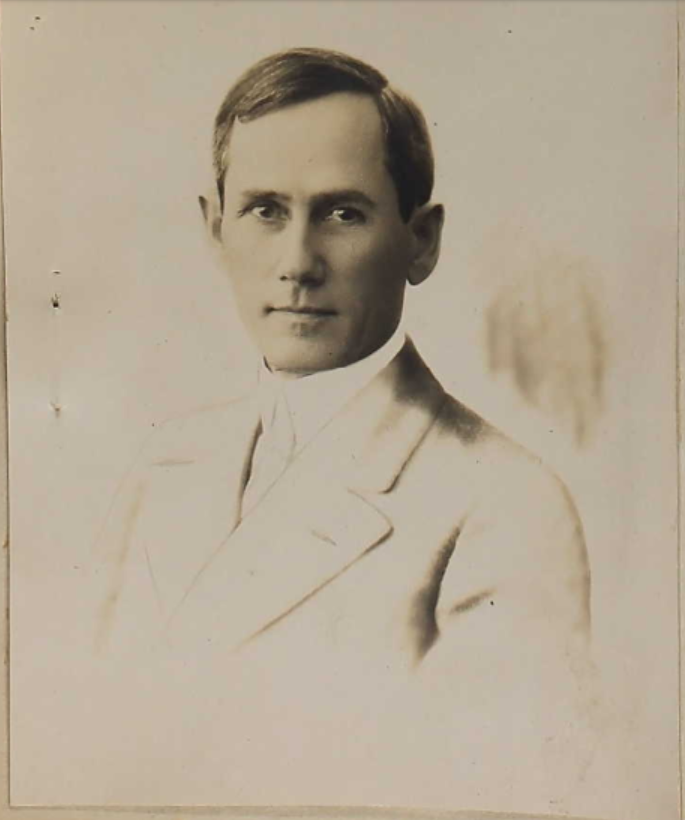
Robert Emmett Mansfield
Passport photo from Ancestry.com
Fanny Gowdy and Robert Mansfield first met in Rush County, Indiana. Robert was a journalist in Muncie and often visited her father on business. When John K. Gowdy accepted the post of Consul General to Paris, his wife and daughter accompanied him to France.  Naturally, Robert was delighted to receive the position of Gowdy's personal secretary.

However, Mansfield was soon called away to Valparaiso, Chile, on a political assignment. The consular position in Chile was a highly sought-after office, but Mr. Mansfield was determined not to stay longer than necessary.  He soon petitioned for a transfer.

With so many thousand miles of territory between the young people their happiness could not be complete and therefore Mr. Mansfield can certainly be pardoned for his anxiety to effect a transfer to Calais, which is within easy reach of Paris.  The members of the Indiana delegation, who have hearts as big as the side of a hill, certainly will do whatever is in their power to help Mr. Mansfield, who is popular with them.  (New Castle Daily Press, New Castle, Indiana, 24 Oct 1903, page 1.)

Fanny Gowdy, age 28, and her mother in Paris
Mr. Mansfield was not the only one who thought well of Miss Gowdy.  At one time, there were rumors that Fanny was to marry a French count. It was clear that Europeans and Americans alike admired her elegance and charming manners, and she quickly became a leading lady of Parisian society.

Several newspapers credit Fanny Gowdy with the establishment of a popular literary salon.  This is regarded as a wonderful achievement by the Europeans, who understand the great importance of these gatherings [are] ostensibly social, but also frequently political. ("Four New American Romances", The Saint Paul Globe, Saint Paul, Minnesota, 6 Dec 1903, page 30.)

In 1900, Tennessee artist Willie Betty Newman, who was living in Paris, painted a remarkable portrait of Fanny Gowdy.  "Portrait of Miss Gowdy" was heralded as one of the best portraits of the year and received an honorable mention at the 1900 Paris Salon.

"Portrait of Miss Gowdy" by Willie Betty Newman
The painting was again displayed in 2002 as part of an exhibit of Newman's pieces at the Parthenon in Tennessee.  A review of the recent exhibit describes the century-old portrait: Newman captures Fanny -- a lithe, Gwyneth Paltrow-style beauty -- as she lounges on a divan with a vase of white flowers at her elbow.  ("An Artist Reclaimed" by Angela Wibking, 14 Feb 2002)

Another publication mentions the painting's "exquisite color arrangement."  I would love to see the original color palette of the portrait; unfortunately, I have only found it reproduced in black and white. I'm not exactly sure where the painting is now, but it may be in storage at the Smithsonian. Perhaps it will be displayed again some day so I can see it in person!

Early in 1906, Fanny and Robert officially announced their engagement, putting an end to the constant rumors generated by newspapers throughout America and Europe.  Soon after, Consul Mansfield started his voyage home from Chile.  Then he ran into trouble.  On January 31, 1906, an earthquake, measuring 8.8 on the Richter scale, resulted in destructive tidal waves off the coasts of Ecuador and Colombia.
Washington Times, 14 Mar 1906 
Although Mr. Mansfield wasn't harmed in the disaster, the delay in his journey caused much anxiety for his family and friends.

San Fransisco Call. 12 Jul 1903
Robert and Fanny were married the 17th of April, 1906. If you were expecting to hear a grand account of an extravagant wedding ceremony, I'm sorry to disappoint you.   The popular couple chose to have a small, quiet ceremony at the Gowdy's home in Rushville.  They did not even make the wedding time known to their friends -- I suspect they were tired of being in the spotlight.  Apart from the immediate family, only two guests attended; Fanny's elderly aunt, Mary Jane Green, and Mrs. Posey, a neighbor.

In June of 1906, the Mansfields moved to Lucerne, Switzerland, where Robert served as consul.  After four years abroad, the couple returned home to Indiana for good.  During her lifetime, Fanny visited or resided in many countries including France, Switzerland, Germany, Italy, Holland, Belgium, Sweden, Denmark, and Canada.

Robert died at Methodist Hospital in Indianapolis on September 18, 1925 after a long illness.  Fanny died at the age of 67 in her hometown of Rushville on March 23, 1937.  The Mansfields never had any children, so there are no descendants.  Although I am only distantly related to Fanny (she is my 1st cousin 4 times removed), I felt compelled to recount her fascinating life.

Friday, December 19, 2014

52 Ancestors: #51 Emily Ann Montgomery, a Posthumous Child


Illustration by unknown artist.
I was a posthumous child.  My father's eyes had closed upon the light of this world six months, when mine opened upon it.  There is something strange to me, even now, in the reflection that he never saw me; and something stranger yet in the shadowy remembrance that I have of my first childish associations with his white gravestone in the churchyard, and of the indefinable compassion I used to feel for it lying out there alone in the dark night. (From The Personal History and Experience of David Copperfield the Younger by Charles Dickens.)

These words help me imagine what life might have been like for my third great-grandmother, Emily Ann Montgomery.  According to One Man's Family by Olive Lewis Kolb, Emily was a posthumous baby.

Emily Montgomery was born April 24, 1838, the eighth and last child of John and Elizabeth Montgomery. Her father passed away only a month before her birth, on March 6th.  Emily's mother remarried twice after John Montgomery died, first to Jacob Shiplet, then finally to a man with the surname Bly or Blythe.

Just a few days prior to her 19th birthday, Emily married John William Worland on April 20, 1857 in Shelby County, Indiana.  They had a family of nine children: George Isom, Cecilia Elyrine, Mary Elizabeth, Samuel Montgomery, Lewis Milburn, Martha, Zerada Frances, Lucy Burnetta, and Sarah Ella.

A devout Catholic, Emily was a member of the St. Joseph Catholic Church in Shelby County.  Six days after her 77th birthday, Emily passed away at the home of her daughter, Lucy Burnetta Hendricks.  She is buried at St. Vincent de Paul Catholic Cemetery in Waldron, Indiana.