Showing posts with label Rush County. Show all posts

Wednesday, June 14, 2017

Jacob B. Mull, Whiskey Merchant of Manilla

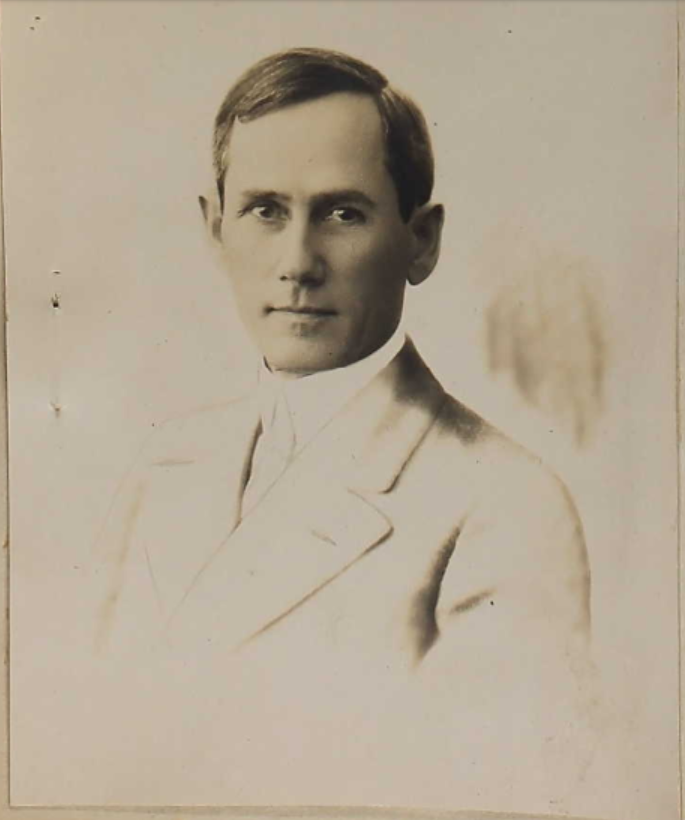
Jacob B. Mull (1803-1861), taken, c. 1860
From In Old Kentucky: The Story Of My
Forbears by William DePrez Inlow
My 5th great-grandfather, Jacob Mull, was born on July 12, 1803 in Loudoun County, Virginia.  Jacob was the fourth of seven children of George Washington Mull, a veteran of the War of 1812, and his wife Mary Katherine Long. Well before the Revolutionary War, Jacob's German grandfather, David Muhle, came to America as an indentured servant at the age of nine.  David Mull (he later adopted the Scottish spelling of his surname despite being German) married a woman named Eva Margaret Boothe.  Margaret outlived her husband by seven years, and possibly ran a distillery. Interestingly, this association with liquor sale was a source of income in her grandson Jacob's life as well. Margaret died in 1801, two years before Jacob was born.

At the age of ten Jacob moved with his parents to Warren County, Ohio.  There Jacob married Margaret Richinson, a New Jersey native of Scotch descent, around 1823.  Their first daughter, Catherine (my 4th great grandmother), was born in Ohio the following year.  But Jacob Mull moved yet again, coming to Rush County, Indiana in the spring of 1826. (Centennial History of Rush County by Abraham Lincoln Gary, 1888). Two of Jacob's brothers, twins Frederick Mull and George Mull Jr., also immigrated to Rush County around the same time.  Sometime during 1835, Jacob sold his stock of goods with the intent of farming, but gave it up the following year and returned to being a merchant.

After arriving in Rush County, the Mulls had three more children: George (in 1827), Cyrus (1829), and Mary Ann (1831).  Catherine and Mary Ann both grew up to marry doctors, and their homes, two of the most prominent brick houses in Manilla, were next door to each other. Sadly, their brother George died of an unknown cause before reaching the age of eight.  In 1847, a school for higher learning was established in Farmington, near Rushville; Jacob Mull's youngest son Cyrus was notably one of the first two students enrolled.  (Sketches of Rush County, pg. 25)  The school took place in a rented tavern.  Cyrus Mull later assumed full management of a farm that adjoined his father's in Rush County.

The Rushville Jacksonian, 5 Oct 1859
The town of Manilla, originally named Wilmington, was organized on January 4, 1836. Jacob Mull was one of the four settlers who founded the town, the others being Elias Murphy, Jonathan Murphy, and J. Edward.  He was the first merchant in the town, and kept his store in a small house.

During this time, whiskey was heavily marketed as a beverage for medicinal benefit, rather than as a hard liquor.  Jacob branded himself as a whiskey merchant, specializing in such medicinal concotions as "Ayer's Cherry Pectoral." Essentially, this cherry pectoral was a cough medicine that merely treated symptoms, but was not effective in curing advanced diseases like consumption, as advertised.  Ayer's recipe for his patent medicine, incidentally, included 3 grams of morphine, along with other herbal ingredients.

Jacob Mull, along with his son Cyrus and son-in-law James W. Trees, operated a mercantile venture in Manilla called J. & C. Mull and Trees.  As a prominent businessman in the small community, Jacob was elected to several municipal positions and was an early philanthropist to the town.  He donated $18,000 for the first railroad to pass through Rushville, Indiana, finally emerging in 1857 as the Sandusky, Indiana, and Louisville Railroad.  Jacob died in 1861 at the age of 57, leaving a wife, three children, and seven grandchildren.  The Centennial History of Rush County refers to Jacob Mull as a Manilla pioneer "to whose enterprise and public spirit does that town owe much."

Wednesday, April 27, 2016

Lot Green, M.D. and the 1902 Smallpox Outbreak

Dr. Lot Green (1847-1905)

Dr. James Wilkinson Green and Mary Jane Gowdy had thirteen children - five of them followed their father's profession.  Lot Green was their oldest child and the first of his brothers to become a doctor.  As a young man, Lot studied medicine under his father, a country physician in Shelbyville, and became well versed in anatomy and physics.

In 1872, Lot Green married Cordelia J. Barnard.  Six years later he entered the medical department of Butler University.  Lot graduated in 1880 and began his medical practice alongside his father before going on to open his own office.

Lot and Cordelia had five sons; Lucien Louis, Hallie Wilkinson, Frank Hayes, Charles Sumner, and Derby Blaine Green.  Lot took his oldest son Lucien with him on multiple house calls, perhaps to encourage him to become a doctor. These early experiences must have not made a good impression on Lucien, because he left Rushville for good and started a career as a loan officer in Indianapolis.  Of the five sons, only Frank Hayes Green continued the tradition of Green doctors, like his father and his grandfather had done.

During the summer of 1902, Lot Green issued a mandate for the residents of Rush County to be vaccinated after discovering a case of smallpox.  The news was publicized in the Indianapolis Journal as an effort to convince locals that the situation could turn serious.  However, the citizens of Greensburg in neighboring Decatur County disregarded the warning.  A special sanitary marshal was appointed to enforce the quarantine.

On February 21, 1905, Lot Green died at the age of 57.  There are differing accounts as to how Lot died; one article in the Indianapolis News states that he was "stricken with apoplexy while in his office." However, the Shelbyville Democrat said that Dr. Green was found in his sleigh, after he had an attack of apoplexy.

Wednesday, April 8, 2015

52 Ancestors 2015: #14 Little Napoleon

James Cyrus Green, c. 1898
H. S. Stephens, Rushville, Indiana
This is my great-grandfather when he was about four years old.  I wonder how he felt about wearing this outfit.  The enormous bow tie and the tall button boots must have been very uncomfortable for him, but perhaps it made him feel special to be all dressed up.  The riding crop and bicorne hat seem unusual to me -- maybe they are props from the photographer.  I think they make him look like a little Napoleon Bonaparte.

James Cyrus Green (called Cyrus) was born on September 12, 1894 in Arlington, Indiana.  His parents were John D. Green, M.D. and Lavanche Emarine Trees.  He had two younger siblings, a sister named Mary Catherine and a brother named Maurice Thomas.  As a young man, Cyrus attended Sewanee Military Academy in Tennessee.  On June 12, 1916, Cyrus married Mary Ida Sefton in Greensburg, Indiana.  He died June 25, 1964 in Rushville, Indiana.

Tuesday, April 7, 2015

52 Ancestors 2015: #12 and #13 The Twin Doctors Green

Left to right: William F. Green, Mr. Davis, Mr. Parrish, Thomas G. Green.
On the back of the picture is written "Davis and Parrish, from Illinois." 
This photograph of four young medical students was taken by Sally E. Garrity at her Louisville, Kentucky studio sometime between 1886 and 1889.  Miss Garrity was one of the first female photographers to achieve recognition and success. Often she photographed as many as 150 people a day, while also overseeing the development of every picture herself.  I've always been intrigued by this picture because of the strange way the men are positioned.  While researching Sally Garrity, I found that many of her pictures are charaterized by unusual poses. 

William Frame Green and Thomas Gary Green were identical twins, born on April 6, 1865 in Arlington, Rush County, Indiana.  Their father, James Wilkinson Green, was a doctor; four of their older brothers were doctors as well, including James C. Green and John D. Green.  William and Thomas graduated together from Louisville Medical College in Kentucky in 1889.  

For 10 years William and Thomas both practiced medicine in Shelbyville, Indiana, then William moved his practice to Indianapolis and eventually to Cambridge City, Indiana.  Thomas stayed in Shelbyville until he died in 1929 at the age of 63.  William died in 1931 in Cambridge City.

Both William and Thomas were interested in their family history. William wrote a history of his family that was used for SAR and DAR applications.  I have a letter that Thomas wrote to his fifteen-year-old nephew, James Cyrus Green (my great-grandfather), containing stories about the early Greens in America.  The following is a quote from the letter: "I have looked up the family history for you and will write you a brief copy, which if you will keep may be useful and valuable to you sometime."

Monday, March 16, 2015

52 Ancestors 2015: #10 A Tragic Accident at the Indiana Republican Convention

Dr. James C. Green, son Hugh, and wife Azzie, c. 1892
James C. Green was born March 10, 1860, in Arlington, Rush County, Indiana.  The son of Dr. James Wilkinson Green and Mary Jane Gowdy, he was the seventh of 13 siblings.  Six of those siblings became doctors, including James and his brother, John D. Green (my great great grandfather.)  James attended courses at the newly-formed Medical College of Indiana, which was a department of Butler University. Following his graduation in 1880, James began his practice as a physician alongside his father in Arlington.

On October 23, 1883, James was married to Azzie E. Winship, a young woman from Rushville, Indiana. The couple had two children -- an infant daughter who died in 1885 and a son, Hugh Clifford Green, born on December 31, 1886.

In 1892, James C. Green was chosen to be a delegate to the Indiana Republican convention.  The convention, which was held on June 28 at the Princess Rink in Fort Wayne, lasted for only one day. The event drew such a large crowd that officials threatened to clear the hall to make room for all the delegates waiting to get inside.  In the chaos, James was pushed against a door knob and critically wounded.  Sadly, he died from his injuries a few weeks later.

The Indianapolis Journal, July 17, 1892

Tuesday, February 24, 2015

52 Ancestors 2015: #8 Gowdy's Good Deed

My 3rd great-grand uncle, John K. Gowdy
A Family History Comprising the Surnames of Gowdy
and the Variant Forms
 by Mahlon Myron Gowdy, 1919, p. 537.
John K. Gowdy's son was born on the last day of November 1867 in the little town of Arlington, Indiana. Given the rather unusual name of Latta Theodore, he was the pride of his father, the joy of his mother, and their first born -- a beautiful and sprightly child.

On March 24, 1870, little Latta Gowdy died.

He was only two years, three months and twenty-four days of age.  Those, who have wept, and still weep over a loss like this -- the death of a first born -- can best sympathize with those who weep.  His [father], mother and sister survive.  (Rushville Republican, 22 Aug 1931, p. 4)

It must have been a terrible shock to the Gowdy family, especially since their daughter Fanny had been born just two weeks earlier. I'm sure that John never got over the loss of his beloved son, yet he found a way to ease his grief and help someone else in the process. Sometime around 1876, John Gowdy took in a boy from the Cincinnati Children's Home.

For three years, the Gowdys provided a caring home for this new son.  Then something completely unexpected happened...

Last week the boy's father, living at Lawrenceburg, heard of his whereabouts, came and claimed him, and they reluctantly gave him up. (Rushville Republican, 16 Oct 1879, p. 3.)

I really wish I knew what the boy's name was so that I could find out more about him.  Hopefully, his father treated him well.  I like to think that John Gowdy's kindness had a lasting impact on the boy's life.

Monday, February 9, 2015

52 Ancestors 2015: #6 Robert Mansfield, U.S. Consul for 19 Years

Consul Robert E. Mansfield
Passport photo
I am experiencing a feeling of relief that comes from the giving up of a very strenuous life, of a public career, for the more quiet, less extracting, home life. I am a Hoosier born, and it is gratifying to feel that after nineteen years spent in other countries, that I have returned to my native state, to live among old friends and associations that are more to be desired than are the varied experiences that are a part of a public career. (Robert E. Mansfield, "Resigns Post at Stockholm", The Daily Republican, Rushville, Indiana, 6 Jan 1917, page 1)

Robert Emmet Mansfield was far away from home quite often.  He served for nearly 20 years as a U.S. consul, beginning with his first appointment by President McKinley in 1899 to Zanzibar.  In 1901, he was transferred to Valparaiso, Chile, where he spent five years.  During that time, he wrote a book, Progressive Chile, about his observations and impressions.

From 1906-1913, Robert Mansfield served as consul in three different locations in Switzerland.  His wife Fanny, whom he married in 1906, lived in Switzerland with him for much of this time.  In 1913, he was given a new post in Vancouver, British Columbia, Canada, where he remained until 1916, when he was transferred to Stockholm, Sweden.  Robert finally retired from his consular career in 1917.

Robert's wife, Fanny Gowdy Mansfield
The Indianapolis News 2 Feb 1901, p. 16
Fanny and Robert quickly settled into their new life in Fanny's hometown of Rushville, Indiana.  Before his consular career, Robert had been a newspaper editor for the Muncie Times, the Indianapolis Journal, and the Marion News.  Soon he began writing articles for the Daily Republican (Rushville), including an article about his personal friend, poet James Whitcomb Riley.

Mansfield became very involved in the civic affairs of his community and was in great demand as a public speaker. He also promoted the work of the Red Cross in Rushville during the first world war.  In the spring of 1924, he sponsored a public speaking contest at the Rushville high school, called the Mansfield Declamation Contest.

Robert Mansfield died on September 18, 1925 at Methodist Hospital in Indianapolis, Indiana at the age of 59 after a long illness involving his heart.  Although he had only been a resident of Rushville for eight years, he made a great impact on the small town.  The following is part of a lengthy tribute written by a group of Rush County teachers after his death:

Born with unsual capacities for serving his country and his neighbors...he always accepted honor as duty and brought to such duties his very highest energies and talents, whether serving as foreign representatives of his government or making an inspirational address in a remote community.  Although accustomed to move with natural ease in the ranks of high social standing, Mr. Mansfield never lost the common touch, which enabled him to win the confidence of even the most timid school-child. His broad-mindedness, his constant  and unceasing effort to understand and appreciate the people with whom he associated, in whatever hemisphere of the world, have been often noted. 

An attempt to enumerate the worthy qualities of this good and genial man would, for their very number, be difficult.  His death calls to mind the truth that the characters of the great are, after all, only a composite of the plainest and simplest virtues.  This group of teachers therefore joins with the entire community and also with the host of friends even in distant parts of the world who are saddened by the death of this gentleman and scholar. ("R.E. Mansfield Funeral Sunday," The Daily Republican, Rushville, Indiana, 21 Sept 1925, page 2)

Robert Mansfield's house in Rushville, Indiana.  

Thursday, January 15, 2015

52 Ancestors 2015: #3 Margaret Richinson, Dour Indeed

Margaret Richinson Mull, c. 1860.
From In Old Kentucky, Vol. 3 by Wm. DePrez Inlow
Judging by this picture, my 5th great grandmother Margaret Richinson appears to be a tough, strong woman.  And I am not the only one to think so.  In his book In Old Kentucky, William DePrez Inlow says of Margaret's portrait,  "She seems to be dour, dour indeed!"  

Margaret Richinson has also been a tough woman to research! I don't know her parent's names -- in fact, I'm not even sure whether her maiden name is Richinson or Richardson.  I don't know the county of her birth or exactly when she was married, and she died before death records were kept in the county where she died.

I have pieced together a few details of Margaret's life. She was born on the third day of January, 1805 in New Jersey, to a family of Scottish descent. Like many families of the early 19th century, Margaret's family moved west.  She met and married Jacob Mull in Ohio, most likely in Warren County.

The Mulls had four children born between 1824 and 1831: Catherine (my 4th great grandmother), George, Cyrus, and Mary Ann.  July 16, 1835 had to be one of the saddest days of Margaret's life.  Her oldest son, George Mull, died at the age of seven.

Margaret's husband Jacob died on June 5, 1861.  Although I assume she went to live with one of her children, I can't find Margaret in the 1870 census.  According to Findagrave, Margaret died on April 21, 1872 and is buried at the Manilla Cemetery in Manilla, Indiana.

Wednesday, December 31, 2014

52 Ancestors: #52 Fanny Gowdy and an American Romance in Paris

 Fanny Alice Gowdy
The Saint Paul Globe, 1903
Back of the prosaic announcement that Robert E. Mansfield, Consul at Valapariso, Chile, has petitioned his department at Washington for a transfer to France ... is an interesting little romance.  Consul Mansfield is in love.  And the object of his affection is ... Miss Fanny Gowdy, daughter of the United States Consul General in Paris.  

What is more, Miss Gowdy is also in love -- with Mr. Mansfield. And here Uncle Sam, after allowing them to be together for a long time, has separated them almost as far as he possibly could.  No wonder Mr. Mansfield wants to get back to France, and Miss Gowdy is anxious that he should be there.  ("Four New American Romances," The Saint Paul Globe, Saint Paul, Minnesota, 6 Dec 1903, page 30.)

The courtship of Fanny Gowdy and Robert Mansfield was a favorite topic in the gossip columns of many newspapers across the country and abroad.  It is not surprising; they were both young, attractive, and accomplished.

Fanny Alice Gowdy was born on March 6, 1870, in Arlington, Rush County, Indiana, to John K. Gowdy and Eve Eliza Gordon.   She was raised as an only child, since her brother died two weeks after she was born. In 1887, 17-year-old Fanny graduated from Rushville High School as valedictorian of her class with special honors in elocution and literature.  She went on to study literature, art, and linguistics at DePauw University in Greencastle, Indiana.
Robert Emmett Mansfield
Passport photo from Ancestry.com
Fanny Gowdy and Robert Mansfield first met in Rush County, Indiana. Robert was a journalist in Muncie and often visited her father on business. When John K. Gowdy accepted the post of Consul General to Paris, his wife and daughter accompanied him to France.  Naturally, Robert was delighted to receive the position of Gowdy's personal secretary.

However, Mansfield was soon called away to Valparaiso, Chile, on a political assignment. The consular position in Chile was a highly sought-after office, but Mr. Mansfield was determined not to stay longer than necessary.  He soon petitioned for a transfer.

With so many thousand miles of territory between the young people their happiness could not be complete and therefore Mr. Mansfield can certainly be pardoned for his anxiety to effect a transfer to Calais, which is within easy reach of Paris.  The members of the Indiana delegation, who have hearts as big as the side of a hill, certainly will do whatever is in their power to help Mr. Mansfield, who is popular with them.  (New Castle Daily Press, New Castle, Indiana, 24 Oct 1903, page 1.)

Fanny Gowdy, age 28, and her mother in Paris
Mr. Mansfield was not the only one who thought well of Miss Gowdy.  At one time, there were rumors that Fanny was to marry a French count. It was clear that Europeans and Americans alike admired her elegance and charming manners, and she quickly became a leading lady of Parisian society.

Several newspapers credit Fanny Gowdy with the establishment of a popular literary salon.  This is regarded as a wonderful achievement by the Europeans, who understand the great importance of these gatherings [are] ostensibly social, but also frequently political. ("Four New American Romances", The Saint Paul Globe, Saint Paul, Minnesota, 6 Dec 1903, page 30.)

In 1900, Tennessee artist Willie Betty Newman, who was living in Paris, painted a remarkable portrait of Fanny Gowdy.  "Portrait of Miss Gowdy" was heralded as one of the best portraits of the year and received an honorable mention at the 1900 Paris Salon.

"Portrait of Miss Gowdy" by Willie Betty Newman
The painting was again displayed in 2002 as part of an exhibit of Newman's pieces at the Parthenon in Tennessee.  A review of the recent exhibit describes the century-old portrait: Newman captures Fanny -- a lithe, Gwyneth Paltrow-style beauty -- as she lounges on a divan with a vase of white flowers at her elbow.  ("An Artist Reclaimed" by Angela Wibking, 14 Feb 2002)

Another publication mentions the painting's "exquisite color arrangement."  I would love to see the original color palette of the portrait; unfortunately, I have only found it reproduced in black and white. I'm not exactly sure where the painting is now, but it may be in storage at the Smithsonian. Perhaps it will be displayed again some day so I can see it in person!

Early in 1906, Fanny and Robert officially announced their engagement, putting an end to the constant rumors generated by newspapers throughout America and Europe.  Soon after, Consul Mansfield started his voyage home from Chile.  Then he ran into trouble.  On January 31, 1906, an earthquake, measuring 8.8 on the Richter scale, resulted in destructive tidal waves off the coasts of Ecuador and Colombia.
Washington Times, 14 Mar 1906 
Although Mr. Mansfield wasn't harmed in the disaster, the delay in his journey caused much anxiety for his family and friends.

San Fransisco Call. 12 Jul 1903
Robert and Fanny were married the 17th of April, 1906. If you were expecting to hear a grand account of an extravagant wedding ceremony, I'm sorry to disappoint you.   The popular couple chose to have a small, quiet ceremony at the Gowdy's home in Rushville.  They did not even make the wedding time known to their friends -- I suspect they were tired of being in the spotlight.  Apart from the immediate family, only two guests attended; Fanny's elderly aunt, Mary Jane Green, and Mrs. Posey, a neighbor.

In June of 1906, the Mansfields moved to Lucerne, Switzerland, where Robert served as consul.  After four years abroad, the couple returned home to Indiana for good.  During her lifetime, Fanny visited or resided in many countries including France, Switzerland, Germany, Italy, Holland, Belgium, Sweden, Denmark, and Canada.

Robert died at Methodist Hospital in Indianapolis on September 18, 1925 after a long illness.  Fanny died at the age of 67 in her hometown of Rushville on March 23, 1937.  The Mansfields never had any children, so there are no descendants.  Although I am only distantly related to Fanny (she is my 1st cousin 4 times removed), I felt compelled to recount her fascinating life.

Tuesday, December 16, 2014

52 Ancestors: #50 John Kennedy Gowdy and the Search for John Paul Jones

Consul General John Kennedy Gowdy
John Paul Jones was the founder of the American Navy, a prolific and eloquent writer, and a fluent speaker of several languages. Perhaps the most well-known aspect of his posterity was his reply to a demand for surrender: "I have not yet begun to fight."  

However, when the celebrated admiral died in Paris in 1792, his burial was poorly recorded and his funeral was attended by few. For 113 years, America's first naval hero lay in an unmarked tomb in France.  One of the chief detectives in the search for his burial place was my third great grand-uncle, John Kennedy Gowdy.

John K. Gowdy was born in the small town of Arlington, Rush County, Indiana on August 23, 1843 to Adam McConnell Gowdy and Nancy Oliver.  The Gowdy family migrated from Rush County to Jasper County in 1848. When Adam Gowdy died at the young age of 48, John became responsible for the farm.  He divided his time by working on the farm during the summer and returning to Arlington each November, where he lodged with his sister Mary Jane and attended the local school.

At the age of 18, John K. Gowdy joined the Fifth Indiana Volunteer Cavalry.  He helped pursue and capture General John Hunt Morgan, the only Confederate leader to pass through Indiana. Gowdy served under General Ambrose Burnside in the winter of 1863-64 and under General William Tecumseh Sherman during the Georgia campaign.  After the war, Captain John K. Gowdy became an active member of the Grand Army of the Republic.

On January 24, 1867, John married Eve Eliza Gordon in Rush County, Indiana.  The Gowdys had three children, but only one, Fanny Alice, survived past childhood.  Their two year-old son, Latta Theodore, died two weeks after his sister Fanny was born, on March 24, 1870.  Between the years of 1887 and 1888, John K. Gowdy built a fine brick house in Rushville, Indiana. His former residence is now home to the Rush County Historical Society and is listed on the National Register of Historic Places of Rush County.

John K. Gowdy's house.
Gowdy was twice elected sheriff of Rush County (the youngest in the history of the county at the time.) From 1890 to 1897, he served as chairman of the Indiana Republican State committee.  In recognition of his services to the party, he was appointed by President William McKinley as consul-general to Paris on March 20, 1897.  The news of his position was reported in many papers throughout the country, including this California publication:  He will take with him to France, his wife and charming daughter.  Mr. Gowdy has no knowledge of the French language, but thinks he can manage it.  (Sacramento Daily Union, Vol. 93, No. 51, 13 Apr 1897.)  Consul-General Gowdy also took his horses to France.  The horses, "Rush" and "Brooks," were bred and trained in Rush County, Indiana. While in Paris, the horses were involved in an unfortunate incident:

John K. Gowdy at far right, wife Eve and daughter Fanny in coach.
Chaffeur Stephen Hordsbath and the Rush County horses.
Paris, France, 1898.
[M]iscreants broke into the private stable of United States Consul Gowdy in Paris and cut off the manes and tails of the American-bred horses that he had taken over from Rush Co., Indiana ...  It is assumed that this action was designed as a hint to Mr. Gowdy that he should do in Paris as the Parisians do, and drive bang-tailed horses.  It is an outrage and the severest punishment should be visited on the perpetrators if they can be discovered.  (The Breeder's Gazette, Vol. 34, 1898.)

Nearly two years after Gowdy began his service in France, he wrote a letter urging for an investigation to locate the remains of John Paul Jones:

To Representative Charles B. Landis, January 2, 1899, Paris, France.

It does seem strange that we have not identified ourselves in gratitude to him who fought our battles at sea in our struggle for independence and who was the first to secure our recognition as a Republic.  His achievement of glorious deeds commends itself to the gratitude of the country.  Every thoughtful American citizen can not but feel the deepest regret that we have shown no interest in his resting place.  The graves of other heroes of the Revolution have been marked, and honor paid.  John Paul Jones' love of liberty and devotion to the United States Government, and its principles, were the strongest passions of his life.  Besides fighting our battles, he identified himself in many ways with our Government, that in the past century should have called forth, as for other heroes of the Revolution, the praise and admiration of a grateful people.
                                                                                                               John K. Gowdy 

John Paul Jones Monument, Washington, D.C.
The quest began in June of 1899.  Two search teams were formed, one headed by U.S. Ambassador Horace Porter, and the other directed by John K. Gowdy. Although Consul-General Gowdy later wrote that the two worked in "perfect harmony", it seems that there was a spirited competition between the two teams.  The exhaustive search was concluded on April 14, 1905, when Porter's men discovered the coffin shortly before Gowdy's team arrived at the spot.  On January 26, 1913, the remains of John Paul Jones were at last re-interred at the Naval Academy Chapel at Annapolis, Maryland.

According to a transcript of an unidentified American newspaper, Captain John K. Gowdy ... never received the credit that [was] due him for his part in the search for the body of John Paul Jones.  On his own initiative and at considerable personal expense, Gowdy, while consul-general at Paris, employed a searching party and directed its operations.  John K. Gowdy later said that he did not have any hard feelings that the Ambassador received full credit for the discovery.

Consul-General Gowdy was also instrumental in the purchasing the right to build the Panama Canal. As recognition for his extensive services to France, John K. Gowdy was awarded the Legion of Honor, the highest decoration in France, on September 30, 1905.

John K. Gowdy died at his Rushville home on June 25, 1918, at the age of 74.  On the day of his funeral, flags were lowered to half-mast and many local businesses were closed.  Scores of telegrams from old political friends were received by his family.  John K. Gowdy is buried at Arlington East Hill Cemetery in his birthplace of Arlington, Indiana.

Thursday, December 4, 2014

52 Ancestors: #49 Nancy Oliver, Who Waited 3 Years for Groceries

My 4th great-grandmother, Nancy Oliver, was born in Bourbon County, Kentucky on the first of June 1807 to John Oliver and his wife Jane Hill.  Sometime around 1821, the Oliver family moved to Rush County, Indiana.

At the age of 22, Nancy married Adam McConnell Gowdy, a blacksmith who was two years her junior. The couple had two daughters, named Mary Jane and Martha Ann, then three sons, Lewis Oliver, John Kennedy, and Adam Thomas.

General Store, shared under creative commons license on Flickr.
https://www.flickr.com/photos/jalan68/14769865418/in/photostream/
Nancy's husband died in 1857; their youngest son, Adam Thomas Gowdy, died two years afterwards at the age of ten. Three of the Gowdy children (Mary, Martha, and Lewis) were married by this time, which only left one son, John Kennedy Gowdy, at home to look after his widowed mother.  The two lived on a farm in Rensselaer, Indiana.

[John] was living with his mother near Jasper [Indiana] when the war broke out.  He was 17 years old.  His mother sent him one day to a grocery two miles distant for soap, molasses, and a broom.  He found an excited group about the store discussing war news, and there was a recruiting officer in the town seeking volunteers. Young Gowdy promptly enlisted without consulting his mother, knowing she would object. Three years later, he came marching home again in a blue suit, with an honorable discharge in his pocket and the title of captain stuck to his name, enough to make any patriotic mother forgive anything or everything and be proud all the rest of her days. [But] he brought more.  He stopped at the grocery and bought the supplies his mother sent for three years before.  His first words on reaching home were: "Here, mother, are the soap, molasses, and broom you told me to get."  (The Literary Digest, Vol. 15, No. 2, pg. 59)

This same son was twice elected sheriff of Rush County.  John Kennedy Gowdy later became a famous Hoosier politician and served as Consul General to Paris during the William McKinley administration.  He received the Legion of Honor for his great service to France.

In her later years, Nancy Gowdy lived with her daughter Mary's family in Arlington, Indiana.  She died there at the age of 75 on September 3, 1882 and is buried at Arlington East Hill Cemetery in Rush County, Indiana.

Tuesday, November 25, 2014

52 Ancestors: #47 James Whitlow Trees, Still a Democrat

Portrait taken from 1888 History of Rush County
J. W. Trees, of Manilla, was in town today on his way to Indianapolis.  He is still a democrat.  (Columbus Daily Herald; Columbus, Indiana; 5 Apr 1892)

I was amused when I ran across this article about my 4th great grandfather, and I can only guess at what the writer was implying.  A biographical sketch of James W. Trees also mentions that "he was ever a democrat." (History of Rush County, Part II)  It seems that he readily expressed his political views.

James Whitlow Trees was born March 21, 1818 in Clermont County, Ohio.  Adam Trees and Mary Ann Hill were his parents.  His middle name came from his Irish grandmother, Elizabeth Jane Whitlow.  James migrated with his family to Rush County, Indiana on March 27, 1823.

At the age of 20, James decided to pursue a career of medicine.  He went to the small town of Milroy, Indiana and studied under Dr. Samuel Barbour, who was one of the earliest physicians of Rush County.  While he underwent medical training, he also was a clerk at a dry goods store. James received his physician's license from the Indiana Medical Institute in May of 1841.  A few months later, James set up his own medical practice in Manilla, Indiana.

He married Catherine Mull on September 18, 1842 in Rush County, Indiana.  The couple had six children together, but only three sons lived to adulthood: Ethan Allen, Leander Mull, and Cyrus Ebon.  The three youngest children -- Lavanche, Maggie, and Marshall -- all died at a young age.

Around 1852, James W. Trees entered into a mercantile partnership with Jacob and Cyrus Mull, his father-in-law and brother-in-law.  According to William DePrez Inlow, author of In Old Kentucky, "It was common at the time for physicians to engage in business in addition to their profession."

By 1864, Dr. Trees had sold his medical practice to his son-in-law, Dr. J. J. Inlow, and was operating his own dry goods store in Manilla. "By strict attention to his profession, he amassed a goodly fortune.  He and his two sons, Ethan A. and Cyrus E., were of the staunchest business men in the county." (The History of Rush County, Part II)  According to the Indianapolis Journal, the store was robbed in 1875; the burglars got away with $500.

An early map of the town of Manilla, Indiana.  The land Dr. Trees owned is highlighted. 
In 1872, the small town of Manilla received state-wide attention when James W. Trees discovered several fossilized bones of a mastodon on the farm of his neighbor, A. J. Westerfield. (You can see the farm in the map shown above.)  The Indianapolis Journal reported that the fossils "were in a remarkable state of preservation."

The residence of Dr. James W. Trees in Manilla, Indiana.
On April 25, 1895, a Shelbyville newspaper stated that James W. Trees was dangerously ill. He died a short while later, on May 4, 1895, and was buried at Forest Hill Cemetery in Shelbyville, Indiana.

Recently, I made an interesting discovery.  There is a subdivision in Manilla, Indiana named after James W. Trees!  Looks like I need to make a trip to Manilla so I can see his house (shown at right) and his subdivision!  {Update:} I visited the Trees house in Manilla on July 5, 2015 with my family.  The current owners told us that when they renovated the building, they found an underground passageway that connected the house to the doctor's office across the street.  One of the front rooms in the house was fitted out for a funeral parlor.  When a patient died, the body was discreetly brought into the house via the tunnel.

July 5, 2015.  My brother and I in front of James W. Trees' house in Manilla, Indiana.
SaveSave

Thursday, November 20, 2014

52 Ancestors: #46 Malachi Cooper, 13 Year-Old Patriot

My fifth great-grandfather, Malachi Cooper, was barely 13 years old when he enlisted for service under General Nathanael Greene (who is also a relation of mine) in Guilford County, North Carolina.
Malachi was born on the 14th of April, 1762 in Pasquotank, North Carolina, to David Cooper and his wife Elizabeth Wilder.  Both Malachi and his father served in the War for Independence. Some Cooper descendants claim that the Battle of Cowpens was fought near David Cooper's plantation in Spartanburg, South Carolina.

"Battle of Guilford Courthouse" from Wikipedia
On March 15, 1781, Malachi fought at the Battle of Guilford Court House, a pivotal battle in the Revolutionary War's Southern Campaign. After two hours of intense fighting between General Nathanael Greene's forces and the British troops under Lord Cornwallis' command, Greene withdrew his weary soldiers.  His retreat preserved the strength of his army, while Cornwallis' frail victory cost him over a quarter of his men.  Cornwallis was later heard to say about the battle: I never saw such fighting since God made me.  The Americans fought like demons.

Although I don't know of any other battles he participated in, Malachi served in the militia for six more years.  At the close of the war, Malachi was still a young man of 20 years.  He made his way to Edenton, North Carolina, and there he married 17 year-old Anna Wilkinson.  The couple had a total of 12 children; all except one lived to reach adulthood.  Their eighth child, Anna Cooper Green, was my fourth great-grandmother.

Around 1795, Malachi, his wife, and their small children migrated to the new state of Kentucky. Malachi's younger brother Edward and his bride Susanna traveled with them.  According to a family history written by Clyde Toland, the Cooper clan made the journey by pack train, crossed Daniel Boone's Wilderness Trail, and settled in the foothills beyond Cumberland Gap.  Malachi and Edward are described as "a pair of tall, silent brothers."

Malachi Cooper served on the first grand jury in Pulaski County, Kentucky in 1797.  The jury returned indictments for retailing liquor without license, profanity, and gambling.  When the jury retired to consider their verdicts, they were compelled to go outside since there was no room to meet inside.

In 1806, Malachi was granted 135 acres of land on Fishing Creek.  As an ordained Baptist minister, Malachi Cooper established the Old Fishing Creek Church in Pulaski County and ministered there for many years. Two of his sons, Levi and James Cooper, also became Baptist ministers.

After the death of his wife in 1820, Malachi began to disperse his land holdings in Pulaski County. Records of these transactions are found in Pulaski County deed books.  In 1825, he "sold" 100 acres to his son Milton Cooper for $1 "in consideration of love and natural affection he entertains for his son."  However, two years later Malachi sold 235 acres of land to his son Asa, for $700.  (Pulaski County, Kentucky Deed Books)  I wonder why he practically gave land to Milton, but expected Asa to pay a substantial amount.

This is the only known signature of Malachi Cooper, an endorsement on a 1782 currency certificate.
Malachi's name has been spelled a number of ways: "Malleki" in his father's will, "Malikiah" in D.A.R. records, "Malikah" as a member of the Pulaski County grand jury, "Malekiaha" in probate records of his son Asa's estate, and finally as "Malicha" in a family history written by his grandson James Wilkinson Cooper.  Malachi himself signed his name as "Malicha." Perhaps this is how he spelled and pronounced it. However, he may have copied someone else's writing, since he signed other documents with his mark. I've decided to use the common Biblical spelling of "Malachi."

Malachi Cooper's monument erected by the DAR
Photo taken by James Arnold of the Daniel Guthrie Chapter SAR in June of 2006.
Malachi Cooper was living at the home of his grandson, Dr. Stanley Cooper, in Rush County, Indiana when he passed away in the fall of 1843.  (A few sources say he died in February of 1845.)

In the summer of 1978, a local DAR chapter erected a monument for Malachi and held a dedication ceremony at Pleasant Run Cemetery in New Salem, Rush County, Indiana. Unfortunately, his first and last name have been reversed on the plaque.  I have a copy of some correspondence that discusses the error. Some effort has been made to correct the mistake, but nothing has been done yet.  More than 30 years have passed since the plaque was installed, and I would really like for it to finally be corrected.  Malachi Cooper should be honored with an accurate monument.

Monday, November 3, 2014

52 Ancestors: #44 Isaac Inlow, Undone by His Son

Taken from In Old Kentucky, a History of My Forbears
My 4th great-grandfather, Isaac Inlow, came from a large family.  His parents, James Inlow and Mary Wilson, had 15 children; Isaac was the 14th child.  In 1840, Isaac married Lucinda Bell in Fleming County, Kentucky.  Isaac, his wife, and their five children moved to Manilla, Rush County, Indiana about 10 years later.

Isaac was a respected farmer and a man of tireless energy; he was numbered among the wealthy and influential citizens of Rush County.  He helped to found the Christian Church at Manilla and remained a faithful member there throughout his life.  Isaac was also a member of the Knights of Pythias.  At two different times, he was tendered a nomination to the legislature of the Democratic party, but Isaac chose instead to live a quiet life in his Rush County home.

However, Isaac's second son, John William Inlow, was his undoing.  John was a man with big ideas... and a spendthrift. He had great visions of doubling his father's assets.  John invested a great deal of his father's money in real estate in Indianapolis.  According to the Indianapolis Journal, on March 14, 1871, John purchased a lot for $2,300. (That's roughly equivalent to $45,000 today!)   Then, his scheme backfired, and John lost his father's money. Isaac was forced to to sell the Manilla farm in 1879.  John ended up as a floorwalker at the New York Store (aka Pettis Dry Goods Co.) in Indianapolis, a position he held for many years.

After he lost his farm, Isaac and his wife moved 50 miles away to Alexandria, Indiana, where his oldest son, James Elliott Inlow, was practicing as a doctor.  When James relocated to Hancock County, Isaac and Lucinda returned to Manilla.  In 1894, Lucinda Inlow died.  At the time of her death, she was completely blind.  It then fell upon the youngest son, George Jefferson Inlow, to care for his elderly father.  George worked as both a carpenter and a druggist in Manilla.  Isaac Inlow died at George's home, at the age of 89, from a stroke.

(Much of the biographical information in this blogpost comes from the book In Old Kentucky, a History of My Forbears, Book 3 by William DePrez Inlow, published in 1950.)

Thursday, October 30, 2014

52 Ancestors: #43 Mary Ann Hill, Born on the Atlantic Ocean

Mary Ann Hill was born aboard a ship on passage from Ireland to America on June 6, 1790.  This is confirmed by 1880 census reports from four of her children.  Her birth at sea is also mentioned in a biographical sketch of her son, James Whitlow Trees. (The sketch is from the History of Rush County, Part II.)

Like many Irish immigrants of that period, Mary Ann's parents, John Hill and Elizabeth Jane Whitlow, came from Ulster.  John Hill was a weaver in trade.

After the Hills arrived in America, they located somewhere in Pennsylvania.  I don't know exactly when they left that state, but Mary Ann spent most of her early years in Bracken County, Kentucky.

In 1811, Mary Ann married another first-generation American, John Adam Trees, in Clermont County, Ohio.  After spending well over 10 years in Clermont County, Adam and Mary Ann decided to move to Indiana.  For 10 days, they traveled over almost impassable roads, crossing the White and Miami Rivers. Their youngest child, John Kell Trees, was barely two months old at the time. The family arrived in Richland Township, Rush County, Indiana on March 27, 1823. The Trees raised ten children, who all lived to adulthood.

Mary Ann Trees died on July 23, 1863 in Shelby County, Indiana, less than a year after the death of her husband.  She was 73 years old.  Her father, John Hill, outlived her by a few years.

Friday, October 17, 2014

52 Ancestors: #40 Squire Lot Green, Pioneer School Teacher

A schoolhouse similar to the one Lot Green would have taught in.
Lot Green was a farmer of Rush County all his active life. He was a man of fine attainments for those days and at different times taught school with such success that he is regarded as having been an able educator. For twenty years he was Justice of the Peace under the old constitution. (From the Pictorial and Biographical Memoirs of Indianapolis and Marion County, Indiana, 1893.)

My 4th great grandfather, Lot Green, conducted one of the oldest schools in Anderson Township, Rush County, Indiana. The log cabin school stood on the farm of Jacob Hackleman, one of the original settlers of Rush County.  In 1829, a man named George Wrinbro assumed the task of teaching the school. At the end of the school year, Mr. Wrinbro treated his students to whisky!  Another teacher in Anderson Township at the time was the famous evangelist and poet Knowles Shaw, who wrote the lyrics to the Gospel hymn "Bringing in the Sheaves."  

Lot was born on April 15, 1799 in Pulaski County, Kentucky, the tenth of eleven children. His parents were Thomas Greene and Elizabeth Ann Ransbird Mathews. (I believe Lot was the first Green in the family line to drop the final "e" from the surname.) Thomas Greene was a Patriot spy during the American Revolution and was the first cousin of General Nathanael Greene. Nathanael and Thomas Greene came from Quaker families, but both were turned out from the congregation because they would not acknowledge that they were wrong in joining the fight for freedom.

On April 27, 1824, Lot married Anna Cooper in Pulaski, Kentucky.  Together they had nine children. Anna died in 1841, when their youngest child was less than two years old.  Lot married Sarah Houston on June 7, 1842.  He was chosen as a delegate to attend the Rush County convention on April 18, 1843.

Lot's involvement in education had a lasting effect on his descendants.  Two of his sons, James Wilkinson Green and William Frame Green, became doctors.  Another son, John Cooper Green, was a well-known lawyer in Shelby County, Indiana.  His youngest son, Perry M. Green, was also a lawyer and a founder of the city of Pasadena, California.  Six of Lot's grandchildren became doctors, including my great grandfather, John D. Green.

Lot Green died on July 12, 1845 in Rush County, Indiana, at the age of 46.

Thursday, July 31, 2014

52 Ancestors: #24 Cyrus Ebon Trees, Once the Wealthiest Man in Rush County

Cyrus Trees' birthplace in Manilla, Indiana.  The house was built by his grandfather, Jacob Mull, who was one of the founders of Manilla.  (Photo was taken from the book, In Old Kentucky, a History of My Forbears, written by William DePrez Inlow.)

My great-great-great grandfather Cyrus Ebon Trees was born August 4, 1848 in Rush County, Indiana, the third son of James Whitlow Trees and Catherine Mull.  His father was a physician for a short while, but later became a dry goods merchant.  He received a common education in nearby schools and went on to attend Northwestern University in Illinois.

Cyrus Trees was married to Annie Inlow in Manilla, Indiana on May 4, 1869. They had only one child, Lavanche.  But when their daughter was only six years old, Annie suddenly died of an unknown illness.  Cyrus remained a widower for nearly two years, then he remarried in 1877.  His second wife, Charlotte Macy, was just eleven years older than his young daughter.  Cyrus and Lottie had two children, Lee and Mary Catherine.

Shelbyville Democrat published May 21, 1881
In his early career, Cyrus was unusually prosperous, always thinking of ways to expand and progress. Associated with his father in the grain business,  he built a name for himself and also helped to make Manilla one of the best grain markets in Indiana.  By 1883, he was running his grain elevator night and day.  Cyrus was also a merchant in both the livestock and the lumber trades.  I'm sure his lumber company (Trees and Mohler) used his befitting last name to drum up business.

In addition to all of these business ventures, Cyrus Trees was actively involved in politics.    One Shelbyville, Indiana newspaper described "Cy" as "a red hot Democrat."  He held his beliefs firmly and was slow to change his views.

In the 1880's, Cyrus engaged in land investments in Kansas, and encouraged everyone he knew to do the same.  He became the vice president and director of the Kiowa Land Investment Company.  And if all this wasn't enough,  Cyrus started something completely new; he organized the First Manilla Bank in 1895.  Eventually, the strain of all this responsibility caused serious repercussions and robbed him of his sanity and health.

Land investors in Haskell County, Kansas.
The beginning of his troubles started in the late 1890's.  Cyrus had invested largely in land ($80,000 to be exact) in Haskell County, Kansas.  It appeared to be a great success. New settlers were enticed by the glowing accounts and came in throngs with hopes of becoming successful ranchers.  But with the influx of settlers and the breaking of sod, it soon became apparent that the range would be spoiled.  Adding to the rancher's problems were the discouraging prices and the long drive to market.

Although Haskell County had enjoyed a boom in the 1880's, it suffered an even larger bust in the 90's.  The county's population plummeted, and Cyrus' investments were gone.  When he received the news that the whole enterprise had collapsed, Cyrus underwent a nervous breakdown.  In September of 1899, Cyrus, now seriously ill, was admitted to a sanitarium in Martinsville, Indiana.

The Indianapolis Journal published February 10, 1901
On Christmas Day, 1900, Cyrus Trees was declared of unsound mind and was committed to a private sanitarium in Indianapolis.   The Manilla bank had to be closed for six weeks until someone could take it over.  A relative, John Blessing, was chosen as guardian for the unfortunate ex-banker.  To pay off Cyrus' debts, which amounted to $66,000,  Blessing sold his ward's land in several counties and also sold the Manilla bank.

However, not all of the debts were paid off.  Dr. John D. Green, son-in-law of Cyrus, filed a complaint against Blessing, asking $8,000 for services rendered as a physician to Cyrus and his family.  The doctor stated that, in 1897, his father-in-law had become so ill that he required someone to look after him constantly.  Cyrus proposed that his son-in-law might abandon his practice as a general physician and devote his entire time and attention to himself and his wife and daughter, promising to pay him what his services were reasonably worth.  Dr. Green agreed to the plan, but was not reimbursed.  Cyrus, now a resident of the Richmond Insane Asylum, was powerless to pay him.  A settlement was reached, and the doctor accepted payment of $3,500.

In 1901, Cyrus was transferred for the third time to a sanitarium in Oxford Ohio, his last residence.  He died in the asylum on February 18, 1902, at the age of 53.

"Cy was one of those warm hearted, generous, whole souled persons whom it is always a pleasure to meet, of a most sociable disposition, honest and faithful to his friends.   He was enterprising, shrewd, and progressive.  In his death his family is called upon to mourn the loss of a kind hearted and affectionate husband and companion." (From his obituary in the Shelbyville Democrat)


Thursday, May 1, 2014

52 Ancestors: #17 Mary Jane Gowdy and the Mysterious Oil Painting

Mary Jane Gowdy Green, 1876
English artist Edwin Farrer painted this now faded portrait of my 3rd great-grandmother, Mary Jane Gowdy.  For years, my family did not know who the subject of the portrait was, except that she was a relation of my grandfather's.  I discovered that the artist immigrated from England to Rush County, Indiana in 1870.  The portrait was dated 1876.  Trying to find out who the woman was, I reviewed the records on my grandpa's family in Rush County, and Mary Jane was the only one that fit.

Mary Jane was born on July 18, 1830.  She was the eldest child of Adam McConnell Gowdy, a blacksmith from Ohio, and Nancy Oliver of Kentucky.  Her brother, John Kennedy Gowdy, was the consul-general to Paris during the McKinley Administration.  Mary Jane had two other brothers, Lewis Oliver and Adam Thomas, and a sister, Martha Ann.

The Green residence, Arlington, 1988
On May 18, 1846, Mary Jane married the physician James Wilkinson Green in Rush County.  According to several sources for her birthdate, she was not yet sixteen when they were married.  She and James became the parents of thirteen children.  Out of nine sons, six of them became doctors, including my great-grandfather, John D. Green.  The Green family lived on a farm in Arlington, Rush County, Indiana.  In 1886, Mary Jane's brother-in-law, a physician in nearby Shelbyville, died and left his medical practice to his brother James.  They left Arlington behind and relocated to Shelbyville.

"Mrs. Green is what might be termed an extraordinary woman; she has raised a large family and is one of the best of wives, mothers, and companions; her home has always been noted for its generous hospitality." (Illustrated Historical Atlas of Rush County, Indiana, 1879.)

Mary Jane died on September 20, 1907.