Showing posts with label Civil War. Show all posts

Friday, December 16, 2016

Henry Fisher, Rensselaer Tile Farmer

Found in History of the Town of Remington and Vicinity, Jasper County, Indiana by James H. Royalty, 1894, p. 134

Early settlers of Rensselaer, Indiana.
Henry is in the middle row, second from right.

Henry James Fisher was born on February 24, 1821 in Marion County, Indiana.  His father, James Fisher, was a Pennsylvania native and his mother, Sarah Rue, was born in Kentucky.

Henry married Nancy Elizabeth McLaughlin, also a native of Marion County, on March 13, 1843.  The story is handed down in the family that they eloped to be married; Henry was 22 and Nancy was not yet 17.

After their marriage, the Fishers lived in Marion County, Indiana where Henry engaged in farming.  He supposedly owned the land in the Beech Grove area where Amtrak is now located.  Around 1850, Henry, Nancy, and their three young daughters lived next door to the Marion County Asylum (which was essentially a poorhouse for paupers and the feeble-minded).  Henry was the superintendent of the asylum.

Later, the Fishers lived in the village of Broad Ripple, and are shown in the 1860 census with six of their children: Lavina, Minerva, Joseph, Benjamin, James, and Rebecca (my great-great grandmother).  The two oldest children, Susan and Elizabeth Jane, had died before the census was taken.

Henry Fisher was a Civil War veteran, mustered in on August 30, 1862 and discharged on February 12, 1864 with a disability.  He served in the 63rd Infantry Regiment (History of Indianapolis and Marion County; Marion County in the War of the Rebellion, page 36.)

Henry Fisher, c. 1890
After Henry returned from the War, the Fisher family moved to northwest to Jasper County, Indiana in 1877.  There Henry continued farming and operated his own tile factory.  According to the common practice of that time, the tile was installed in the fields as a means to drain the farmland and make it more productive.

When we take into consideration that Remington and 
the surrounding country [Rensselaer] was classed as swamp lands by the United States general survey, we may well look upon 
it with great astonishment. It is now considered to be 
the finest farming country in northwestern Indiana. The 
lands have been all placed in a high state of cultivation; 
nearly all of it having fine farm residences and the greater 
portion of it being well drained both by open ditches 
and tile drainage, the tiling having been mostly done 
within the past few years, which fact alone has added at 
least twenty dollars in value to every acre so drained. The 
County is being rapidly populated with wealthy and ener- 
getic men. (History of the Town of Remington and Vicinity, Jasper County, Indiana by James H. Royalty, 1894, p. 155).

In 1895, both Henry's wife and son Benjamin died, and by the 1900 census he was living with his fourth child, Minerva, and her family in Jennings County, Indiana.  In September of 1904, with his health failing, he went back to Rensselaer to live with his son, James.

Henry and Nancy Fisher's headstone
Weston Cemetery in Rensselaer, Indiana
Photo taken 18 April 2016 by Brenna G.
Uncle Henry Fisher, as he has been long familiarly known, died on Monday morning, February 27, 1905, at the home of his son James Fisher on Front Street.  He had been confined to the house since before Christmas, with a valvular disease of the heart, complicated with Bright's disease of the kidneys.  He has all along been in possession of his faculties and able to sit up every day, as in fact he was obliged to to much of the time to get his breath.  He has lately been subject to sinking spells and it was one of these that carried him off.  His age was 84 years and 3 days.  

He was a resident of this country for many years on a farm northwest of town, and after owning a residence in town on Main Street.  Some five years ago he went to Jennings County to live with his children, but returned here last September to live with his son, at whose house he died.

He leaves one other son, Joseph, and three daughters: Mrs. Minerva C. Mills, Mrs. Mary E. Nichols (wife of George E. Nichols), and Mrs. Anna Worland - all living in the southern part of the state. 

Tuesday, January 13, 2015

52 Ancestors 2015: #1 Susan Driskill, Civil War Widow

File:Love's Melancholy by Constant Mayer 1866.jpg
"Love's Melancholy" by Constant Mayer, 1866
Public Domain from Wikipedia Commons
On August 18, 1862, Susan Driskill Latham's life was changed forever. Her husband of nearly 22 years, the father of her seven children, died from typhoid fever in a military hospital in Nashville, Tennessee.

Susan H. Driskill was born in 1827 in Kentucky.  At the age of 17, she married James Harvey Latham on September 25, 1844 in Clarksville, Tennessee.  They settled in Todd County, Kentucky, where they lived at the time the 1850 census was taken. Sometime between 1854 and 1856, the Lathams moved to Greeneville, Muhlenberg County, Kentucky.

James and Susan had nine children; seven of them survived childhood.  Two year-old Cordelia and baby Stephen, just 11 days old, died from scarlet fever in 1856. James and Susan's youngest child, Harvey Edward Latham, was born less than a month before his father was mustered in with his regiment on October 10, 1861.

It is doubtful that James Harvey Latham ever saw his wife or children again -- he died less than a year later. On the day of his death, he was quickly buried at the Nashville City Cemetery, then was later re-interred at the Nashville National Cemetery.  It does not seem likely that Susan would have been able to visit her husband's grave.  She had young children to care for, Nashville was over 100 miles away, and wartime made it unsafe to travel.

At the start of the Civil War, Kentucky was one of the neutral "border states", split in two over the issues of slavery and seccession.  Since it was a strategically important stronghold to both the North and South, Kentucky saw many fierce battles, many of them not far from where the Lathams lived. Perhaps this explains why Susan Latham and her seven childen moved to Hamilton County, Illinois between 1863 and 1864.

On October 12, 1864, Susan married Edmund Hawthorn, a widower, in Hamilton County.  She was 37; he was 51.  Edmund became the guardian for Susan's younger children, and his signature appears on the marriage license for my third great grandfather, John Wesley Latham.  Edmund and Susan had one daughter, Ida, who was born on June 13, 1867.  Susan's three oldest children (George, John, and Sophronia) were married and lived nearby -- and Susan now had three grandchildren.

Then, on November 20, 1869, Edmund Hawthorn died in Logansport, Illinois.  Susan was widowed twice by the time she was 42 years old.  But what happened to Susan after Edmund Hawthorn died? Unfortunately, I don't know.  Susan Hawthorn appears in the 1870 census with her four youngest children, but I haven't been able to find her in any records after that.  Perhaps she married a third time, or maybe she died before the 1880 census was taken.

Recently, I was able to connect with a cousin partly because of this blog!  She read my post on James Harvey Latham and visited his grave in Nashville a few weeks ago.  I have wanted to visit his grave myself for a long time, and it would be even more meaningful now that I know about Susan.

Tuesday, December 16, 2014

52 Ancestors: #50 John Kennedy Gowdy and the Search for John Paul Jones

Consul General John Kennedy Gowdy
John Paul Jones was the founder of the American Navy, a prolific and eloquent writer, and a fluent speaker of several languages. Perhaps the most well-known aspect of his posterity was his reply to a demand for surrender: "I have not yet begun to fight."  

However, when the celebrated admiral died in Paris in 1792, his burial was poorly recorded and his funeral was attended by few. For 113 years, America's first naval hero lay in an unmarked tomb in France.  One of the chief detectives in the search for his burial place was my third great grand-uncle, John Kennedy Gowdy.

John K. Gowdy was born in the small town of Arlington, Rush County, Indiana on August 23, 1843 to Adam McConnell Gowdy and Nancy Oliver.  The Gowdy family migrated from Rush County to Jasper County in 1848. When Adam Gowdy died at the young age of 48, John became responsible for the farm.  He divided his time by working on the farm during the summer and returning to Arlington each November, where he lodged with his sister Mary Jane and attended the local school.

At the age of 18, John K. Gowdy joined the Fifth Indiana Volunteer Cavalry.  He helped pursue and capture General John Hunt Morgan, the only Confederate leader to pass through Indiana. Gowdy served under General Ambrose Burnside in the winter of 1863-64 and under General William Tecumseh Sherman during the Georgia campaign.  After the war, Captain John K. Gowdy became an active member of the Grand Army of the Republic.

On January 24, 1867, John married Eve Eliza Gordon in Rush County, Indiana.  The Gowdys had three children, but only one, Fanny Alice, survived past childhood.  Their two year-old son, Latta Theodore, died two weeks after his sister Fanny was born, on March 24, 1870.  Between the years of 1887 and 1888, John K. Gowdy built a fine brick house in Rushville, Indiana. His former residence is now home to the Rush County Historical Society and is listed on the National Register of Historic Places of Rush County.

John K. Gowdy's house.
Gowdy was twice elected sheriff of Rush County (the youngest in the history of the county at the time.) From 1890 to 1897, he served as chairman of the Indiana Republican State committee.  In recognition of his services to the party, he was appointed by President William McKinley as consul-general to Paris on March 20, 1897.  The news of his position was reported in many papers throughout the country, including this California publication:  He will take with him to France, his wife and charming daughter.  Mr. Gowdy has no knowledge of the French language, but thinks he can manage it.  (Sacramento Daily Union, Vol. 93, No. 51, 13 Apr 1897.)  Consul-General Gowdy also took his horses to France.  The horses, "Rush" and "Brooks," were bred and trained in Rush County, Indiana. While in Paris, the horses were involved in an unfortunate incident:

John K. Gowdy at far right, wife Eve and daughter Fanny in coach.
Chaffeur Stephen Hordsbath and the Rush County horses.
Paris, France, 1898.
[M]iscreants broke into the private stable of United States Consul Gowdy in Paris and cut off the manes and tails of the American-bred horses that he had taken over from Rush Co., Indiana ...  It is assumed that this action was designed as a hint to Mr. Gowdy that he should do in Paris as the Parisians do, and drive bang-tailed horses.  It is an outrage and the severest punishment should be visited on the perpetrators if they can be discovered.  (The Breeder's Gazette, Vol. 34, 1898.)

Nearly two years after Gowdy began his service in France, he wrote a letter urging for an investigation to locate the remains of John Paul Jones:

To Representative Charles B. Landis, January 2, 1899, Paris, France.

It does seem strange that we have not identified ourselves in gratitude to him who fought our battles at sea in our struggle for independence and who was the first to secure our recognition as a Republic.  His achievement of glorious deeds commends itself to the gratitude of the country.  Every thoughtful American citizen can not but feel the deepest regret that we have shown no interest in his resting place.  The graves of other heroes of the Revolution have been marked, and honor paid.  John Paul Jones' love of liberty and devotion to the United States Government, and its principles, were the strongest passions of his life.  Besides fighting our battles, he identified himself in many ways with our Government, that in the past century should have called forth, as for other heroes of the Revolution, the praise and admiration of a grateful people.
                                                                                                               John K. Gowdy 

John Paul Jones Monument, Washington, D.C.
The quest began in June of 1899.  Two search teams were formed, one headed by U.S. Ambassador Horace Porter, and the other directed by John K. Gowdy. Although Consul-General Gowdy later wrote that the two worked in "perfect harmony", it seems that there was a spirited competition between the two teams.  The exhaustive search was concluded on April 14, 1905, when Porter's men discovered the coffin shortly before Gowdy's team arrived at the spot.  On January 26, 1913, the remains of John Paul Jones were at last re-interred at the Naval Academy Chapel at Annapolis, Maryland.

According to a transcript of an unidentified American newspaper, Captain John K. Gowdy ... never received the credit that [was] due him for his part in the search for the body of John Paul Jones.  On his own initiative and at considerable personal expense, Gowdy, while consul-general at Paris, employed a searching party and directed its operations.  John K. Gowdy later said that he did not have any hard feelings that the Ambassador received full credit for the discovery.

Consul-General Gowdy was also instrumental in the purchasing the right to build the Panama Canal. As recognition for his extensive services to France, John K. Gowdy was awarded the Legion of Honor, the highest decoration in France, on September 30, 1905.

John K. Gowdy died at his Rushville home on June 25, 1918, at the age of 74.  On the day of his funeral, flags were lowered to half-mast and many local businesses were closed.  Scores of telegrams from old political friends were received by his family.  John K. Gowdy is buried at Arlington East Hill Cemetery in his birthplace of Arlington, Indiana.

Wednesday, October 8, 2014

52 Ancestors: #37 James Harvey Latham, Survived the Battle of Shiloh

Pen-and-ink and watercolor map by Captain Leon J. Fremaux.
My 4 times great-grandfather, James Harvey Latham, was among the 111,000 men who fought at the two-day battle at Shiloh. The carnage amounted to the greatest devastation known on the American continent to that date -- more than 23,000 casualties.  Yet somehow he survived the horrible battle.

James was born on February 5, 1823 in Todd County, Kentucky. His parents were Stephen R. Latham and Mary Elizabeth Sears.

On September 25, 1844, James married Susan H. Driskill in Montgomery County, Tennessee. He was 21, and she was 17.  The Lathams raised their family in Greenville, Muhlenberg County, Kentucky. They had nine children: George Washington, John Wesley (my 3rd great-grandfather), Sophronia, Mary Susannah, Cordelia Josephine, twins Robert Oscar and Stephen Finis, Margaret Marcella, and Harvey Edward Latham.  Tragically, two of their children, three-year-old Cordelia and newborn Stephen, died from scarlet fever in 1856.

James enlisted as a private in Company K, 11th Kentucky Infantry, which was attached to Fifth Division of the Army of the Ohio.  On April 6, 1862, his regiment engaged in the Battle of Shiloh. Colonel Pierce Butler Hawkins, commander of James' brigade, in his report of the battle stated:

The enemy ... [was] drawn up in considerable numbers in the brush and playing upon us from their batteries ... We were compelled to fall back to the original line of battle. I then by your order charged the enemy, and succeeded in driving [them], found and captured one piece of artillery ... holding it until the engagement ceased.

Shiloh was the first battle for the men in the 11th Kentucky Infantry. For James Harvey Latham, it was also his last battle.

James' gravestone at Nashville National Cemetery
On August 18, James was sent to General Hospital #1 in Nashville, Tennessee. He died ten days later on August 28, 1862, from typhoid fever at the age of 39.  He was buried the same day in Nashville City Cemetery and was later re-interred in the Nashville National Cemetery. By the end of the war, the 11th Kentucky had lost 214 enlisted men by disease.

Two years after his death, James' widow Susan married a man named Edmund Hawthorne.  Mr. Hawthorne became the legal guardian of the four minor heirs of James Latham (namely, Mary Susannah, Robert Oscar, Margaret Marcella, and Harvey Edward) and helped them obtain a pension of eight dollars a month.

Like countless others, James had his life cut short by disease during the war.  James Harvey Latham's grandfather, Elijah Stephen Latham, lived to be 102 years old.   Elijah's father, Jeremiah, died at the age of 104.  Jeremiah's father, Phillip Latham, was born in 1710 and died in 1820.  Yes, that's 110 years!  I wonder how long James Harvey Latham would have lived if he had not been struck down by typhoid fever.

Thursday, August 21, 2014

52 Ancestors: #29 The Wartime Diary of Captain Willis E. Hedgecock

Stone reads: To live in loving hearts is not to die.
My five times great-grandfather was Willis E. Hedgecock.  He was born on December 21, 1813 in North Carolina to Thomas Hedgecock and Martha Edwards.

In 1833, Willis married Mary Ann Rausin, a Tennessee native.  He was nineteen, and she was sixteen.  They began their family in Knox County, Tennessee.  The family consisted of eleven children when Willis enlisted, ranging from 1 to 26 years old.  Their second child, Angeline, was my four times great-grandmother.

Willis was mustered in as a Union private at Camp Pine Knot in Company G, 1st Tennessee Infantry.  He was promoted to Captain of Company H, 5th Tennessee Infantry.  He participated in the Battle of Pine Mountain at Cumberland Gap.

After the war, Willis started his own dry goods store in the small hamlet of Letsinger.  An 1876 directory of Letsinger listed the total population of the village to be 30 people.

Mary Ann, his wife of 44 years, died in July of 1877.  Willis was married again the following year to Margaret Fox, a widower with one child.

Willis applied for a pension in 1895.  He was examined by Dr. A. B. Eaton on March 26, 1895.  His report stated: "I found him suffering from general debility and nervous prostration. He was also troubled with chronic bronchitis. I called again to see him March 29, 1895. He improved under treatment and I again saw him on May 4th, 1895 which was my last visit."

Willis Hedgecock died August 7, 1895 at the age of 81.  He is buried at Hickory Creek Cemetery in Knoxville, Tennessee.

During the war, Captain Hedgecock recorded a personal account of his experiences in a journal, which he later titled "Diary Which I Kept While in the Army Against the Rebellion.  A 16-page transcription of the diary was published in the August 2000 edition of Tennessee Ancestors.  Below are my favorite entries from the diary.

August 11, 1861:  I left my home in Knox County, Tennessee, on the evening of August 11th, 1861.  Traveled at night by Scarbro town on the Clinton Road, then turned and passed through Frosts Bottom and across to New River wearing my summer goods.  This was the second night.  It rained upon us all night.  Some took shelter in a rock house.  Some around a fire, standing or laying, taking in the rain.

September 1, 1861:  Many of the boys were attacked with measles which proved fatal to some.  Here, I witnessed such attention and kindness shown to our sick, suffering and dying soldiers as sympathizing hearts and angel hands above can administer.  I allude to the attention paid by the ladies of Danville.  My gratitude as a soldier is due to them, and they will ever be held in memory by me.

President Andrew Johnson

September 6, 1861:  Andrew Johnson came to this place [Danville, Tennessee] on the sixth and was cordially received. He greeted all the East Tennesseans with a smile, .... delivered to each East Tennessee soldier two dollars and fifty cents ... tendered as a compliment in evidence of the high regard for their loyalty and patriotism.

November 27, 1861:  I was taken sick with cold from exposure, which so affected me that I took to my pallet in camp and took medicine from McMillan.  Thomas (my son) turned out to find a house ... where I could stay.  I remained there twelve days.

January 27, 1862:  I was taken sick ... received into the residence of Mr. Andrew Phelps.  Received medical attendance by Mr. Gillilan, cost free.

March 17, 1862:  Sworn in as Captain of [Company] H of Tennessee Volunteers.

June 1, 1862:  In camp on Mud Creek.  It is raining and tents missing through mismanagement of quartermaster Lane.  Camp Landrum provisions scarce and soldiers mad and complaining.

June 8, 1862. Out on picket duty.  Received uniform at the following prices: 
Cap   $4.50     Sword and Belt   $18.00
Sash   $8.00    Expenses   $1.00
Total paid out   $31.50

July 4, 1862:  Ordered by Gen. Morgan that three national salutes by fired at morning, noon and night.

Captain Hedgecock's description of the engagement on September 11th at Pine Mountain follows.

September 11, 1862:  Myself was ordered to post my 100 men somewhere near the top of the mountain.  This I done, choosing my own postition ... while we were thus posted, a company of Rebel Cavalry came along at quick speed.  They were fired upon at each post.  At the one held by myself, they passed with all speed on fleet horses as quick as the rough nature of the road and good riders could make it.  A full volley was fired into them ... killing some and wounding others and literally piling horses.

September 30, 1862: During this whole march, 230 miles, we never drew one ration, though occasionally, we got part ration of coffee and part ration of beef, sometimes without salt and no cooking vessels to prepare it in, and often not time to roast it.   As for bread, we had none but lived on roasting ears and hard corn by gritting.  Men carried their own gritters with them all day and after leaving Cumberland Gap, we never saw a good spring until we got to Ohio.

October 3, 1862:   I saw the beautiful river of Ohio for the first time.

October 19, 1862:  Boys complaining on account of becoming so bare for clothes and shoes.  Many are now so destitute, that their nakedness can no longer be hid.  Frosty nights are also beginning to set in, which, to the soldiers in their condition, is disagreeable.

November 5, 1862: [Sent] to my family... $50.00, also my own likeness and my son, Thomas. 

Tennessee State Capitol, 1862.

December 24, 1862. ... on Christmas Eve, we entered Nashville.  We marched through and encamped in the suburbs.  Nashville is an extensive city, in a most beautiful and rich surrounding country ... though the city is now quite filthy, and emits an offensive smell to the traveller as he passes through.  Here, I had opportunity to examine the state house, which is by far the most magnificent superstructure I have ever had the pleasure to look at.

January 13, 1862: We set out at daybreak upon an expedition to follow the rebels ... who were reported to be marching ... to burn our steamboats, laden with supplies.  We soon came on their encampment.  Stayed at night on a rebel plantation.  Next morning, we continued pursuit.  It has rained all day.  We stayed out at night without tents.  During the night, it changed into sleet and thence into snow.  Next morning, the little stream called Harper's River, was so swollen, a considerable snow had fallen, we were compelled, on the 15th, to abandon the enterprise and return to our camp.  Upon the whole, it was the most disagreeable march of the campaign, up to this date.


Battle of Stones River
January 16, 1863:  Reached Murfreesboro after passing over a portion of the late, hard contested battlefield, which, by graves, dead horses, entrenchments, scars of balls, cannon and rifle-perforated walls of buildings, destroyed farms, showed but too well the horrors of war.

February 12, 1863:  Better view of Stones River was had.  There is astonishing evidence of a great battle.  Marks of cannon and rifle balls exceed anything I have yet seen.  Some rebel corpses are partially exposed to view.

February 22, 1863:  Case of Campbell decided to be smallpox, and my company, with a portion of companies G and K, ordered to leave the Regiment.

March 4, 1863:  Campbell, with smallpox, died just before sunset.

March 10, 1863:  This is now 19 months since I left home.  No letter received since September 17, 1862.  Thomas not much better yet in health.  Is still with me at my quarters.  Some indications of other cases of smallpox in the company.

March 12, 1863:  Thomas seems a little better today... received letter from home today. All well.

March 21, 1863:  Ordered back to regiment.  Returned all, except the smallpox mess.

April 3, 1863:  We entered Liberty at 12 o'clock ... the rebels had planted a cannon on a commanding eminence, overlooking the town, and that morning, ordered out all the citizens, intending, as they said, to shell the town, but a few shots from our artillery directed at their piece on the eminence, they soon considered it policy to skedaddle.

April 4, 1863:  After travelling a distance of 25 miles, the boys were all broke down with feet skinned and blistered, legs strained.  Many could scarcely walk.

On the 22nd of April, 1863, Captain Hedgecock applied for discharge due to his increasingly poor health.   The following is a transcription of his resignation letter:

Head quarters 5th Regt. E. Tenn Vols, Infty.
Camp near Carthage, Tenn.

April 22, 1863

I hereby tender my resignation as Captain of company H., 5th Regiment East Tennessee Vols. Infty. on account of disability caused by chronic bronchitis and cories (?) of the left Fermus. I have had disease called scroffa for over thirty years. I am 49 years of age and being thus afflicted am unable longer to discharge the duties of a soldier or officer in the army. I respectfully request that my Tender of Resignation be accepted for the said reasons given.

Willis E Hedgecock
Captain commanding Co. H. 5th Regt. E. Tenn Vol Infantry

Captain Hedgecock's resignation was accepted, and he received an honorable discharge.

May 6, 1863:  Received my discharge.

May 10, 1863:  Left right at 3 o'clock for Carthage.  Went aboard the steamboat "May Duke".  Day clear, sun shines beautifully.  Thomas along.  [I am] still in poor health.  All quiet along the river.  Arrive at Nashville at 6 o'clock.  Went with Thomas to Barracks.  Stay till Thursday.

May 14, 1863:  Took train for Louisville.  Had a delightful ride.  Reached Louisville at 6 o'clock.  Went to Soldiers Home.  This was a well fitted up building and it is truly what it imports to be, affording comfort to the passing soldier.  Stayed one day at Louisville.

May 15, 1863:  Left Louisville at six o'clock for Jefferson City, Indiana.  Took train ... and arrived at Vincennes at 3 o'clock.  The last named place is on the Wabash River, the line between Indiana and Illinois.

On May 16, Willis arrived in McLeansboro, Illinois, where he stayed for two weeks.  He visited his daughter Angeline's family, and helped his son-in-law Henry Richardson plant corn.  His granddaughter and my great-great-great grandmother, Sarah Richardson, was six years old at the time.

After visiting with his daughter's family, Willis made his way back to Tennessee.  The remainder of his journey sounds exhausting to me.  By foot he made his way to the banks of the Ohio River, where he took a boat to Evansville, Indiana.  From there he boarded another vessel to Louisville.  He traveled by stage coach to Danville, Kentucky.  The final leg of his journey was made on foot.  For four days, he marched across Tennessee.  

Clinch River, Tennessee
June 7, 1863:  Came to within four miles of town.

June 8, 1863:  Came into Somerset.  Found many old acquaintances.

June 9, 1863:  Traveled that day across the mountain.

Captain Hedgecock made his final diary entry on June 10, 1863:  

Waded Clinch River about 10 o'clock in the night, and in an hour more, I found myself once more at home to the great joy of myself and my family.

Wednesday, August 6, 2014

52 Ancestors: #26 George Holzlider, Stowaway from Luxembourg

Port of Havre, France, in 1841.
My 3 times great-grandfather, George Holzlider, had to flee for his life because he accidentally killed a rabbit.  His job was to flush out game for noblemen to hunt on the King's grounds in Luxembourg. In those days it was a crime to kill animals belonging to nobility.  After hiding in a dry well for a few days, George ventured his way to the French coast.  He stowed away on a ship that set sail from Havre, France bound for America.

According to George's granddaughter, Stella McCammon,  George became friends with the ship's young cook, who secretly gave him food.  Her name was Mary Gertrude. On August 13, 1850, George married her in Hamilton County, Ohio.  They were both 29.  He was a devout Protestant, and she was a Catholic.

George and Gertrude had two children while they lived in Ohio: Anna Mary and William (my great-great grandfather.)  Three more, Edward, Julia, and Lena, were born after the Holzliders moved to Jennings County, Indiana.  Lena, the youngest, was just six months old when her father enlisted in Co. D, 7th Decatur County Indiana Infantry on September 13, 1861.  He was discharged on September 20, 1864, after being wounded in the leg.  As a Civil War veteran, he received a pension of fourteen dollars a month.

After his wife died, George went to live with his granddaughter, Stella Holzlider McCammon, in Pierceville, Indiana. Sometime soon after, he fell out of a haymow and broke his hip.  George lived for two more weeks, then died on September 6, 1897 and was buried at St. Denis Cemetery in Zenas, Jennings County, Indiana. 

Friday, May 9, 2014

52 Ancestors: #19 James Harvey Bird, Civil War Soldier for Nine Days

Tintype of James Harvey Bird
On the evening of July 8, 1863, Governor of Indiana, Oliver Morton, received word that a Confederate force led by General John Hunt Morgan had crossed the Ohio River and was heading toward Corydon. The governor at once issued a call upon the citizens of Indiana to leave their various occupations and organize for defense. Within 48 hours, 65,000 men had offered their services.  My great-great-great grandfather, James Harvey Bird (known as Harvey), was one of those men.

General John Hunt Morgan
The 104th Indiana Regiment was organized on July 10, 1863 in Greensburg, Indiana to repel Morgan's Raid, and Harvey enlisted that very day.  The 104th began pursuit of Morgan immediately.

After Morgan escaped into Ohio, the regiment returned to Greensburg and was mustered out on July 18, 1863.  Harvey Bird's service in the Union Army totaled nine days. Morgan and his men were later captured and put in the Ohio State Penitentiary. In November of 1863, the general and some of his officers tunneled out of their cells and boarded a train to Cincinnati.  A year later, Morgan was killed in battle.

Harvey Bird in his later years
James Harvey Bird was born on July 12, 1824 in Decatur County, Indiana, where he lived his entire life.  His father was William Bird (a War of 1812 veteran), and his mother's name was Maria Dent. Harvey was a successful farmer and won many awards for his hogs at the Decatur County Fair.  He married Nancy Johnson sometime before 1850 and they had six children together.  Nancy died in 1859, the same year that their last child was born.

On March 14, 1865, Harvey married Sarah Ann Lane.  They had four children, including my great-great-grandmother, Mary Edna Bird. Sarah died from complications of childbirth in 1873, along with her infant son.  Harvey remained a widower for the rest of his life -- nearly 20 years.

James Harvey Bird died on October 12, 1892 in Decatur County from heart trouble, or as his obituary was worded, "from an affection of the heart."  He had been in poor health for 10 years. "He was a man of rugged character and good-heartedness and many are the friends who will miss his jovial presence." (Greensburg Standard, October 14, 1892)

Monday, May 5, 2014

52 Ancestors: #18 Andrew Harmon Smith, a Resilient Soldier

My 3rd great-grandfather, Andrew Harmon Smith was born on April 11, 1838, in Hanover, Germany.  His father's name was John Henry Smith, but I don't know his mother's name.  At the age of seven, Andrew immigrated with his family to America.  Andrew had fourteen siblings; eight were born after the family came to America.  They all lived in Ripley County, Indiana.  By the time he was 22, Andrew was boarding with a family in Aurora, Dearborn County, Indiana.

Pontoon Bridge over North Anna River, May 1864.
In 1861, Andrew enlisted as a private in the 7th Indiana Infantry, Company A. (Coincidentally, he was in the same regiment as George Holzlider, the father of his future son-in-law.)  At the Battle of Port Republic in Virginia on June 9, 1862, Andrew was seriously wounded in the right arm.  A note written by his granddaughter Stella Holzlider McCammon describes his injury:  "He didn't have any bone in his arm from the shoulder to the elbow; it was shot out in the war."

Andrew traveled back to Dearborn County and married Sophia B. Schroeder (whose family also came from Hanover) on March 17, 1864.  Soon after, he rejoined his regiment.

In mid May, 1864, Andrew was injured again at the Battle of North Anna in Virginia.  He sustained a wound in the left side.  Andrew was transferred to the 20th Indiana Infantry, Company G on September 20, 1864.  He was discharged on May 25, 1865, having fought in nine battles during his service.

Ella Dorothy Smith, Andrew and Sophia's first child, was born in 1866.  She was my great-great grandmother.  Sadly, Sophia died in childbirth in 1882, and Andrew was left a widower with eight children.  The newborn daughter, Ethel, lived only a year.  In March of 1884, Andrew, now 45, married again.  His new wife, 24 year-old Sarah Frances Baker, was just six years older than his oldest daughter, Ella.  Sarah and Andrew had three children together between 1885 and 1891.

Andrew Smith died December 27, 1921 at the age of 83.   Even though he was wounded twice during the war, he outlived both of his wives and six of his children.  Andrew was buried at Bear Creek Cemetery in Jennings County, Indiana.


Sunday, April 13, 2014

52 Ancestors: #11 Sarah Elvira Richardson, Horseback Bride

The Richardson siblings. Standing, from left: Henrietta, Amanda, Rose, Elizabeth, Mary Ann.
Seated, from left: Millage, Lucetta, Sarah, Henry.  The eldest sister, Lorinda, had died before the picture was taken.
Sarah Richardson and Caywood Davis were married for 72 years!  The young couple (both were 17) married on October 4, 1874 in McCleansboro, Illinois at the home of Sarah's parents.  Following the ceremony, the couple rode on horseback to the home of the groom's brother, William C. Davis, for the wedding dinner. 

Sarah Elvira Richardson, my 3rd great grandmother, was born on October 14, 1855 in Tennessee.  Her parents were Henry Woodward Richardson and Angeline Hedgecock.  She was one of ten children; eight were girls.  By 1863 her family had moved to Illinois.  Her grandfather, Willis Hedgecock, was a Union captain in the Civil War.  In his wartime diary, Captain Hedgecock mentions visiting Sarah's family after he was discharged.

After Sarah and Caywood were married, they had eight children: Milton, William, Belle, Rose, Lawrence, Millage, Paris, and an infant who died.  They raised their children on a farm in Illinois, but by 1914 they had moved to Vincennes, Indiana.  Caywood started a furniture store with his oldest son, Milton.

Sarah and Caywood Davis with two of their sons.
By 1923 Sarah and Caywood had moved to Connersville, Fayette County, Indiana. Sarah died in Connersville, Indiana on April 19, 1947, ten days after the death of her husband.

Saturday, February 22, 2014

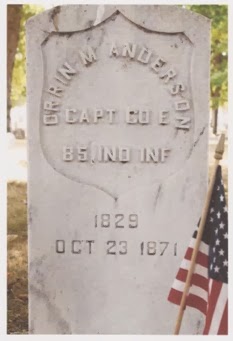
52 Ancestors: #2 Orin McClure Anderson, Capt. Co. E


Orrin McAnderson
Photo from "The History of the 85th Indiana Volunteer Infantry"
Orin McClure Anderson, my 3 times great grandfather, was born in 1829 in Clark County, Illinois.  On February 28, 1849, he was married to Mary Ann Bushnell in Vigo County, Indiana.  They settled in Prairieton, Indiana.  By 1860, the couple had three children:  Sarah, Charles, and Mary.  

On August 19, 1862, Orin enlisted in the 85th Indiana Volunteer Infantry and was later commissioned as the 1st Lieutenant of Company E.   

The chaplain of the regiment, J.E. Brant, wrote a history of the 85th Indiana.  Below are his thoughts on the formation of the regiment: 

"Those who went out in 1861 were under the impression that the war would soon end, but we who answered to the call of '62, faced an era of dread that the struggle would be long and fearful.  So the separation from loved ones in Camp was one fraught with dire forebodings."  [History of the 85th Indiana Volunteer Infantry, Rev. J. E. Brant, page 8.]

The infamous Libby Prison in Richmond, April 1865.  

After receiving outdated Belgian muskets in Indianapolis, the company traveled to Cincinnati and entered Kentucky, where they camped and drilled for nearly five months.  They then traveled by steamboat from Louisville to Nashville.  Their first battle was at Thompson Station, Tennessee.  They were forced to surrender when they were flanked and surrounded by Nathan Bedford Forrest's cavalry division.  The entire brigade was captured.  They were put into boxcars and "shipped like so many cattle to Richmond." They arrived at Libby Prison on the snowy morning of March 16, 1863. The company was released on March 31 as part of a prisoner exchange.  They had a fortunate escape; Libby Prison is generally regarded as second in notoriety to Andersonville Prison in Georgia. 

Orin was promoted to Captain on September 1, 1864.  He is often referred to in military records and books as "Captain McAnderson," a shortened form of his middle and last names.  The 85th Indiana took part in the Battle of Resaca, the Siege of Atlanta, and Sherman's March to the Sea.  Captain Anderson was mustered out with his regiment on June 12, 1865 at Washington, DC.

After the war, Orin returned home to Indiana and resumed life with his family.  Two more children were born -- Lawrence and Jennie.  Sadly, his daughter Mary died in 1870 at the age of 12.  Orin died the following year on October 23.  The war had likely cut his life short; he was only 42.  He is buried at Woodlawn Cemetery in Terre Haute, Indiana.  My mother and I visited his grave in July 2012.