Showing posts with label Green. Show all posts

Wednesday, April 27, 2016

Lot Green, M.D. and the 1902 Smallpox Outbreak

Dr. Lot Green (1847-1905)

Dr. James Wilkinson Green and Mary Jane Gowdy had thirteen children - five of them followed their father's profession.  Lot Green was their oldest child and the first of his brothers to become a doctor.  As a young man, Lot studied medicine under his father, a country physician in Shelbyville, and became well versed in anatomy and physics.

In 1872, Lot Green married Cordelia J. Barnard.  Six years later he entered the medical department of Butler University.  Lot graduated in 1880 and began his medical practice alongside his father before going on to open his own office.

Lot and Cordelia had five sons; Lucien Louis, Hallie Wilkinson, Frank Hayes, Charles Sumner, and Derby Blaine Green.  Lot took his oldest son Lucien with him on multiple house calls, perhaps to encourage him to become a doctor. These early experiences must have not made a good impression on Lucien, because he left Rushville for good and started a career as a loan officer in Indianapolis.  Of the five sons, only Frank Hayes Green continued the tradition of Green doctors, like his father and his grandfather had done.

During the summer of 1902, Lot Green issued a mandate for the residents of Rush County to be vaccinated after discovering a case of smallpox.  The news was publicized in the Indianapolis Journal as an effort to convince locals that the situation could turn serious.  However, the citizens of Greensburg in neighboring Decatur County disregarded the warning.  A special sanitary marshal was appointed to enforce the quarantine.

On February 21, 1905, Lot Green died at the age of 57.  There are differing accounts as to how Lot died; one article in the Indianapolis News states that he was "stricken with apoplexy while in his office." However, the Shelbyville Democrat said that Dr. Green was found in his sleigh, after he had an attack of apoplexy.

Saturday, July 18, 2015

Perry Green, a Hoosier Pioneer of Pasadena

Let others stay here and freeze if they wish; I’m going to California.
- Helen Elliott, an original member of the Indiana Colony in 1873[1]

The vibrant city of Pasadena, California, home of the Rose Parade and Caltech, has deep Indiana roots reaching back to the early 1870’s. The brutal winter of 1872-1873 pounded the Midwest with conditions unequaled in recorded history, which left many Indiana residents wishing for a more temperate climate.[2] Moreover, some believed that warmer weather would be beneficial to their health. A group of hopeful families migrated 2,000 miles west to form the quiet farming community that would later become Pasadena. As one of the original Indiana colonists determined to build a new life, Perry M. Green played a vital role in the establishment, growth, and culture of Pasadena, California.

In the spring of 1873, Perry first heard glowing accounts of life in California from a letter that was being passed around a group of his Indianapolis friends.[3] Many of the Hoosiers, including Perry himself, resolved that they would head to California as soon as possible. He joined the company in the hope of improving the health of his ailing wife, Hettie.[4] The small band of investors, calling themselves the “Indiana Colony,” immediately laid out their plans for departure.

However, their endeavors got off to a rocky start when the economy collapsed during the Panic of 1873. Perry Green described the devastating effect the financial depression had on the Indiana Colony:
Alas for the uncertainty of human calculations! The financial crash of 1873 fell upon the country like a clap of thunder from a clear sky, and failure, disaster, and bankruptcy swept like a tidal wave over the land, and the bright hopes of the “California Colony of Indiana” went down into the frightful vortex.[5]
Although they had lost much of their financial backing, Perry Green and those faithful to the cause rallied to form the San Gabriel Orange Grove Association.[6] In essence, their perseverance transformed a dream into reality.


In 1875, the association finally purchased land; Perry Green’s investment secured him 60 acres in the San Gabriel Valley. [7] Before building one of the first homes in the colony, Perry assisted in laying underground irrigation pipes, surveying the land, and planting grape cuttings.[8]  Then, Perry met with other community leaders to discuss a name for the new town. Someone suggested “Pasadena,” a Chippewa word that meant “of the valley.”[9] This name seemed to reflect the character of the beautiful landscape better than all the other proposals.

Many of Pasadena’s original citizens were educated professionals – doctors, lawyers, and journalists – with little to no agricultural experience. One visitor to Pasadena even remarked: “What a highly educated lot of farmers you have out here! Do they all talk so learnedly?”[10] In 1877, the celebrated naturalist, John Muir, wrote a letter which further illustrates this point:
There is nothing more remarkable in the character of the colony than the literary and scientific taste displayed. The conversations of most I have met here is seasoned with a smack of mental ozone, attic salt, which struck me as being rare among the tillers of California soil. People of taste and money in search of a home would do well to prospect the resources of this aristocratic little colony.[11]
Yet Pasadena clearly needed more than scholarly attainment. Those who had even a rudimentary knowledge of agriculture were a huge asset to the community. Perry Green was an educated attorney, but as a boy, he had been employed as a farm hand in rural Indiana.[12] His early familiarity with farming now equipped him to guide his struggling neighbors. Eager to help his fellow farmers succeed, Perry and several others formed a society for the purpose of developing the necessary skills to cultivate fruits such as oranges, figs, and apricots.[13]

The novice farmers soon came to realize that adequate irrigation was the key to their success. As one California pioneer put it: “Water here means gold.”[14] This need resulted in the formation of the Land and Water Company of Pasadena in 1877. Perry Green was on the company’s first board of directors and was selected to fill the position of vice president, a role he continued for 25 years.[15]

Another issue in the early years of Pasadena was the anti-liquor ordinance. In the beginning, the majority of the colony, including Perry Green, was strongly in support of the Temperance Movement, forbidding even the cultivation of certain grapes that could be used in the production of wine.[16] Notably, during the first nine years of the settlement, there was not one single criminal prosecution.[17] However, with the arrival of new settlers who did not share the same sentiments, it became harder to keep the founding principles enforced. In 1888, Perry Green served as chairman of a mass meeting of 1,000 concerned Pasadena citizens. The deliberation resulted in a set of anti-liquor resolutions and an “enforcement committee,” of which Perry was a member.[18]

Perry Green was the driving force in organizing many major financial and business institutions, particularly Pasadena’s first bank. Although he had no previous experience with banking, Perry saw the need for a bank and was willing to contribute his time and money to make the venture succeed. The bank prospered, and by 1886 it received a charter to become the First National Bank of Pasadena.[19] In addition to being the president of the First National Bank, Perry was involved in at least a dozen other civic establishments as a board member, trustee, or treasurer.

In the space of ten years, Pasadena had already outgrown its status as a quaint agrarian community and was well on its way to becoming a bustling city. As a result, it became necessary to create a better form of internal transportation. Perry Green embraced these changes and invested more of his time and money in streetcars and railroads, becoming reasonably wealthy in the process. He became both director and treasurer for the first streetcar company of Pasadena, as well as joining the Los Angeles and Pasadena Railway Company’s board of directors.[20]

With Pasadena’s central transportation system flourishing, Perry turned his attention to a new enterprise that would benefit his city. He had an idea to construct a railway into the Sierra Madre Mountains (now known as the San Gabriel Mountains), allowing adventurous tourists to experience the beauty of the landscape.[21] More importantly for Pasadena, the proposed railway would become a source of revenue. Perry provided some initial funds for the project and commissioned Thaddeus Lowe, a well-known engineer, to oversee the monumental task of building a track up the side of the steep mountain.[22]


On Independence Day 1893, a multitude of spectators attended the unveiling of the Mount Lowe Incline Railway, paying the substantial fee of $5 for a ride to the top of the mountain.[23] The completed railway was an incredible feat of engineering. Perry Green, as vice president of the Pasadena and Mount Wilson Railway Company, gave the opening remarks for the occasion: “The railroad is . . . such a triumph of engineering and construction and skill, as to challenge our unbounded admiration.”[24] Eventually, hotels were built at the top of the mountain, making Pasadena one of the most popular vacation spots of that era. Although the Mount Lowe Incline Railway no longer exists, it ultimately changed the character of Pasadena from an ordinary town into a well-known resort destination.

As an educated man, Perry Green naturally involved himself with the academic sector of Pasadena. The California Institute of Technology (also known as Caltech), was founded in 1891 as Throop Polytechnic Institute, a vocational and preparatory college. Perry Green, part of the initial board of directors, was elected as the institute’s first treasurer.[25] Furthermore, he took a philanthropic interest in the school, as shown in the following remarks made by his Throop colleagues:
Mr. Green has given the best that was in him for the advancement of this school. He yearned to help the young, frequently paying the tuition of deserving students who were unable to meet that expense, and following their career through the school with watchful interest.[26]
Over time, the California Institute of Technology has emerged as one of the most prominent scientific and engineering schools in the country.

Without a doubt, the Rose Parade is [27] The first parades consisted of horse-drawn buggies ornately decorated with locally-grown roses and orange blossoms.  But by the early twentieth century, some merchants who had previously sponsored the parade no longer saw its potential; they decided to withdraw funding that was crucial to the parade’s operation.[28] As treasurer of the Rose Parade committee, Perry appealed to the community for help. A group of supportive citizens responded by donating the needed $13,000.[29] Perry’s timely intervention was pivotal in preserving the city’s unique celebration.  Pasadena’s most iconic tradition. Even so, it is not widely known that the New Year’s celebration was created to boost morale after a financial depression. By showcasing the best of what sunny Pasadena had to offer, Perry Green and other community leaders also hoped to renew interest in investors from the Midwest.

Perry M. Green’s steadfast guidance was truly essential to the formation, progress, and character of Pasadena. He overcame many obstacles to fulfill the vision that he had for his adopted homeland. Through hard work and careful investing, Perry amassed a great amount of wealth, which he generously poured back into his community. Even toward the end of his life, as his health declined, Perry continued to serve his city in countless ways. On the day of his funeral, all of Pasadena’s businesses closed their doors as a tribute to the city’s beloved founder.[30] The beautiful city of Pasadena, California stands as a legacy of Perry Green’s leadership, dedication, and ingenuity.


[1] James H. Madison, “Taking the Country Barefooted: The Indiana Colony in Southern California,” California History, Fall 1990, 237.
[2] Michael Snyder, “Flower Power,” Indianapolis Monthly, Dec 1998, accessed January 15, 2015, 86. https://books.google.com/books?id=Fh0DAAAAMBAJ&printsec=frontcover#v=onepage&q&f=false
[3] R. W. C. Farnsworth, A Southern California Paradise (Pasadena: Farnsworth, 1883), 35. https://books.google.com/books?id=6XcUAAAAYAAJ&printsec=frontcover#v=onepage&q&f=false
[4] James Miller Guinn, Historical and Biographical Record of Southern California, (Chicago, Chapman Publishing Company, 1902), 227. https://books.google.com/booksid=3BU1AQAAMAAJ&printsec=frontcover#v=onepage&q&f=false
[5] Farnsworth, 35.
[6] Guinn, 226.
[7] “Appreciating Pasadena, Garden of the Californian Dream,” Kim Weir, accessed January 19, 2015, http://www.uptheroad.org/appreciating-pasadena-garden-of-the-california-dream
[8] Ann Scheid Lund, Historic Pasadena: An Illustrated History (Pasadena, HPN Books, 1999), accessed January 15, 2015, 20-21. https://books.google.com/books?id=3HLb4SY0uyEC&printsec=frontcover&source=gbs_atb#v=onepage&q&f=false
[9] Snyder, 92.                                                                                                                                       
[10] Lund, 25.
[11] Ibid, 25.
[12] Guinn, 227.
[13] Lund, 25.
[14] Madison, 240.
[15] Guinn, 227.
[16] Farnsworth, 39.
[17] Ibid, 46.
[18] Hiram Alvin Reid, A History of Pasadena, (Pasadena, Pasadena History Company, 1895), 256. https://books.google.com/books?id=uRU1AQAAMAAJ&printsec=frontcover#v=onepage&q&f=false
[19] J. W. Wood, Pasadena, California, Historical and Personal: A Complete History of the Organization of the Indiana Colony, (Wood, 1917), 246. https://books.google.com/booksid=YxQpAAAAYAAJ&printsec=frontcover#v=onepage&q&f=false
[20] Reid, 430, 434.
[21] Michael A. Patris, Mount Lowe Railway, (Arcadia Publishing, 2007), 8. https://books.google.com/books?id=IFEmrlwqgUIC&printsec=frontcover#v=onepage&q&f=false
[22] Ibid, 9.
[23] Ibid, 45.
[24] Reid, 448.
[25] Ibid, 191.
[26] “Honor His Memory – Citizens Pay Tribute To Late P. M. Green,”Los Angeles Herald, March 25, 1903, accessed January 19, 2015.  http://cdnc.ucr.edu/cgi-bin/cdnca=d&d=LAH19030325.1.10&e=-------en--20--1--txt-txIN------#
[27] Snyder, 92.
[28] Lee E. Johnson and C. W. Taylor, Eminent Californians 1953, (Palo Alto, C. W. Taylor Publishing, 1953), 15.
[29] Ibid, 15.
[30] “Last Honors Paid – Funeral of Late P. M. Green,” Los Angeles Herald, March 27, 1903, accessed January 19, 2015. http://cdnc.ucr.edu/cgi-bin/cdnc?a=d&d=LAH19030327.2.140

Thursday, April 16, 2015

52 Ancestors 2015: #15 Mary Green, Early Pasadena Pianist

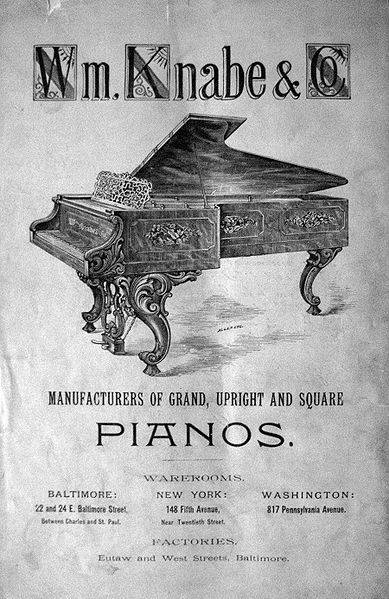
1889 Wm. Knabe & Co. piano advertisement
http://pianoartisans.com/piano-info/piano-history/knabe-piano-company/
What was to be a joyous birthday present from the late P. M. Green to his daughter now comes to her as a sweet but sad memorial to his love. Some months ago, the millionaire ... gave his order for a specially designed Art Grand Piano to be manufactured by the famous old house William Knabe and Co., Baltimore.  Such special work requires months of patient waiting before the finished product is ready for shipment and this order was no exception to the rule... The piano arrived only yesterday, and is now on display at the Pacific Music company's warerooms... Seldom, if ever, has any show window in this city been decorated by such a magnificent specimen of the piano maker's art.  (Los Angeles Herald, 9 Aug 1903) 

The recipient of that piano was Mary Green, my 1st cousin 4 times removed.  She was born in March 1863 in Shelby County, Indiana and was the only child of Perry M. Green and Henrietta "Hettie" Campbell.  Mary's mother had poor health, which influenced the family's decision to seek a better climate. When Mary was 10 years old, she and her parents, aunt, uncle, and cousins joined a migration of Indiana families to southern California. 

Mary was the founder of the Pasadena Symphony Club, which met for the first time at her parents' house on November 5, 1896.  The club's meetings included papers given on composers and musical forms, orchestral and piano rehearsals, and many public performances.  According to several newspaper accounts, Mary was a remarkable musician and a pianist of great technical ability.  (I wish there was a recording of her playing!)  Among the pieces she performed with the Pasadena Symphony Club were:

Dvorak's Symphony No. 5 in E minor "From the New World"
Saint-Säens' Dance Macabre "Dance of Death"
Raff's Symphony No. 5 in E Major "Lenore"
Schubert's "Death and the Maiden" 

After Mary's father died in March of 1903, her mother's health also began to decline.  Hettie, who for a while benefited from the climate change, eventually contracted severe bronchitis and passed away in 1908.  Two years later, on July 22, 1910, Mary Green died from heart failure at the age of 47.  She never married and has no descendants.  I wonder what happened to Mary's beautiful piano.  I like to hope that it is preserved in a museum somewhere.

Wednesday, April 8, 2015

52 Ancestors 2015: #14 Little Napoleon

James Cyrus Green, c. 1898
H. S. Stephens, Rushville, Indiana
This is my great-grandfather when he was about four years old.  I wonder how he felt about wearing this outfit.  The enormous bow tie and the tall button boots must have been very uncomfortable for him, but perhaps it made him feel special to be all dressed up.  The riding crop and bicorne hat seem unusual to me -- maybe they are props from the photographer.  I think they make him look like a little Napoleon Bonaparte.

James Cyrus Green (called Cyrus) was born on September 12, 1894 in Arlington, Indiana.  His parents were John D. Green, M.D. and Lavanche Emarine Trees.  He had two younger siblings, a sister named Mary Catherine and a brother named Maurice Thomas.  As a young man, Cyrus attended Sewanee Military Academy in Tennessee.  On June 12, 1916, Cyrus married Mary Ida Sefton in Greensburg, Indiana.  He died June 25, 1964 in Rushville, Indiana.

Tuesday, April 7, 2015

52 Ancestors 2015: #12 and #13 The Twin Doctors Green

Left to right: William F. Green, Mr. Davis, Mr. Parrish, Thomas G. Green.
On the back of the picture is written "Davis and Parrish, from Illinois." 
This photograph of four young medical students was taken by Sally E. Garrity at her Louisville, Kentucky studio sometime between 1886 and 1889.  Miss Garrity was one of the first female photographers to achieve recognition and success. Often she photographed as many as 150 people a day, while also overseeing the development of every picture herself.  I've always been intrigued by this picture because of the strange way the men are positioned.  While researching Sally Garrity, I found that many of her pictures are charaterized by unusual poses. 

William Frame Green and Thomas Gary Green were identical twins, born on April 6, 1865 in Arlington, Rush County, Indiana.  Their father, James Wilkinson Green, was a doctor; four of their older brothers were doctors as well, including James C. Green and John D. Green.  William and Thomas graduated together from Louisville Medical College in Kentucky in 1889.  

For 10 years William and Thomas both practiced medicine in Shelbyville, Indiana, then William moved his practice to Indianapolis and eventually to Cambridge City, Indiana.  Thomas stayed in Shelbyville until he died in 1929 at the age of 63.  William died in 1931 in Cambridge City.

Both William and Thomas were interested in their family history. William wrote a history of his family that was used for SAR and DAR applications.  I have a letter that Thomas wrote to his fifteen-year-old nephew, James Cyrus Green (my great-grandfather), containing stories about the early Greens in America.  The following is a quote from the letter: "I have looked up the family history for you and will write you a brief copy, which if you will keep may be useful and valuable to you sometime."

Monday, March 16, 2015

52 Ancestors 2015: #10 A Tragic Accident at the Indiana Republican Convention

Dr. James C. Green, son Hugh, and wife Azzie, c. 1892
James C. Green was born March 10, 1860, in Arlington, Rush County, Indiana.  The son of Dr. James Wilkinson Green and Mary Jane Gowdy, he was the seventh of 13 siblings.  Six of those siblings became doctors, including James and his brother, John D. Green (my great great grandfather.)  James attended courses at the newly-formed Medical College of Indiana, which was a department of Butler University. Following his graduation in 1880, James began his practice as a physician alongside his father in Arlington.

On October 23, 1883, James was married to Azzie E. Winship, a young woman from Rushville, Indiana. The couple had two children -- an infant daughter who died in 1885 and a son, Hugh Clifford Green, born on December 31, 1886.

In 1892, James C. Green was chosen to be a delegate to the Indiana Republican convention.  The convention, which was held on June 28 at the Princess Rink in Fort Wayne, lasted for only one day. The event drew such a large crowd that officials threatened to clear the hall to make room for all the delegates waiting to get inside.  In the chaos, James was pushed against a door knob and critically wounded.  Sadly, he died from his injuries a few weeks later.

The Indianapolis Journal, July 17, 1892

Saturday, February 14, 2015

One Year Blogiversary!

One year ago today I started my blog!  Thank you to everyone who has taken the time to read my posts.  Here are a few from the past year that are my favorites.

First post:  Mary Ida Sefton and Her 29 Roses

Most viewed post: Carrie C. Fields, Red Skelton's Aunt

Favorite post:  Fanny Gowdy and an American Romance in Paris

Longest post:  The Wartime Diary of Captain Willis E. Hedgecock

Shortest post: Nancy Tombaugh, Midwife of Richland County

Saddest post: Little Mary Catherine Green

Funniest post:  Nancy Oliver, Who Waited 3 Years For Groceries

And finally, the post with my favorite picture:

Dola M. Worland, Gold Star Mother

Friday, October 17, 2014

52 Ancestors: #40 Squire Lot Green, Pioneer School Teacher

A schoolhouse similar to the one Lot Green would have taught in.
Lot Green was a farmer of Rush County all his active life. He was a man of fine attainments for those days and at different times taught school with such success that he is regarded as having been an able educator. For twenty years he was Justice of the Peace under the old constitution. (From the Pictorial and Biographical Memoirs of Indianapolis and Marion County, Indiana, 1893.)

My 4th great grandfather, Lot Green, conducted one of the oldest schools in Anderson Township, Rush County, Indiana. The log cabin school stood on the farm of Jacob Hackleman, one of the original settlers of Rush County.  In 1829, a man named George Wrinbro assumed the task of teaching the school. At the end of the school year, Mr. Wrinbro treated his students to whisky!  Another teacher in Anderson Township at the time was the famous evangelist and poet Knowles Shaw, who wrote the lyrics to the Gospel hymn "Bringing in the Sheaves."  

Lot was born on April 15, 1799 in Pulaski County, Kentucky, the tenth of eleven children. His parents were Thomas Greene and Elizabeth Ann Ransbird Mathews. (I believe Lot was the first Green in the family line to drop the final "e" from the surname.) Thomas Greene was a Patriot spy during the American Revolution and was the first cousin of General Nathanael Greene. Nathanael and Thomas Greene came from Quaker families, but both were turned out from the congregation because they would not acknowledge that they were wrong in joining the fight for freedom.

On April 27, 1824, Lot married Anna Cooper in Pulaski, Kentucky.  Together they had nine children. Anna died in 1841, when their youngest child was less than two years old.  Lot married Sarah Houston on June 7, 1842.  He was chosen as a delegate to attend the Rush County convention on April 18, 1843.

Lot's involvement in education had a lasting effect on his descendants.  Two of his sons, James Wilkinson Green and William Frame Green, became doctors.  Another son, John Cooper Green, was a well-known lawyer in Shelby County, Indiana.  His youngest son, Perry M. Green, was also a lawyer and a founder of the city of Pasadena, California.  Six of Lot's grandchildren became doctors, including my great grandfather, John D. Green.

Lot Green died on July 12, 1845 in Rush County, Indiana, at the age of 46.

Thursday, July 31, 2014

52 Ancestors: #24 Cyrus Ebon Trees, Once the Wealthiest Man in Rush County

Cyrus Trees' birthplace in Manilla, Indiana.  The house was built by his grandfather, Jacob Mull, who was one of the founders of Manilla.  (Photo was taken from the book, In Old Kentucky, a History of My Forbears, written by William DePrez Inlow.)

My great-great-great grandfather Cyrus Ebon Trees was born August 4, 1848 in Rush County, Indiana, the third son of James Whitlow Trees and Catherine Mull.  His father was a physician for a short while, but later became a dry goods merchant.  He received a common education in nearby schools and went on to attend Northwestern University in Illinois.

Cyrus Trees was married to Annie Inlow in Manilla, Indiana on May 4, 1869. They had only one child, Lavanche.  But when their daughter was only six years old, Annie suddenly died of an unknown illness.  Cyrus remained a widower for nearly two years, then he remarried in 1877.  His second wife, Charlotte Macy, was just eleven years older than his young daughter.  Cyrus and Lottie had two children, Lee and Mary Catherine.

Shelbyville Democrat published May 21, 1881
In his early career, Cyrus was unusually prosperous, always thinking of ways to expand and progress. Associated with his father in the grain business,  he built a name for himself and also helped to make Manilla one of the best grain markets in Indiana.  By 1883, he was running his grain elevator night and day.  Cyrus was also a merchant in both the livestock and the lumber trades.  I'm sure his lumber company (Trees and Mohler) used his befitting last name to drum up business.

In addition to all of these business ventures, Cyrus Trees was actively involved in politics.    One Shelbyville, Indiana newspaper described "Cy" as "a red hot Democrat."  He held his beliefs firmly and was slow to change his views.

In the 1880's, Cyrus engaged in land investments in Kansas, and encouraged everyone he knew to do the same.  He became the vice president and director of the Kiowa Land Investment Company.  And if all this wasn't enough,  Cyrus started something completely new; he organized the First Manilla Bank in 1895.  Eventually, the strain of all this responsibility caused serious repercussions and robbed him of his sanity and health.

Land investors in Haskell County, Kansas.
The beginning of his troubles started in the late 1890's.  Cyrus had invested largely in land ($80,000 to be exact) in Haskell County, Kansas.  It appeared to be a great success. New settlers were enticed by the glowing accounts and came in throngs with hopes of becoming successful ranchers.  But with the influx of settlers and the breaking of sod, it soon became apparent that the range would be spoiled.  Adding to the rancher's problems were the discouraging prices and the long drive to market.

Although Haskell County had enjoyed a boom in the 1880's, it suffered an even larger bust in the 90's.  The county's population plummeted, and Cyrus' investments were gone.  When he received the news that the whole enterprise had collapsed, Cyrus underwent a nervous breakdown.  In September of 1899, Cyrus, now seriously ill, was admitted to a sanitarium in Martinsville, Indiana.

The Indianapolis Journal published February 10, 1901
On Christmas Day, 1900, Cyrus Trees was declared of unsound mind and was committed to a private sanitarium in Indianapolis.   The Manilla bank had to be closed for six weeks until someone could take it over.  A relative, John Blessing, was chosen as guardian for the unfortunate ex-banker.  To pay off Cyrus' debts, which amounted to $66,000,  Blessing sold his ward's land in several counties and also sold the Manilla bank.

However, not all of the debts were paid off.  Dr. John D. Green, son-in-law of Cyrus, filed a complaint against Blessing, asking $8,000 for services rendered as a physician to Cyrus and his family.  The doctor stated that, in 1897, his father-in-law had become so ill that he required someone to look after him constantly.  Cyrus proposed that his son-in-law might abandon his practice as a general physician and devote his entire time and attention to himself and his wife and daughter, promising to pay him what his services were reasonably worth.  Dr. Green agreed to the plan, but was not reimbursed.  Cyrus, now a resident of the Richmond Insane Asylum, was powerless to pay him.  A settlement was reached, and the doctor accepted payment of $3,500.

In 1901, Cyrus was transferred for the third time to a sanitarium in Oxford Ohio, his last residence.  He died in the asylum on February 18, 1902, at the age of 53.

"Cy was one of those warm hearted, generous, whole souled persons whom it is always a pleasure to meet, of a most sociable disposition, honest and faithful to his friends.   He was enterprising, shrewd, and progressive.  In his death his family is called upon to mourn the loss of a kind hearted and affectionate husband and companion." (From his obituary in the Shelbyville Democrat)


Thursday, May 1, 2014

52 Ancestors: #17 Mary Jane Gowdy and the Mysterious Oil Painting

Mary Jane Gowdy Green, 1876
English artist Edwin Farrer painted this now faded portrait of my 3rd great-grandmother, Mary Jane Gowdy.  For years, my family did not know who the subject of the portrait was, except that she was a relation of my grandfather's.  I discovered that the artist immigrated from England to Rush County, Indiana in 1870.  The portrait was dated 1876.  Trying to find out who the woman was, I reviewed the records on my grandpa's family in Rush County, and Mary Jane was the only one that fit.

Mary Jane was born on July 18, 1830.  She was the eldest child of Adam McConnell Gowdy, a blacksmith from Ohio, and Nancy Oliver of Kentucky.  Her brother, John Kennedy Gowdy, was the consul-general to Paris during the McKinley Administration.  Mary Jane had two other brothers, Lewis Oliver and Adam Thomas, and a sister, Martha Ann.

The Green residence, Arlington, 1988
On May 18, 1846, Mary Jane married the physician James Wilkinson Green in Rush County.  According to several sources for her birthdate, she was not yet sixteen when they were married.  She and James became the parents of thirteen children.  Out of nine sons, six of them became doctors, including my great-grandfather, John D. Green.  The Green family lived on a farm in Arlington, Rush County, Indiana.  In 1886, Mary Jane's brother-in-law, a physician in nearby Shelbyville, died and left his medical practice to his brother James.  They left Arlington behind and relocated to Shelbyville.

"Mrs. Green is what might be termed an extraordinary woman; she has raised a large family and is one of the best of wives, mothers, and companions; her home has always been noted for its generous hospitality." (Illustrated Historical Atlas of Rush County, Indiana, 1879.)

Mary Jane died on September 20, 1907.


Tuesday, April 29, 2014

52 Ancestors: #16 Lavanche Emarine Trees, A Very Unusual Name

Lavanche (H. S. Stephens Studio, Rushville, Ind.)
I have always thought that my great great-grandmother, Lavanche Emarine Trees, had a very unusual name.  I believe she was named after her aunt Lavanche, who only lived for four years.  The name Emarine came from her great-grandmother, who was probably of English descent.  The Trees surname was an anglicized form of Driess, a German name.

Lavanche was born March 26, 1870 in Manilla, Indiana. Her father was Cyrus Ebon Trees, a very wealthy businessman from Manilla.  Her mother, Annie Elizabeth Inlow, a native of Fleming County, Kentucky, died when Lavanche was only six years old.  A year later, her father married again.  Lavanche's new stepmother was a young woman named Lottie Macy; there were eleven years of age difference between them.  Lavanche's half siblings, Lee Mull and Mary Catherine, were born in 1881 and 1884.

On August 2, 1893, Lavanche married John D. Green in her hometown of Manilla.  The couple had three children: James Cyrus, Mary Catherine, and Maurice Thomas.

When John and Lavanche were newly married, her father offered to send John to medical school in Louisville, Kentucky.  He graduated in 1896 and started his practice in Rush County. Lavanche completed two years of college herself and was a practical nurse, according to the 1940 census. She often was a hostess to her husband's patients.  Lavanche liked to crochet, knit, and sew.  She made a crazy quilt in 1899, which is still in the family.  I also have a topaz bracelet that belonged to her.

Tragedy came to the household when John and Lavanche's daughter Mary died from the measles before the age of six.  The youngest son, Maurice, had severe asthma.  Lavanche travelled with him to a hot springs resort in the south in the hope of improving his health.  He was only 26 years old when he died of tuberculosis, leaving behind a young widow.

After her husband died in 1921, Lavanche moved to Oxford, Ohio, to work as a housekeeper for an elderly couple.  In 1941, her daughter-in-law died, so she came back to Indiana to help take care of her grandson (my grandpa).

My grandpa wrote these words about her:  "She was a grand lady, yet not afraid of hard work; and she was a good businesswoman.  I had a terrible time accepting the loss of my mother.  Grandma's faith, strength, and example of self-reliance gave me purpose.  I grew to appreciate her love and what she was doing for me."

Lavanche died on November 11, 1960 in Greensburg, Indiana at the age of 90.

Monday, April 21, 2014

52 Ancestors: #14 John D. Green, M. D.

John D. Green
John D. Green was born in Arlington, Indiana on January 9, 1864.  He was the ninth child of Dr. James Wilkinson Green and Mary Jane Gowdy.  His parents did not give him a middle name, so he later assumed the middle initial D.  I guess his parents ran out of naming ideas after nine children, although they later had four more children (with middle names.)

John married Lavanche Emarine Trees, a native of Rush County, in Manilla, Indiana on August 2, 1893.  Shortly after he and Lavanche were married, his father-in-law, Cyrus Trees, asked why he had not become a doctor like his five brothers.  John was working as a telegrapher on the B & O Railroad at the time.  He replied to his father-in-law that he guessed his father had run out of money and could not send him to medical school.  Cyrus said he would send him and did so.

The residence of Dr. Green at Manilla


John left Rush County, Indiana and went to school at Louisville Medical College in Kentucky while my great-grandfather, James Cyrus Green, was just a baby. When the family first lived in Louisville, Little James Cyrus had to sleep in a dresser drawer set across two straight back chairs as a makeshift crib.  John graduated in 1896, then moved back home to Rush County to begin his practice.

John D. and Lavanche Green


Two more children were added to the family: Mary Catherine (1896), and Maurice Thomas (1903).  Mary died from the measles a month before her sixth birthday in 1902; she never met her brother Maurice.  Maurice struggled with asthma all his life and also died relatively young at the age of 26, from tuberculosis.

Dr. Green built up a large medical practice in Rush and Shelby Counties and also became involved in several fraternities and lodges.

After returning home one day from a house call, the doctor went outside to feed the chickens.  His wife found him in the yard, unable to get up.  He lost consciousness and died of a stroke the next morning, February 26, 1921. He was 57. 

Friday, March 21, 2014

52 Ancestors: #8 Little Mary Catherine Green


Mary Catherine Green, Age: 3 yrs.
Three year-old Mary Catherine Green received a gift from her mother on Christmas Day of 1899.  It was Lewis Carroll's Alice In Wonderland. The light green cover had gilded lettering and dark green vines mingling with red berries. 

Book inscription
Lavanche, Mary's mother, wrote an inscription on the front page of the book.  Underneath her message, a child copied the word "Xmas."  Perhaps it was little Mary who did it.

Mary Catherine Green was born on July 18, 1896 in Rush County, Indiana. She was probably named after her aunt, Mary Catherine Trees.  Mary had one older brother, James Cyrus (my great grandfather).   Her family lived in a big brick house in Manilla, Rush County, Indiana.  On June 15, 1902, Mary died from the measles, just one month before her sixth birthday.  It must have been devastating for her father, who was a doctor.


Mary and her brother, James Cyrus Green.  Don't you love her dress?
 
Mary's Alice In Wonderland

Several years ago, my grandpa gave Mary's book to me.  A note was written by my grandpa and tucked inside Mary's book:  

 Mary C. Green was "little Mary," daughter of John D. and Lavanche E. Green.  She died when she was about six years of age.  She would have been my Aunt.

I recently read Mary's book.  Many of the pages have scribbles in the margins, and some are torn.  Maybe it wasn't the best idea to use such a tattered copy, but I enjoyed reading it.  I wonder if Mary Catherine liked her Christmas present.

Monday, February 24, 2014

52 Ancestors: #3 James Wilkinson Green, Country Doctor

James Wilkinson Green, M.D.
My grandfather recounted the following story about James Wilkinson Green, his great grandfather. 

Late one evening during the Civil War, Dr. Green was returning from his home making house calls.  He was on horseback.  As he approached the town of Arlington, Indiana from the south, he had to pass through a clearing adjacent to the banks of the Little Blue River. As he came closer, he observed a bonfire with many people gathered around.  No greeting came from the group, and the Doctor silently rode through the assembly.

Dr. Green recognized nearly every face he could see.  Not a word passed between them, and it was then that the realization came to him that he had chanced upon a meeting of Rush County's southern sympathizers, The Knights of the Golden Circle.

It was years later that Dr. Green told this story to his family.  There were never any problems created by his discovery of the group, but after that night the country doctor always carried a pistol with him until the war's end.

James Wilkinson Green was born February 5 1825 in Rush County, Indiana, to Squire Lot Green and Anna Cooper.  He was the eldest of eight children.  He and his younger brother, William Frame Green, attended Rush Medical College in Illinois.  He also studied at the Indiana Fifth Dist. Medical Institute, where he graduated in 1846.  James began his medical practice the same year in Arlington, Indiana.  On May 18, 1846, he married Mary Jane Gowdy.  Together they had 13 children; ten survived to adulthood.

The family lived on a farm in Posey Township, Arlington, Indiana.


From 1856 to 1886, he practiced medicine in Arlington, Indiana.  Dr. Green enjoyed a wide acquaintance in his community and over the 50 years in his practice he had delivered nearly all the babies in the area.  While the country doctor did not serve in the Civil War, a biography made notice of his care of the wives, widows, and children of the Union soldiers. "During the four years of the late war, the Doctor was more than a father to many families in his neighborhood; never in one instance did he make a charge for professional service against those who were from home defending our country's cause." (From a biographical sketch in the Illustrated Historical Atlas of Rush County, Indiana, 1879.) 

Six of Dr. Green's sons became doctors themselves: Lot, Preston, James, John, and William and Thomas, who were twins.  They all practiced medicine in Indiana.  Some of James Wilkinson Green's grandsons also continued the family tradition and became doctors.

Dr. J. W. Green in front of his Shelbyville, Indiana office.

After the death of his brother William in 1886, James relocated to Shelbyville and took over his brother's practice.

He died on July 27, 1896 in Shelbyville.  His death certificate, which was completed by his son William, states that he died of "physical exhaustion." He is buried at East Hill Cemetery in Rushville, Indiana.