Showing posts with label Inlow. Show all posts

Tuesday, March 3, 2015

The Slaves of Abraham Inloes of Fell's Point, Baltimore, Maryland

Fell's Point, Balitmore, Maryland, as it appeared in 1800.
According to his will, Abraham's property faced
Ann Street and reached back halfway to Argyle Alley
Schalene Dagutis of Tangled Roots and Trees has initiated a new genealogy project: The Slave Name Roll Project.  It provides a way for genealogists to trace their enslaved ancestors during a time when very little documentation of these people existed.  By digitizing and recording information about ancestors who owned slaves, others can help piece together their ancestor's lost stories.

For my first contribution to the project, I chose to write about Abraham Inloes, a collateral relative.  I found a transcription of his will in a three-volume family history book about the Inlow/Inloes family, entitled In Old Kentucky, A History of My Forbears.

Born about 1736, Abraham Inloes was the grandson of a Dutch immigrant.  He lived in Fell's Point, Baltimore, Maryland and was one of the first in his family (if not the first) to own slaves.  Fell's Point is the oldest neighborhood in the city of Baltimore.  During and after the Revolutionary War, it became one of the leading harbors in the country. Between 1774 and 1821, over 800 ships were constructed at the Fell's Point shipyards.  In 1835, Frederick Douglass, while still enslaved, worked for a ship builder in Fell's Point.  It was here that he taught himself how to read and write, by copying and memorizing the letters with which the shipyard men labeled boards.

On December 28, 1790, Abraham Inloes died.  He was about 54 years old.  The following is a portion of Abraham's will, dated November 18, 1790.
I give and bequeath unto my Loving Wife [Elizabeth] all my negroes to wit Negro Joshua, Sarah, Thomas, and Ann with their increase to her, her heirs and assigns forever, as it was my Intention to have Manumitted my negroes aforesaid, but by my present Indisposition hinders the same. I have given them to wife to do with them as she pleases, Yet having confidence in her that she will by a sufficient deed of Manumission make them free after my decease, and I look upon them as making no part of my Estate. My Will and desire is that if any of my children hereafter named should or shall hereafter lay any claim to them or any part of their appraisement or by suit or other ways disturb my wife or my Executor or the Slaves themselves in claiming them or any of them or any part of them, then it is my will that such child or children shall take no part in my Estate hereinafter bequeathed unto them and that their part, his or her part so offending shall be divided amongst my other children who obey, and keep my Will.
Further on, Abraham lists his ten children by name: Anthony, Abraham, Elizabeth, Joshua, James, John, Eleanor, Temperance, William, and Margaret.  It seems that in his later years he firmly believed that owning slaves was wrong, since he threatened to disinherit his children if they tried to contest his will.  I don't know what actually happened to Joshua, Sarah, Thomas, and Ann after Abraham Inloes died, but I hope they were given their freedom.

Monday, November 3, 2014

52 Ancestors: #44 Isaac Inlow, Undone by His Son

Taken from In Old Kentucky, a History of My Forbears
My 4th great-grandfather, Isaac Inlow, came from a large family.  His parents, James Inlow and Mary Wilson, had 15 children; Isaac was the 14th child.  In 1840, Isaac married Lucinda Bell in Fleming County, Kentucky.  Isaac, his wife, and their five children moved to Manilla, Rush County, Indiana about 10 years later.

Isaac was a respected farmer and a man of tireless energy; he was numbered among the wealthy and influential citizens of Rush County.  He helped to found the Christian Church at Manilla and remained a faithful member there throughout his life.  Isaac was also a member of the Knights of Pythias.  At two different times, he was tendered a nomination to the legislature of the Democratic party, but Isaac chose instead to live a quiet life in his Rush County home.

However, Isaac's second son, John William Inlow, was his undoing.  John was a man with big ideas... and a spendthrift. He had great visions of doubling his father's assets.  John invested a great deal of his father's money in real estate in Indianapolis.  According to the Indianapolis Journal, on March 14, 1871, John purchased a lot for $2,300. (That's roughly equivalent to $45,000 today!)   Then, his scheme backfired, and John lost his father's money. Isaac was forced to to sell the Manilla farm in 1879.  John ended up as a floorwalker at the New York Store (aka Pettis Dry Goods Co.) in Indianapolis, a position he held for many years.

After he lost his farm, Isaac and his wife moved 50 miles away to Alexandria, Indiana, where his oldest son, James Elliott Inlow, was practicing as a doctor.  When James relocated to Hancock County, Isaac and Lucinda returned to Manilla.  In 1894, Lucinda Inlow died.  At the time of her death, she was completely blind.  It then fell upon the youngest son, George Jefferson Inlow, to care for his elderly father.  George worked as both a carpenter and a druggist in Manilla.  Isaac Inlow died at George's home, at the age of 89, from a stroke.

(Much of the biographical information in this blogpost comes from the book In Old Kentucky, a History of My Forbears, Book 3 by William DePrez Inlow, published in 1950.)

Saturday, September 13, 2014

52 Ancestors: #32, Catherine Mull and Her Sister

Mary Ann
Catherine
My four times great- grandmother, Catherine Mull, and her sister, Mary Ann, "were about as close as it was possible for sisters to be."  Living as next-door neighbors, they were together daily.  Often they could be seen walking together, attired in "elegant dresses, long and full, with many petticoats, with spring bonnets bedecked with flowers tied under their chins, holding their skirts on one side."


Catherine and Mary Ann's father, Jacob Mull, was a pioneer of the town of Manilla and a whisky merchant.  Their mother was a stern-faced Scot named Margaret Richinson.  Catherine was the eldest of four, being born in 1824; Mary Ann was the youngest child, born in 1831.  They had two brothers, Cyrus and George.  

On September 18, 1842, Catherine married a Manilla doctor, James W. Trees.  Mary Ann followed suit in 1853 and was also wedded to a physician, John James Inlow.  Doctors J. W. Trees and J. J. Inlow even practiced medicine together for a short time.  James and Catherine had six children: Ethan Allen, Leander Mull, Cyrus Ebon, Lavanche, Margaret, and Marshall.

The sisters lived in very similar houses; in fact, one was a copy of the other.  In about 1858, Jacob Mull built his house in Manilla, "which though not the largest house to be ever constructed in Manilla, was nevertheless at the time the best, and architecturally speaking, the most distinctive. Soon after they were married, Mary Ann and her husband, Dr. J. J. Inlow, built their house next to Jacob's house. They were obviously similar, however, it was built in wood instead of brick. Doubtless, the young couple could not afford to spend the sum that the father could.  When Jacob Mull died in 1861, his home became the residence of his daughter Catherine, and her husband, Dr. J. W. Trees.  From that point on, the two sisters lived side by side in the most prominent location in the town."

Dr. Trees' residence, where Catherine lived.
Dr. Inlow's residence, where Mary Ann lived.
Catherine and Mary Ann "spent a lot of their time conversing with the neighbors and with people who came into town to see the doctor. [Catherine], for instance, if while sweeping out her front room she should see someone with whom she wanted to speak would throw up the window and call, stopping her work and leave it for the maid to finish."

Catherine died on November 5, 1884 in Manilla; Mary Ann died in 1902.

All quotations and pictures are from the book In Old Kenucky, a History of My Forbears by William DePrez Inlow.

Thursday, July 31, 2014

52 Ancestors: #24 Cyrus Ebon Trees, Once the Wealthiest Man in Rush County

Cyrus Trees' birthplace in Manilla, Indiana.  The house was built by his grandfather, Jacob Mull, who was one of the founders of Manilla.  (Photo was taken from the book, In Old Kentucky, a History of My Forbears, written by William DePrez Inlow.)

My great-great-great grandfather Cyrus Ebon Trees was born August 4, 1848 in Rush County, Indiana, the third son of James Whitlow Trees and Catherine Mull.  His father was a physician for a short while, but later became a dry goods merchant.  He received a common education in nearby schools and went on to attend Northwestern University in Illinois.

Cyrus Trees was married to Annie Inlow in Manilla, Indiana on May 4, 1869. They had only one child, Lavanche.  But when their daughter was only six years old, Annie suddenly died of an unknown illness.  Cyrus remained a widower for nearly two years, then he remarried in 1877.  His second wife, Charlotte Macy, was just eleven years older than his young daughter.  Cyrus and Lottie had two children, Lee and Mary Catherine.

Shelbyville Democrat published May 21, 1881
In his early career, Cyrus was unusually prosperous, always thinking of ways to expand and progress. Associated with his father in the grain business,  he built a name for himself and also helped to make Manilla one of the best grain markets in Indiana.  By 1883, he was running his grain elevator night and day.  Cyrus was also a merchant in both the livestock and the lumber trades.  I'm sure his lumber company (Trees and Mohler) used his befitting last name to drum up business.

In addition to all of these business ventures, Cyrus Trees was actively involved in politics.    One Shelbyville, Indiana newspaper described "Cy" as "a red hot Democrat."  He held his beliefs firmly and was slow to change his views.

In the 1880's, Cyrus engaged in land investments in Kansas, and encouraged everyone he knew to do the same.  He became the vice president and director of the Kiowa Land Investment Company.  And if all this wasn't enough,  Cyrus started something completely new; he organized the First Manilla Bank in 1895.  Eventually, the strain of all this responsibility caused serious repercussions and robbed him of his sanity and health.

Land investors in Haskell County, Kansas.
The beginning of his troubles started in the late 1890's.  Cyrus had invested largely in land ($80,000 to be exact) in Haskell County, Kansas.  It appeared to be a great success. New settlers were enticed by the glowing accounts and came in throngs with hopes of becoming successful ranchers.  But with the influx of settlers and the breaking of sod, it soon became apparent that the range would be spoiled.  Adding to the rancher's problems were the discouraging prices and the long drive to market.

Although Haskell County had enjoyed a boom in the 1880's, it suffered an even larger bust in the 90's.  The county's population plummeted, and Cyrus' investments were gone.  When he received the news that the whole enterprise had collapsed, Cyrus underwent a nervous breakdown.  In September of 1899, Cyrus, now seriously ill, was admitted to a sanitarium in Martinsville, Indiana.

The Indianapolis Journal published February 10, 1901
On Christmas Day, 1900, Cyrus Trees was declared of unsound mind and was committed to a private sanitarium in Indianapolis.   The Manilla bank had to be closed for six weeks until someone could take it over.  A relative, John Blessing, was chosen as guardian for the unfortunate ex-banker.  To pay off Cyrus' debts, which amounted to $66,000,  Blessing sold his ward's land in several counties and also sold the Manilla bank.

However, not all of the debts were paid off.  Dr. John D. Green, son-in-law of Cyrus, filed a complaint against Blessing, asking $8,000 for services rendered as a physician to Cyrus and his family.  The doctor stated that, in 1897, his father-in-law had become so ill that he required someone to look after him constantly.  Cyrus proposed that his son-in-law might abandon his practice as a general physician and devote his entire time and attention to himself and his wife and daughter, promising to pay him what his services were reasonably worth.  Dr. Green agreed to the plan, but was not reimbursed.  Cyrus, now a resident of the Richmond Insane Asylum, was powerless to pay him.  A settlement was reached, and the doctor accepted payment of $3,500.

In 1901, Cyrus was transferred for the third time to a sanitarium in Oxford Ohio, his last residence.  He died in the asylum on February 18, 1902, at the age of 53.

"Cy was one of those warm hearted, generous, whole souled persons whom it is always a pleasure to meet, of a most sociable disposition, honest and faithful to his friends.   He was enterprising, shrewd, and progressive.  In his death his family is called upon to mourn the loss of a kind hearted and affectionate husband and companion." (From his obituary in the Shelbyville Democrat)


Tuesday, April 29, 2014

52 Ancestors: #16 Lavanche Emarine Trees, A Very Unusual Name

Lavanche (H. S. Stephens Studio, Rushville, Ind.)
I have always thought that my great great-grandmother, Lavanche Emarine Trees, had a very unusual name.  I believe she was named after her aunt Lavanche, who only lived for four years.  The name Emarine came from her great-grandmother, who was probably of English descent.  The Trees surname was an anglicized form of Driess, a German name.

Lavanche was born March 26, 1870 in Manilla, Indiana. Her father was Cyrus Ebon Trees, a very wealthy businessman from Manilla.  Her mother, Annie Elizabeth Inlow, a native of Fleming County, Kentucky, died when Lavanche was only six years old.  A year later, her father married again.  Lavanche's new stepmother was a young woman named Lottie Macy; there were eleven years of age difference between them.  Lavanche's half siblings, Lee Mull and Mary Catherine, were born in 1881 and 1884.

On August 2, 1893, Lavanche married John D. Green in her hometown of Manilla.  The couple had three children: James Cyrus, Mary Catherine, and Maurice Thomas.

When John and Lavanche were newly married, her father offered to send John to medical school in Louisville, Kentucky.  He graduated in 1896 and started his practice in Rush County. Lavanche completed two years of college herself and was a practical nurse, according to the 1940 census. She often was a hostess to her husband's patients.  Lavanche liked to crochet, knit, and sew.  She made a crazy quilt in 1899, which is still in the family.  I also have a topaz bracelet that belonged to her.

Tragedy came to the household when John and Lavanche's daughter Mary died from the measles before the age of six.  The youngest son, Maurice, had severe asthma.  Lavanche travelled with him to a hot springs resort in the south in the hope of improving his health.  He was only 26 years old when he died of tuberculosis, leaving behind a young widow.

After her husband died in 1921, Lavanche moved to Oxford, Ohio, to work as a housekeeper for an elderly couple.  In 1941, her daughter-in-law died, so she came back to Indiana to help take care of her grandson (my grandpa).

My grandpa wrote these words about her:  "She was a grand lady, yet not afraid of hard work; and she was a good businesswoman.  I had a terrible time accepting the loss of my mother.  Grandma's faith, strength, and example of self-reliance gave me purpose.  I grew to appreciate her love and what she was doing for me."

Lavanche died on November 11, 1960 in Greensburg, Indiana at the age of 90.

Sunday, April 13, 2014

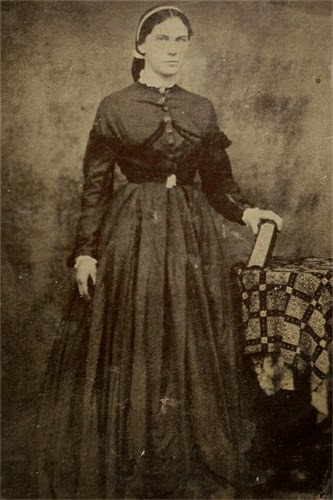
52 Ancestors: #12 Annie Elizabeth Inlow's Tintype

Annie Inlow Trees, Tintype c. 1869
I feel incredibly lucky to have this old tintype of my 3rd great grandmother.  The picture is an unusual size for the time period; 4x6".  The tintype had been cut down and glued into a scrapbook. A yellowed piece of paper, penned by her daughter, attached to the tintype reads "My Mother, Annie E. Inlow Trees."
 
Annie Elizabeth Inlow was born June 21, 1849 in Fleming County, Kentucky, to parents Isaac Inlow and Lucinda Bell.  She was the only daughter of a family of four boys. One sister, Mary Emarine, died young.  Her family had moved to Rush County, Indiana by 1860.

On May 4, 1869, at the age of 19, Annie married Cyrus Ebon Trees, a very successful business man from Manilla, Indiana.  They had one daughter, Lavanche Emarine Trees.  I assume Lavanche was named for her two aunts who died young, Lavanche Trees (Cyrus' sister) and Mary Emarine Inlow (Annie's sister).

Annie died January 8, 1876, in Manilla, Rush County, Indiana.  She was just 26 and left behind her six year old daughter.  I don't know how she died; Rush County didn't start to keep death records until 1882.

She was buried at Forest Hill Cemetery in Shelbyville, Indiana.