Showing posts with label Kentucky. Show all posts

Tuesday, April 21, 2015

52 Ancestors 2015: #16 Long Live the Lathams!

Princeton Leader, Princeton, Kentucky, 18 July 1912
Elijah Stephen Latham, my 6th great grandfather, was born in North Carolina in 1756.  According the the above article, which appeared in at least three different newspapers, Elijah, as well as my 7th and 8th great grandfathers, Jeremiah and Phillip Latham, lived to be over one hundred years old!  Since I know very little about these three men, I was excited to find this information.

My fifth great grandfather, Stephen R. Latham, broke the trend of Latham longevity.  He died of typhoid at the age of 76.  Unfortunately, Stephen's son, James Harvey Latham, also died of typhoid fever.  He was only 39.  I wonder how long they might have lived if they had not been victims of the disease.

By the way, Rev. George Washington Latham, the subject of the newspaper article and a Civil War veteran, died a few years after the story was printed, at the age of 91.

Tuesday, April 7, 2015

52 Ancestors 2015: #12 and #13 The Twin Doctors Green

Left to right: William F. Green, Mr. Davis, Mr. Parrish, Thomas G. Green.
On the back of the picture is written "Davis and Parrish, from Illinois." 
This photograph of four young medical students was taken by Sally E. Garrity at her Louisville, Kentucky studio sometime between 1886 and 1889.  Miss Garrity was one of the first female photographers to achieve recognition and success. Often she photographed as many as 150 people a day, while also overseeing the development of every picture herself.  I've always been intrigued by this picture because of the strange way the men are positioned.  While researching Sally Garrity, I found that many of her pictures are charaterized by unusual poses. 

William Frame Green and Thomas Gary Green were identical twins, born on April 6, 1865 in Arlington, Rush County, Indiana.  Their father, James Wilkinson Green, was a doctor; four of their older brothers were doctors as well, including James C. Green and John D. Green.  William and Thomas graduated together from Louisville Medical College in Kentucky in 1889.  

For 10 years William and Thomas both practiced medicine in Shelbyville, Indiana, then William moved his practice to Indianapolis and eventually to Cambridge City, Indiana.  Thomas stayed in Shelbyville until he died in 1929 at the age of 63.  William died in 1931 in Cambridge City.

Both William and Thomas were interested in their family history. William wrote a history of his family that was used for SAR and DAR applications.  I have a letter that Thomas wrote to his fifteen-year-old nephew, James Cyrus Green (my great-grandfather), containing stories about the early Greens in America.  The following is a quote from the letter: "I have looked up the family history for you and will write you a brief copy, which if you will keep may be useful and valuable to you sometime."

Monday, March 9, 2015

The Slaves of Barnaby Worland of Monroe County, Missouri

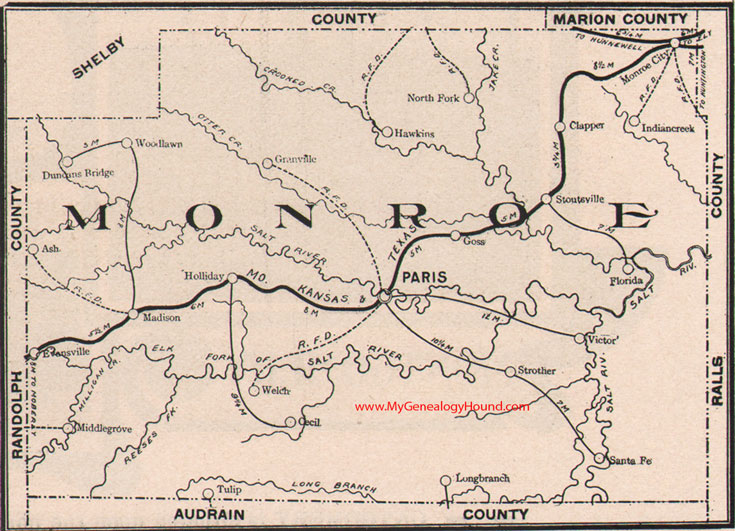
In the 1840's Barnaby owned land near an area called Old Clinton and Jonesburg.
The town was renamed North Fork and is shown at the top of this 1904 map.
http://www.mygenealogyhound.com/maps/missouri-maps/mo-monroe-county-missouri-1904-map.html
Schalene Dagutis of Tangled Roots and Trees has initiated a new genealogy project: The Slave Name Roll Project.  It provides a way for genealogists to trace their enslaved ancestors during a time when very little documentation of these people existed.  By digitzing and recording information about ancestors who owned slaves, others can help piece together their ancestor's lost stories.

Barnabas Worland (also called Barnaby) was born on January 5, 1777 in Maryland.  From there he migrated with his brother Thomas to Kentucky, settling in the Lexington area.  Sometime after 1828, Barnaby and his family relocated to Monroe County, Missouri.  Barnaby Worland married three times and was the father of 15 children.  His first wife was Theresa Hardy, and they had seven children: Matilda, Stephen, Theodore Sebastian, Vincent, Mary Theresa, Verlinda C., and George.  After Theresa died in 1816, Barnaby married Cecelia Gough and they had three children: John Henry, James Guy, and Mary C.  This second wife lived only ten years after their marriage.  Barnaby's third wife was Catherine Theresa Deerling.  Their children were Cecelia Agnes, Anna Gabriella, Sarah Catherine, Elizabeth Lewellen, and Barniellen (who was born after his death.)

The following is an excerpt from Barnaby's will, dated May 26, 1842, which I found in One Man's Family by Olive Lewis Kolb.

In the name of God, Amen:  I, Barnaby Worland of Monroe County and state of Missouri, being of sound mind and perfect memory have made this my last will and testament in manner and form viz:

After my just debts and funeral expenses shall have been paid, I give and bequeath to my beloved wife, Catherine Worland, the whole of the land I purchased of James and George Gough and the land I afterward purchased of James Gough, containing three hundred and thirty acres during her life time with an exception herein contained.  This farm shall be for her home and a residence for my unmarried daughters free of charge as long as they may live with her.  I also give to my beloved wife all my slaves viz -- Britt, Granville, Maria and her three children, Henry, George and William, together with every species of my personal property consisting of stock, agricultural implements, house hold and kitchen furniture together with all money in hands and all bonds not collected out of the uncollected funds as above appropriated.  I will and direct that my executrix shall invest the sum of two thousand five hundred dollars in Lands for the use and benefit of my two daughters Cecelia and Gabrilla, the title of which land shall be made to them and their children forever.  Furthermore it is my will and desire that my executrix or executor shall as soon as practicale purchase a Negro girl between the age of ten and thirteen years, the title of which girl shall be invested in my wife forever.

My further will is that at the death of my wife and youngest child being of full age my executor shall then proceed to sell all my personal estate; my slaves, and household and kitchen furniture excepted, of every description and divid the proceeds between my daughters Therese Combs, Verlinda Smith and Mary Worland.  As to my slaves at that time I give to my four daughters by my present wife viz - Cecelia - Gabrilla, Sarah Catharine and Lieu Ellen my negro woman Maria, together with her three children and any increase she (Maria) may in future have -- which slave are to be equally divided between my four daughters as before mentioned.  The remainder of the slaves viz -- Britt and Granville shall be equally disposed of as practicable without public sale between John H. Worland, Therese Combs, Verlinda Smith and Mary Worland, to them and their heirs forever.

On June 19, 1842, the day before he died, Barnaby Worland wrote an addition to his will:

Whereas, I, Barnaby Worland, upon reflection deem it proper to make some alterations in my will hereunto annex in manner and form as hereinafter mentioned viz . . . My further will and desire is that in the event of any of my heirs or legatees making any effort to prevent my will taking effect different from my intention every provision to them in my will shall be withdrawn and they shall be cut off with six and one fourth cents each, their interest or portion in this will to be divided among the other legatees. 

Friday, January 23, 2015

52 Ancestors 2015: #4 Mary Ann Williamson, Who Knitted Her Way To Indianapolis

"Old Woman Knitting a Sock" by Ivan Khrutsky
Source: Wikimedia Commons
Polly [as Mary Ann was also called] decided to go to Indianapolis to trade one day.  So she climbed on her little mule with her knitting.  She rode and she rode and she knitted and she knitted.  Finally, she met a soldier and asked, "How much farther is Indianapolis?"  He answered, "You passed through Indianapolis two miles back!!"

I found this humorous story in One Man's Family, written by Olive Lewis Kolb.  The tale is attributed to Mary Ann's son, Stephen Theodore Worland.

Mary Ann Williamson was born on October 20, 1811 in Kentucky.  (My 4th great grandmother and I share a birthday and a fondness for knitting!)  I don't have any information about her parents. According to Kolb, she may have been an adopted child.

On March 4, 1833, Mary Ann married Stephen Dominic Worland in Marion County, Indiana.  Stephen came from a Catholic family with deep roots in the history of early Maryland.  By 1840, the Worlands had settled in Shelby County, Indiana.  Mary Ann was the mother of 12 children, the oldest of which was my 3rd great grandfather, John William Worland.  Sadly, Mary Ann's three youngest children did not live past infancy.

Sometime between 1859-1860, the Worlands moved to Millwood, Missouri.  At the outbreak of the Civil War, Missouri was divided on the issue of slavery.  By 1863, conditions there were tumultuous and unstable. The Worlands decided to move back to Indiana.  Tilson Vincent Worland, Mary Ann's grandson, recounted the Worland family's return to Indiana from Missouri:

I have heard my father, Stephen Theodore, tell of the trip back to Indiana.  The womenfolk returned by train, but grandfather [Stephen Dominic Worland] and his six sons drove through bringing six horses. They ferried the Missouri and Mississippi Rivers and followed the old National Trail from St. Louis through Terre Haute, Indiana, to Indianapolis.  It took a week to travel from St. Louis to Terre Haute and they never saw the sun all week.  They had a dog, and after reaching Indiana ... the dog disappeared and several weeks later showed up at the old Missouri home.  How the dog crossed the Mississippi and Missouri Rivers on his return home is still a mystery.   (One Man's Family by Olive Lewis Kolb, pages 1044-1045.)

In 1879, two of Mary Ann's children, 43 year-old Sarah Ann Oefelein and 35 year-old George Tilson Worland, died within the space of two months.  I wonder if there was an epidemic of some kind in Shelby County, Indiana at that time.

Mary Ann Williamson Worland died on December 23, 1894 at the home of her son Stephen and was buried next to her husband at St. Vincent de Paul Catholic Cemetery in Waldron, Shelby County, Indiana.

Tuesday, January 13, 2015

52 Ancestors 2015: #1 Susan Driskill, Civil War Widow

File:Love's Melancholy by Constant Mayer 1866.jpg
"Love's Melancholy" by Constant Mayer, 1866
Public Domain from Wikipedia Commons
On August 18, 1862, Susan Driskill Latham's life was changed forever. Her husband of nearly 22 years, the father of her seven children, died from typhoid fever in a military hospital in Nashville, Tennessee.

Susan H. Driskill was born in 1827 in Kentucky.  At the age of 17, she married James Harvey Latham on September 25, 1844 in Clarksville, Tennessee.  They settled in Todd County, Kentucky, where they lived at the time the 1850 census was taken. Sometime between 1854 and 1856, the Lathams moved to Greeneville, Muhlenberg County, Kentucky.

James and Susan had nine children; seven of them survived childhood.  Two year-old Cordelia and baby Stephen, just 11 days old, died from scarlet fever in 1856. James and Susan's youngest child, Harvey Edward Latham, was born less than a month before his father was mustered in with his regiment on October 10, 1861.

It is doubtful that James Harvey Latham ever saw his wife or children again -- he died less than a year later. On the day of his death, he was quickly buried at the Nashville City Cemetery, then was later re-interred at the Nashville National Cemetery.  It does not seem likely that Susan would have been able to visit her husband's grave.  She had young children to care for, Nashville was over 100 miles away, and wartime made it unsafe to travel.

At the start of the Civil War, Kentucky was one of the neutral "border states", split in two over the issues of slavery and seccession.  Since it was a strategically important stronghold to both the North and South, Kentucky saw many fierce battles, many of them not far from where the Lathams lived. Perhaps this explains why Susan Latham and her seven childen moved to Hamilton County, Illinois between 1863 and 1864.

On October 12, 1864, Susan married Edmund Hawthorn, a widower, in Hamilton County.  She was 37; he was 51.  Edmund became the guardian for Susan's younger children, and his signature appears on the marriage license for my third great grandfather, John Wesley Latham.  Edmund and Susan had one daughter, Ida, who was born on June 13, 1867.  Susan's three oldest children (George, John, and Sophronia) were married and lived nearby -- and Susan now had three grandchildren.

Then, on November 20, 1869, Edmund Hawthorn died in Logansport, Illinois.  Susan was widowed twice by the time she was 42 years old.  But what happened to Susan after Edmund Hawthorn died? Unfortunately, I don't know.  Susan Hawthorn appears in the 1870 census with her four youngest children, but I haven't been able to find her in any records after that.  Perhaps she married a third time, or maybe she died before the 1880 census was taken.

Recently, I was able to connect with a cousin partly because of this blog!  She read my post on James Harvey Latham and visited his grave in Nashville a few weeks ago.  I have wanted to visit his grave myself for a long time, and it would be even more meaningful now that I know about Susan.

Thursday, December 4, 2014

52 Ancestors: #49 Nancy Oliver, Who Waited 3 Years for Groceries

My 4th great-grandmother, Nancy Oliver, was born in Bourbon County, Kentucky on the first of June 1807 to John Oliver and his wife Jane Hill.  Sometime around 1821, the Oliver family moved to Rush County, Indiana.

At the age of 22, Nancy married Adam McConnell Gowdy, a blacksmith who was two years her junior. The couple had two daughters, named Mary Jane and Martha Ann, then three sons, Lewis Oliver, John Kennedy, and Adam Thomas.

General Store, shared under creative commons license on Flickr.
https://www.flickr.com/photos/jalan68/14769865418/in/photostream/
Nancy's husband died in 1857; their youngest son, Adam Thomas Gowdy, died two years afterwards at the age of ten. Three of the Gowdy children (Mary, Martha, and Lewis) were married by this time, which only left one son, John Kennedy Gowdy, at home to look after his widowed mother.  The two lived on a farm in Rensselaer, Indiana.

[John] was living with his mother near Jasper [Indiana] when the war broke out.  He was 17 years old.  His mother sent him one day to a grocery two miles distant for soap, molasses, and a broom.  He found an excited group about the store discussing war news, and there was a recruiting officer in the town seeking volunteers. Young Gowdy promptly enlisted without consulting his mother, knowing she would object. Three years later, he came marching home again in a blue suit, with an honorable discharge in his pocket and the title of captain stuck to his name, enough to make any patriotic mother forgive anything or everything and be proud all the rest of her days. [But] he brought more.  He stopped at the grocery and bought the supplies his mother sent for three years before.  His first words on reaching home were: "Here, mother, are the soap, molasses, and broom you told me to get."  (The Literary Digest, Vol. 15, No. 2, pg. 59)

This same son was twice elected sheriff of Rush County.  John Kennedy Gowdy later became a famous Hoosier politician and served as Consul General to Paris during the William McKinley administration.  He received the Legion of Honor for his great service to France.

In her later years, Nancy Gowdy lived with her daughter Mary's family in Arlington, Indiana.  She died there at the age of 75 on September 3, 1882 and is buried at Arlington East Hill Cemetery in Rush County, Indiana.

Thursday, November 20, 2014

52 Ancestors: #46 Malachi Cooper, 13 Year-Old Patriot

My fifth great-grandfather, Malachi Cooper, was barely 13 years old when he enlisted for service under General Nathanael Greene (who is also a relation of mine) in Guilford County, North Carolina.
Malachi was born on the 14th of April, 1762 in Pasquotank, North Carolina, to David Cooper and his wife Elizabeth Wilder.  Both Malachi and his father served in the War for Independence. Some Cooper descendants claim that the Battle of Cowpens was fought near David Cooper's plantation in Spartanburg, South Carolina.

"Battle of Guilford Courthouse" from Wikipedia
On March 15, 1781, Malachi fought at the Battle of Guilford Court House, a pivotal battle in the Revolutionary War's Southern Campaign. After two hours of intense fighting between General Nathanael Greene's forces and the British troops under Lord Cornwallis' command, Greene withdrew his weary soldiers.  His retreat preserved the strength of his army, while Cornwallis' frail victory cost him over a quarter of his men.  Cornwallis was later heard to say about the battle: I never saw such fighting since God made me.  The Americans fought like demons.

Although I don't know of any other battles he participated in, Malachi served in the militia for six more years.  At the close of the war, Malachi was still a young man of 20 years.  He made his way to Edenton, North Carolina, and there he married 17 year-old Anna Wilkinson.  The couple had a total of 12 children; all except one lived to reach adulthood.  Their eighth child, Anna Cooper Green, was my fourth great-grandmother.

Around 1795, Malachi, his wife, and their small children migrated to the new state of Kentucky. Malachi's younger brother Edward and his bride Susanna traveled with them.  According to a family history written by Clyde Toland, the Cooper clan made the journey by pack train, crossed Daniel Boone's Wilderness Trail, and settled in the foothills beyond Cumberland Gap.  Malachi and Edward are described as "a pair of tall, silent brothers."

Malachi Cooper served on the first grand jury in Pulaski County, Kentucky in 1797.  The jury returned indictments for retailing liquor without license, profanity, and gambling.  When the jury retired to consider their verdicts, they were compelled to go outside since there was no room to meet inside.

In 1806, Malachi was granted 135 acres of land on Fishing Creek.  As an ordained Baptist minister, Malachi Cooper established the Old Fishing Creek Church in Pulaski County and ministered there for many years. Two of his sons, Levi and James Cooper, also became Baptist ministers.

After the death of his wife in 1820, Malachi began to disperse his land holdings in Pulaski County. Records of these transactions are found in Pulaski County deed books.  In 1825, he "sold" 100 acres to his son Milton Cooper for $1 "in consideration of love and natural affection he entertains for his son."  However, two years later Malachi sold 235 acres of land to his son Asa, for $700.  (Pulaski County, Kentucky Deed Books)  I wonder why he practically gave land to Milton, but expected Asa to pay a substantial amount.

This is the only known signature of Malachi Cooper, an endorsement on a 1782 currency certificate.
Malachi's name has been spelled a number of ways: "Malleki" in his father's will, "Malikiah" in D.A.R. records, "Malikah" as a member of the Pulaski County grand jury, "Malekiaha" in probate records of his son Asa's estate, and finally as "Malicha" in a family history written by his grandson James Wilkinson Cooper.  Malachi himself signed his name as "Malicha." Perhaps this is how he spelled and pronounced it. However, he may have copied someone else's writing, since he signed other documents with his mark. I've decided to use the common Biblical spelling of "Malachi."

Malachi Cooper's monument erected by the DAR
Photo taken by James Arnold of the Daniel Guthrie Chapter SAR in June of 2006.
Malachi Cooper was living at the home of his grandson, Dr. Stanley Cooper, in Rush County, Indiana when he passed away in the fall of 1843.  (A few sources say he died in February of 1845.)

In the summer of 1978, a local DAR chapter erected a monument for Malachi and held a dedication ceremony at Pleasant Run Cemetery in New Salem, Rush County, Indiana. Unfortunately, his first and last name have been reversed on the plaque.  I have a copy of some correspondence that discusses the error. Some effort has been made to correct the mistake, but nothing has been done yet.  More than 30 years have passed since the plaque was installed, and I would really like for it to finally be corrected.  Malachi Cooper should be honored with an accurate monument.

Thursday, November 13, 2014

52 Ancestors: #45 Maria Dent, Who Lost a Very Important Paper

Maria Bird, age 82, upon her oath declares that she was granted a pension under the Act of March 9,1878 as the widow of William Bird, who was a Private in Capt. Robert's Co. of Ky Militia, War of 1812. And that in June 1883, she lost her pension certificate in some way, she does not know just how, whether it has been misplaced or lost in some way.  She has made diligent search for the same and has been unable to find the same.  She asks that she be given a new certificate in lieu of the one lost. (War of 1812 Pension and Bounty Land Warrant Application Files, 11 Sept 1883)

At the time Maria appeared in court, she was living with her son Edward's family, which included eight children. (That might explain how something could be lost.)  I assume she was given a new certificate, since "certificate on file" was scribbled on the statement recorded by the notary public.

Maria Dent, my fourth great-grandmother, was born on November 7, 1801 in Stafford County, Virginia.
According to her obituary, she became an orphan at the age of three.  Her father was lost at sea; her mother died soon after. She came to Kentucky in 1811 with her uncle, James Smith.  The only information I have about her uncle is that he was listed as a bondsman on her marriage license.

Maria married William Bird on November 7, 1822 in Nicholas County, Kentucky on her 21st birthday. The couple soon settled in Decatur County, Indiana, where they raised nine children.  She lived there the rest of her life.  In January of 1888, Maria slipped on some ice and broke her leg.  She never recovered from the accident and died on the 27th of January.  She had outlived her husband and four of her children.

There was none more kind as a neighbor, more devoted as a wife, more loving as a mother, and more dearer as a grandmother than she.  In the days of her widowhood, her every aim and interest was centered in her children and her grandchildren.  Very few visits did she make to any of them that she did not leave some token of remembrance, or some deep kindness done by her dear old hands, to tell them that her presence had been there. (Excerpt from Maria's obituary in the Saturday Review, Greensburg, Indiana, 14 Feb 1888)

Monday, November 3, 2014

52 Ancestors: #44 Isaac Inlow, Undone by His Son

Taken from In Old Kentucky, a History of My Forbears
My 4th great-grandfather, Isaac Inlow, came from a large family.  His parents, James Inlow and Mary Wilson, had 15 children; Isaac was the 14th child.  In 1840, Isaac married Lucinda Bell in Fleming County, Kentucky.  Isaac, his wife, and their five children moved to Manilla, Rush County, Indiana about 10 years later.

Isaac was a respected farmer and a man of tireless energy; he was numbered among the wealthy and influential citizens of Rush County.  He helped to found the Christian Church at Manilla and remained a faithful member there throughout his life.  Isaac was also a member of the Knights of Pythias.  At two different times, he was tendered a nomination to the legislature of the Democratic party, but Isaac chose instead to live a quiet life in his Rush County home.

However, Isaac's second son, John William Inlow, was his undoing.  John was a man with big ideas... and a spendthrift. He had great visions of doubling his father's assets.  John invested a great deal of his father's money in real estate in Indianapolis.  According to the Indianapolis Journal, on March 14, 1871, John purchased a lot for $2,300. (That's roughly equivalent to $45,000 today!)   Then, his scheme backfired, and John lost his father's money. Isaac was forced to to sell the Manilla farm in 1879.  John ended up as a floorwalker at the New York Store (aka Pettis Dry Goods Co.) in Indianapolis, a position he held for many years.

After he lost his farm, Isaac and his wife moved 50 miles away to Alexandria, Indiana, where his oldest son, James Elliott Inlow, was practicing as a doctor.  When James relocated to Hancock County, Isaac and Lucinda returned to Manilla.  In 1894, Lucinda Inlow died.  At the time of her death, she was completely blind.  It then fell upon the youngest son, George Jefferson Inlow, to care for his elderly father.  George worked as both a carpenter and a druggist in Manilla.  Isaac Inlow died at George's home, at the age of 89, from a stroke.

(Much of the biographical information in this blogpost comes from the book In Old Kentucky, a History of My Forbears, Book 3 by William DePrez Inlow, published in 1950.)

Thursday, October 30, 2014

52 Ancestors: #43 Mary Ann Hill, Born on the Atlantic Ocean

Mary Ann Hill was born aboard a ship on passage from Ireland to America on June 6, 1790.  This is confirmed by 1880 census reports from four of her children.  Her birth at sea is also mentioned in a biographical sketch of her son, James Whitlow Trees. (The sketch is from the History of Rush County, Part II.)

Like many Irish immigrants of that period, Mary Ann's parents, John Hill and Elizabeth Jane Whitlow, came from Ulster.  John Hill was a weaver in trade.

After the Hills arrived in America, they located somewhere in Pennsylvania.  I don't know exactly when they left that state, but Mary Ann spent most of her early years in Bracken County, Kentucky.

In 1811, Mary Ann married another first-generation American, John Adam Trees, in Clermont County, Ohio.  After spending well over 10 years in Clermont County, Adam and Mary Ann decided to move to Indiana.  For 10 days, they traveled over almost impassable roads, crossing the White and Miami Rivers. Their youngest child, John Kell Trees, was barely two months old at the time. The family arrived in Richland Township, Rush County, Indiana on March 27, 1823. The Trees raised ten children, who all lived to adulthood.

Mary Ann Trees died on July 23, 1863 in Shelby County, Indiana, less than a year after the death of her husband.  She was 73 years old.  Her father, John Hill, outlived her by a few years.

Saturday, October 25, 2014

52 Ancestors: #42 Thomas Worland's Wheel Chart

Thomas Worland's Wheel Chart, which includes 75 grandchildren.
I descend from Thomas' son Stephen, then from Stephen's son John.
One of most useful and interesting genealogical treasures I have inherited is a book about the Worland family.  One Man's Family, written by Olive Lewis Kolb with the help of two Worland descendants, is well over 1000 pages long, including maps, biographical sketches, wills, and family pedigrees.  Hidden within its many pages is this wheel chart of Thomas Worland's family. The wheel chart makes it easy to see how often family names are reused.

Thomas Worland was the eldest son of John Worland III and Mary Brady.  He was born June 11, 1774 in Maryland, probably in Prince George's County.  He assumed responsibility very early in life.  His father's will, written just before Thomas' 16th birthday, named him as co-executor with his mother. (One Man's Family by Kolb)

Thomas married nineteen year-old Virlinda Hardy on December 8, 1799 in Emmitsburg, Maryland. Thomas and his wife raised a large family of 13 children, who all reached adulthood.  Barnabas, a younger brother of Thomas, married Virlinda Hardy's sister, Theresa.

Thomas, Barnabas, and most of the Worland family joined with about 60 other Catholic families in a compact to migrate to Kentucky between 1785 and 1807. This migration was inspired by the great poverty being endured in Maryland and the promise of a better life in Kentucky. By 1810, almost all of the Worland known to be living at that time were in Kentucky.  (One Man's Family by Kolb)

Thomas and Barnabas Worland [were] worthy and respectable citizens, always in active and useful occupation. (The History of Pioneer Lexington, Kentucky by Charles R. Staples)  Thomas and his brother Barnabas seem to have been very closely associated until Thomas decided to leave Kentucky in 1828 and begin a new life in Indiana.  They likely never saw each other again, since Barnabas later gathered up his family and permanently settled in Missouri.

St. Vincent de Paul Catholic Church
Thomas took up his residence in a roughly-hewn log cabin situated near the Little Blue River, one mile east of Shelbyville.  In the fall of 1828, the first Catholic Mass in history of Shelby County, Indiana occured in this house.  At that time, the congregation numbered about 30 members.  On September 6, 1838, a contract was signed to build a church for $619.00 on two acres of land donated by Thomas Worland. The St. Vincent de Paul Catholic Church was built in 1839.

Two of Thomas' daughters, Mary Ann and Eleanor, entered convents. Eleanor became "Sister Mary Saint Paul"; Mary Ann became "Sister Mary Clara."  Sister Mary Clara later wrote a book entitled Lives Of the Saints, where she described the Worland family's influence on Catholicism in Shelby County.

Thomas Worland's youngest daughter, Eulilia, was "feeble-minded." According to Thomas' will, five hundred dollars (in addition to her portion of the estate) was to be set aside after his death for her support.  She only lived nine more years after her father died.

Thomas Worland died July 13, 1850 in Shelby County, Indiana.  He was buried at St. Vincent's Catholic Cemetery, on the land he donated to the church.

Friday, October 17, 2014

52 Ancestors: #40 Squire Lot Green, Pioneer School Teacher

A schoolhouse similar to the one Lot Green would have taught in.
Lot Green was a farmer of Rush County all his active life. He was a man of fine attainments for those days and at different times taught school with such success that he is regarded as having been an able educator. For twenty years he was Justice of the Peace under the old constitution. (From the Pictorial and Biographical Memoirs of Indianapolis and Marion County, Indiana, 1893.)

My 4th great grandfather, Lot Green, conducted one of the oldest schools in Anderson Township, Rush County, Indiana. The log cabin school stood on the farm of Jacob Hackleman, one of the original settlers of Rush County.  In 1829, a man named George Wrinbro assumed the task of teaching the school. At the end of the school year, Mr. Wrinbro treated his students to whisky!  Another teacher in Anderson Township at the time was the famous evangelist and poet Knowles Shaw, who wrote the lyrics to the Gospel hymn "Bringing in the Sheaves."  

Lot was born on April 15, 1799 in Pulaski County, Kentucky, the tenth of eleven children. His parents were Thomas Greene and Elizabeth Ann Ransbird Mathews. (I believe Lot was the first Green in the family line to drop the final "e" from the surname.) Thomas Greene was a Patriot spy during the American Revolution and was the first cousin of General Nathanael Greene. Nathanael and Thomas Greene came from Quaker families, but both were turned out from the congregation because they would not acknowledge that they were wrong in joining the fight for freedom.

On April 27, 1824, Lot married Anna Cooper in Pulaski, Kentucky.  Together they had nine children. Anna died in 1841, when their youngest child was less than two years old.  Lot married Sarah Houston on June 7, 1842.  He was chosen as a delegate to attend the Rush County convention on April 18, 1843.

Lot's involvement in education had a lasting effect on his descendants.  Two of his sons, James Wilkinson Green and William Frame Green, became doctors.  Another son, John Cooper Green, was a well-known lawyer in Shelby County, Indiana.  His youngest son, Perry M. Green, was also a lawyer and a founder of the city of Pasadena, California.  Six of Lot's grandchildren became doctors, including my great grandfather, John D. Green.

Lot Green died on July 12, 1845 in Rush County, Indiana, at the age of 46.

Wednesday, October 8, 2014

52 Ancestors: #37 James Harvey Latham, Survived the Battle of Shiloh

Pen-and-ink and watercolor map by Captain Leon J. Fremaux.
My 4 times great-grandfather, James Harvey Latham, was among the 111,000 men who fought at the two-day battle at Shiloh. The carnage amounted to the greatest devastation known on the American continent to that date -- more than 23,000 casualties.  Yet somehow he survived the horrible battle.

James was born on February 5, 1823 in Todd County, Kentucky. His parents were Stephen R. Latham and Mary Elizabeth Sears.

On September 25, 1844, James married Susan H. Driskill in Montgomery County, Tennessee. He was 21, and she was 17.  The Lathams raised their family in Greenville, Muhlenberg County, Kentucky. They had nine children: George Washington, John Wesley (my 3rd great-grandfather), Sophronia, Mary Susannah, Cordelia Josephine, twins Robert Oscar and Stephen Finis, Margaret Marcella, and Harvey Edward Latham.  Tragically, two of their children, three-year-old Cordelia and newborn Stephen, died from scarlet fever in 1856.

James enlisted as a private in Company K, 11th Kentucky Infantry, which was attached to Fifth Division of the Army of the Ohio.  On April 6, 1862, his regiment engaged in the Battle of Shiloh. Colonel Pierce Butler Hawkins, commander of James' brigade, in his report of the battle stated:

The enemy ... [was] drawn up in considerable numbers in the brush and playing upon us from their batteries ... We were compelled to fall back to the original line of battle. I then by your order charged the enemy, and succeeded in driving [them], found and captured one piece of artillery ... holding it until the engagement ceased.

Shiloh was the first battle for the men in the 11th Kentucky Infantry. For James Harvey Latham, it was also his last battle.

James' gravestone at Nashville National Cemetery
On August 18, James was sent to General Hospital #1 in Nashville, Tennessee. He died ten days later on August 28, 1862, from typhoid fever at the age of 39.  He was buried the same day in Nashville City Cemetery and was later re-interred in the Nashville National Cemetery. By the end of the war, the 11th Kentucky had lost 214 enlisted men by disease.

Two years after his death, James' widow Susan married a man named Edmund Hawthorne.  Mr. Hawthorne became the legal guardian of the four minor heirs of James Latham (namely, Mary Susannah, Robert Oscar, Margaret Marcella, and Harvey Edward) and helped them obtain a pension of eight dollars a month.

Like countless others, James had his life cut short by disease during the war.  James Harvey Latham's grandfather, Elijah Stephen Latham, lived to be 102 years old.   Elijah's father, Jeremiah, died at the age of 104.  Jeremiah's father, Phillip Latham, was born in 1710 and died in 1820.  Yes, that's 110 years!  I wonder how long James Harvey Latham would have lived if he had not been struck down by typhoid fever.

Friday, September 12, 2014

52 Ancestors: #31 William Bird, War of 1812 Veteran

William Bird, 1864 photograph by A. Wilkinson
My 4th great-grandfather served in the closing months of the War of 1812.  William Bird enlisted as a private in Captain Henley Robert's Company on September 10, 1814. He continued in service with his Kentucky regiment for six months.  He was honorably discharged on the ninth of March, 1815, in Walden, Upper Canada.

William Bird was born on November 18, 1891 in Nicholas County, Kentucky.  I know nothing of his parents, except that the family was of Scotch descent.

Sometime after he returned home from the war, William met a young Virginian who had moved to Kentucky with her uncle.  Her name was Maria Dent, and the two decided to marry.

William Bird's marriage bond
In order for William and Maria to marry, a bond was made for the sum of fifty pounds (the currency of Kentucky at the time.) A marriage bond was essentially a form of guarantee that there was no lawful cause to obstruct the marriage.  A bond also affirmed that the groom would not change his mind about the union.  If there were impediments discovered, or if the groom backed away from the marriage, the bondsman would forfeit the money he had pledged. Since Maria Dent was an orphan and only child, one of the bondsmen was Maria's uncle and guardian, James Smith.  The bond was issued on November 5, 1822; the couple was married two days later.  Incidentally, the day of their marriage was also Maria's 21st birthday.

Maria Dent Bird, 1864 photograph by A. Wilkinson
William and Maria left Kentucky and  settled on a farm in Decatur County, Indiana in March of 1823.  In later years, the farm was affectionately known in the Bird family as "the old homestead."  That farm was passed on to William's eldest son and my 3rd great-grandfather, James Harvey Bird.

William and Maria had four sons (James Harvey, Benjamin Franklin, William Henry, and Samuel Edward) and four daughters (Martha Ann, Harriet, Mary, and Minerva.)  A fifth son died in infancy.  All four of William's surviving sons participated in the Civil War.

In 1855, William Bird appeared before the Circuit Court of Decatur County, applying for bounty land that was owed to him from the war.  Previously he had received a land warrant for eighty acres of land.  He had legally disposed of that land and now wanted to receive the other eighty he was entitled to.  William's request was granted.

In politics, William was a decided Whig until the organization of the Republican party, which with he then became identified.  The last presidential vote he cast was for Grant and Colfax.  He was a consistent member of the Shiloh Methodist Episcopal Church for 22 years.

William Bird died at the age of 81 on February 14, 1869.  He and Maria are buried at the secluded Shiloh Cemetery in Decatur County, Indiana.  Unfortunately his tombstone was damaged when the cemetery was vandalized in 2008.  The Shiloh Cemetery Association now keeps the cemetery locked up to prevent further damage.


"[William Bird] was a Kentuckian by birth, and in many characteristics of his early life. Many years ago he was known as 'the wildest man in the county.'  But then the march of Christian civilization came along, and Mr. Bird fell in with it.  [He was] industrious and honest, and recognized among our most worthy and useful citizens.  Coming here poor, he raised a large and respectable family, and leaves them in circumstances of comfortable affluence."  (From his obituary in the Greensburg Standard, February 18, 1869.)

Thursday, August 21, 2014

52 Ancestors: #29 The Wartime Diary of Captain Willis E. Hedgecock

Stone reads: To live in loving hearts is not to die.
My five times great-grandfather was Willis E. Hedgecock.  He was born on December 21, 1813 in North Carolina to Thomas Hedgecock and Martha Edwards.

In 1833, Willis married Mary Ann Rausin, a Tennessee native.  He was nineteen, and she was sixteen.  They began their family in Knox County, Tennessee.  The family consisted of eleven children when Willis enlisted, ranging from 1 to 26 years old.  Their second child, Angeline, was my four times great-grandmother.

Willis was mustered in as a Union private at Camp Pine Knot in Company G, 1st Tennessee Infantry.  He was promoted to Captain of Company H, 5th Tennessee Infantry.  He participated in the Battle of Pine Mountain at Cumberland Gap.

After the war, Willis started his own dry goods store in the small hamlet of Letsinger.  An 1876 directory of Letsinger listed the total population of the village to be 30 people.

Mary Ann, his wife of 44 years, died in July of 1877.  Willis was married again the following year to Margaret Fox, a widower with one child.

Willis applied for a pension in 1895.  He was examined by Dr. A. B. Eaton on March 26, 1895.  His report stated: "I found him suffering from general debility and nervous prostration. He was also troubled with chronic bronchitis. I called again to see him March 29, 1895. He improved under treatment and I again saw him on May 4th, 1895 which was my last visit."

Willis Hedgecock died August 7, 1895 at the age of 81.  He is buried at Hickory Creek Cemetery in Knoxville, Tennessee.

During the war, Captain Hedgecock recorded a personal account of his experiences in a journal, which he later titled "Diary Which I Kept While in the Army Against the Rebellion.  A 16-page transcription of the diary was published in the August 2000 edition of Tennessee Ancestors.  Below are my favorite entries from the diary.

August 11, 1861:  I left my home in Knox County, Tennessee, on the evening of August 11th, 1861.  Traveled at night by Scarbro town on the Clinton Road, then turned and passed through Frosts Bottom and across to New River wearing my summer goods.  This was the second night.  It rained upon us all night.  Some took shelter in a rock house.  Some around a fire, standing or laying, taking in the rain.

September 1, 1861:  Many of the boys were attacked with measles which proved fatal to some.  Here, I witnessed such attention and kindness shown to our sick, suffering and dying soldiers as sympathizing hearts and angel hands above can administer.  I allude to the attention paid by the ladies of Danville.  My gratitude as a soldier is due to them, and they will ever be held in memory by me.

President Andrew Johnson

September 6, 1861:  Andrew Johnson came to this place [Danville, Tennessee] on the sixth and was cordially received. He greeted all the East Tennesseans with a smile, .... delivered to each East Tennessee soldier two dollars and fifty cents ... tendered as a compliment in evidence of the high regard for their loyalty and patriotism.

November 27, 1861:  I was taken sick with cold from exposure, which so affected me that I took to my pallet in camp and took medicine from McMillan.  Thomas (my son) turned out to find a house ... where I could stay.  I remained there twelve days.

January 27, 1862:  I was taken sick ... received into the residence of Mr. Andrew Phelps.  Received medical attendance by Mr. Gillilan, cost free.

March 17, 1862:  Sworn in as Captain of [Company] H of Tennessee Volunteers.

June 1, 1862:  In camp on Mud Creek.  It is raining and tents missing through mismanagement of quartermaster Lane.  Camp Landrum provisions scarce and soldiers mad and complaining.

June 8, 1862. Out on picket duty.  Received uniform at the following prices: 
Cap   $4.50     Sword and Belt   $18.00
Sash   $8.00    Expenses   $1.00
Total paid out   $31.50

July 4, 1862:  Ordered by Gen. Morgan that three national salutes by fired at morning, noon and night.

Captain Hedgecock's description of the engagement on September 11th at Pine Mountain follows.

September 11, 1862:  Myself was ordered to post my 100 men somewhere near the top of the mountain.  This I done, choosing my own postition ... while we were thus posted, a company of Rebel Cavalry came along at quick speed.  They were fired upon at each post.  At the one held by myself, they passed with all speed on fleet horses as quick as the rough nature of the road and good riders could make it.  A full volley was fired into them ... killing some and wounding others and literally piling horses.

September 30, 1862: During this whole march, 230 miles, we never drew one ration, though occasionally, we got part ration of coffee and part ration of beef, sometimes without salt and no cooking vessels to prepare it in, and often not time to roast it.   As for bread, we had none but lived on roasting ears and hard corn by gritting.  Men carried their own gritters with them all day and after leaving Cumberland Gap, we never saw a good spring until we got to Ohio.

October 3, 1862:   I saw the beautiful river of Ohio for the first time.

October 19, 1862:  Boys complaining on account of becoming so bare for clothes and shoes.  Many are now so destitute, that their nakedness can no longer be hid.  Frosty nights are also beginning to set in, which, to the soldiers in their condition, is disagreeable.

November 5, 1862: [Sent] to my family... $50.00, also my own likeness and my son, Thomas. 

Tennessee State Capitol, 1862.

December 24, 1862. ... on Christmas Eve, we entered Nashville.  We marched through and encamped in the suburbs.  Nashville is an extensive city, in a most beautiful and rich surrounding country ... though the city is now quite filthy, and emits an offensive smell to the traveller as he passes through.  Here, I had opportunity to examine the state house, which is by far the most magnificent superstructure I have ever had the pleasure to look at.

January 13, 1862: We set out at daybreak upon an expedition to follow the rebels ... who were reported to be marching ... to burn our steamboats, laden with supplies.  We soon came on their encampment.  Stayed at night on a rebel plantation.  Next morning, we continued pursuit.  It has rained all day.  We stayed out at night without tents.  During the night, it changed into sleet and thence into snow.  Next morning, the little stream called Harper's River, was so swollen, a considerable snow had fallen, we were compelled, on the 15th, to abandon the enterprise and return to our camp.  Upon the whole, it was the most disagreeable march of the campaign, up to this date.


Battle of Stones River
January 16, 1863:  Reached Murfreesboro after passing over a portion of the late, hard contested battlefield, which, by graves, dead horses, entrenchments, scars of balls, cannon and rifle-perforated walls of buildings, destroyed farms, showed but too well the horrors of war.

February 12, 1863:  Better view of Stones River was had.  There is astonishing evidence of a great battle.  Marks of cannon and rifle balls exceed anything I have yet seen.  Some rebel corpses are partially exposed to view.

February 22, 1863:  Case of Campbell decided to be smallpox, and my company, with a portion of companies G and K, ordered to leave the Regiment.

March 4, 1863:  Campbell, with smallpox, died just before sunset.

March 10, 1863:  This is now 19 months since I left home.  No letter received since September 17, 1862.  Thomas not much better yet in health.  Is still with me at my quarters.  Some indications of other cases of smallpox in the company.

March 12, 1863:  Thomas seems a little better today... received letter from home today. All well.

March 21, 1863:  Ordered back to regiment.  Returned all, except the smallpox mess.

April 3, 1863:  We entered Liberty at 12 o'clock ... the rebels had planted a cannon on a commanding eminence, overlooking the town, and that morning, ordered out all the citizens, intending, as they said, to shell the town, but a few shots from our artillery directed at their piece on the eminence, they soon considered it policy to skedaddle.

April 4, 1863:  After travelling a distance of 25 miles, the boys were all broke down with feet skinned and blistered, legs strained.  Many could scarcely walk.

On the 22nd of April, 1863, Captain Hedgecock applied for discharge due to his increasingly poor health.   The following is a transcription of his resignation letter:

Head quarters 5th Regt. E. Tenn Vols, Infty.
Camp near Carthage, Tenn.

April 22, 1863

I hereby tender my resignation as Captain of company H., 5th Regiment East Tennessee Vols. Infty. on account of disability caused by chronic bronchitis and cories (?) of the left Fermus. I have had disease called scroffa for over thirty years. I am 49 years of age and being thus afflicted am unable longer to discharge the duties of a soldier or officer in the army. I respectfully request that my Tender of Resignation be accepted for the said reasons given.

Willis E Hedgecock
Captain commanding Co. H. 5th Regt. E. Tenn Vol Infantry

Captain Hedgecock's resignation was accepted, and he received an honorable discharge.

May 6, 1863:  Received my discharge.

May 10, 1863:  Left right at 3 o'clock for Carthage.  Went aboard the steamboat "May Duke".  Day clear, sun shines beautifully.  Thomas along.  [I am] still in poor health.  All quiet along the river.  Arrive at Nashville at 6 o'clock.  Went with Thomas to Barracks.  Stay till Thursday.

May 14, 1863:  Took train for Louisville.  Had a delightful ride.  Reached Louisville at 6 o'clock.  Went to Soldiers Home.  This was a well fitted up building and it is truly what it imports to be, affording comfort to the passing soldier.  Stayed one day at Louisville.

May 15, 1863:  Left Louisville at six o'clock for Jefferson City, Indiana.  Took train ... and arrived at Vincennes at 3 o'clock.  The last named place is on the Wabash River, the line between Indiana and Illinois.

On May 16, Willis arrived in McLeansboro, Illinois, where he stayed for two weeks.  He visited his daughter Angeline's family, and helped his son-in-law Henry Richardson plant corn.  His granddaughter and my great-great-great grandmother, Sarah Richardson, was six years old at the time.

After visiting with his daughter's family, Willis made his way back to Tennessee.  The remainder of his journey sounds exhausting to me.  By foot he made his way to the banks of the Ohio River, where he took a boat to Evansville, Indiana.  From there he boarded another vessel to Louisville.  He traveled by stage coach to Danville, Kentucky.  The final leg of his journey was made on foot.  For four days, he marched across Tennessee.  

Clinch River, Tennessee
June 7, 1863:  Came to within four miles of town.

June 8, 1863:  Came into Somerset.  Found many old acquaintances.

June 9, 1863:  Traveled that day across the mountain.

Captain Hedgecock made his final diary entry on June 10, 1863:  

Waded Clinch River about 10 o'clock in the night, and in an hour more, I found myself once more at home to the great joy of myself and my family.

Tuesday, April 29, 2014

52 Ancestors: #16 Lavanche Emarine Trees, A Very Unusual Name

Lavanche (H. S. Stephens Studio, Rushville, Ind.)
I have always thought that my great great-grandmother, Lavanche Emarine Trees, had a very unusual name.  I believe she was named after her aunt Lavanche, who only lived for four years.  The name Emarine came from her great-grandmother, who was probably of English descent.  The Trees surname was an anglicized form of Driess, a German name.

Lavanche was born March 26, 1870 in Manilla, Indiana. Her father was Cyrus Ebon Trees, a very wealthy businessman from Manilla.  Her mother, Annie Elizabeth Inlow, a native of Fleming County, Kentucky, died when Lavanche was only six years old.  A year later, her father married again.  Lavanche's new stepmother was a young woman named Lottie Macy; there were eleven years of age difference between them.  Lavanche's half siblings, Lee Mull and Mary Catherine, were born in 1881 and 1884.

On August 2, 1893, Lavanche married John D. Green in her hometown of Manilla.  The couple had three children: James Cyrus, Mary Catherine, and Maurice Thomas.

When John and Lavanche were newly married, her father offered to send John to medical school in Louisville, Kentucky.  He graduated in 1896 and started his practice in Rush County. Lavanche completed two years of college herself and was a practical nurse, according to the 1940 census. She often was a hostess to her husband's patients.  Lavanche liked to crochet, knit, and sew.  She made a crazy quilt in 1899, which is still in the family.  I also have a topaz bracelet that belonged to her.

Tragedy came to the household when John and Lavanche's daughter Mary died from the measles before the age of six.  The youngest son, Maurice, had severe asthma.  Lavanche travelled with him to a hot springs resort in the south in the hope of improving his health.  He was only 26 years old when he died of tuberculosis, leaving behind a young widow.

After her husband died in 1921, Lavanche moved to Oxford, Ohio, to work as a housekeeper for an elderly couple.  In 1941, her daughter-in-law died, so she came back to Indiana to help take care of her grandson (my grandpa).

My grandpa wrote these words about her:  "She was a grand lady, yet not afraid of hard work; and she was a good businesswoman.  I had a terrible time accepting the loss of my mother.  Grandma's faith, strength, and example of self-reliance gave me purpose.  I grew to appreciate her love and what she was doing for me."

Lavanche died on November 11, 1960 in Greensburg, Indiana at the age of 90.

Monday, April 21, 2014

52 Ancestors: #14 John D. Green, M. D.

John D. Green
John D. Green was born in Arlington, Indiana on January 9, 1864.  He was the ninth child of Dr. James Wilkinson Green and Mary Jane Gowdy.  His parents did not give him a middle name, so he later assumed the middle initial D.  I guess his parents ran out of naming ideas after nine children, although they later had four more children (with middle names.)

John married Lavanche Emarine Trees, a native of Rush County, in Manilla, Indiana on August 2, 1893.  Shortly after he and Lavanche were married, his father-in-law, Cyrus Trees, asked why he had not become a doctor like his five brothers.  John was working as a telegrapher on the B & O Railroad at the time.  He replied to his father-in-law that he guessed his father had run out of money and could not send him to medical school.  Cyrus said he would send him and did so.

The residence of Dr. Green at Manilla


John left Rush County, Indiana and went to school at Louisville Medical College in Kentucky while my great-grandfather, James Cyrus Green, was just a baby. When the family first lived in Louisville, Little James Cyrus had to sleep in a dresser drawer set across two straight back chairs as a makeshift crib.  John graduated in 1896, then moved back home to Rush County to begin his practice.

John D. and Lavanche Green


Two more children were added to the family: Mary Catherine (1896), and Maurice Thomas (1903).  Mary died from the measles a month before her sixth birthday in 1902; she never met her brother Maurice.  Maurice struggled with asthma all his life and also died relatively young at the age of 26, from tuberculosis.

Dr. Green built up a large medical practice in Rush and Shelby Counties and also became involved in several fraternities and lodges.

After returning home one day from a house call, the doctor went outside to feed the chickens.  His wife found him in the yard, unable to get up.  He lost consciousness and died of a stroke the next morning, February 26, 1921. He was 57.