Showing posts with label Maryland. Show all posts

Monday, March 9, 2015

The Slaves of Barnaby Worland of Monroe County, Missouri

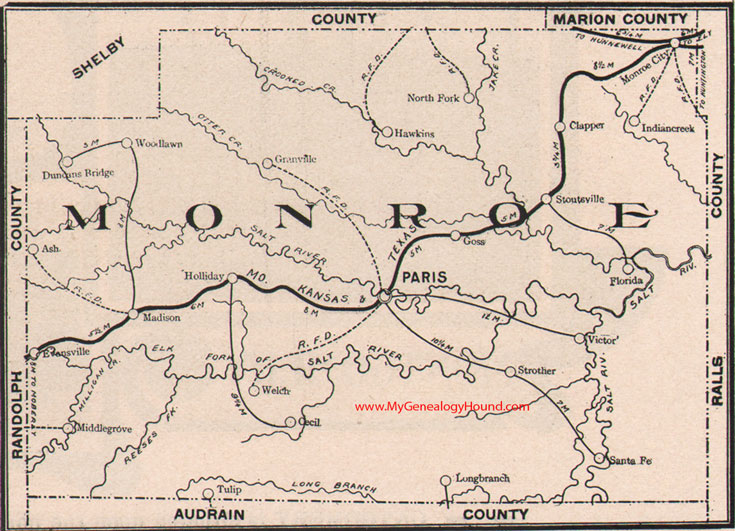
In the 1840's Barnaby owned land near an area called Old Clinton and Jonesburg.
The town was renamed North Fork and is shown at the top of this 1904 map.
http://www.mygenealogyhound.com/maps/missouri-maps/mo-monroe-county-missouri-1904-map.html
Schalene Dagutis of Tangled Roots and Trees has initiated a new genealogy project: The Slave Name Roll Project.  It provides a way for genealogists to trace their enslaved ancestors during a time when very little documentation of these people existed.  By digitzing and recording information about ancestors who owned slaves, others can help piece together their ancestor's lost stories.

Barnabas Worland (also called Barnaby) was born on January 5, 1777 in Maryland.  From there he migrated with his brother Thomas to Kentucky, settling in the Lexington area.  Sometime after 1828, Barnaby and his family relocated to Monroe County, Missouri.  Barnaby Worland married three times and was the father of 15 children.  His first wife was Theresa Hardy, and they had seven children: Matilda, Stephen, Theodore Sebastian, Vincent, Mary Theresa, Verlinda C., and George.  After Theresa died in 1816, Barnaby married Cecelia Gough and they had three children: John Henry, James Guy, and Mary C.  This second wife lived only ten years after their marriage.  Barnaby's third wife was Catherine Theresa Deerling.  Their children were Cecelia Agnes, Anna Gabriella, Sarah Catherine, Elizabeth Lewellen, and Barniellen (who was born after his death.)

The following is an excerpt from Barnaby's will, dated May 26, 1842, which I found in One Man's Family by Olive Lewis Kolb.

In the name of God, Amen:  I, Barnaby Worland of Monroe County and state of Missouri, being of sound mind and perfect memory have made this my last will and testament in manner and form viz:

After my just debts and funeral expenses shall have been paid, I give and bequeath to my beloved wife, Catherine Worland, the whole of the land I purchased of James and George Gough and the land I afterward purchased of James Gough, containing three hundred and thirty acres during her life time with an exception herein contained.  This farm shall be for her home and a residence for my unmarried daughters free of charge as long as they may live with her.  I also give to my beloved wife all my slaves viz -- Britt, Granville, Maria and her three children, Henry, George and William, together with every species of my personal property consisting of stock, agricultural implements, house hold and kitchen furniture together with all money in hands and all bonds not collected out of the uncollected funds as above appropriated.  I will and direct that my executrix shall invest the sum of two thousand five hundred dollars in Lands for the use and benefit of my two daughters Cecelia and Gabrilla, the title of which land shall be made to them and their children forever.  Furthermore it is my will and desire that my executrix or executor shall as soon as practicale purchase a Negro girl between the age of ten and thirteen years, the title of which girl shall be invested in my wife forever.

My further will is that at the death of my wife and youngest child being of full age my executor shall then proceed to sell all my personal estate; my slaves, and household and kitchen furniture excepted, of every description and divid the proceeds between my daughters Therese Combs, Verlinda Smith and Mary Worland.  As to my slaves at that time I give to my four daughters by my present wife viz - Cecelia - Gabrilla, Sarah Catharine and Lieu Ellen my negro woman Maria, together with her three children and any increase she (Maria) may in future have -- which slave are to be equally divided between my four daughters as before mentioned.  The remainder of the slaves viz -- Britt and Granville shall be equally disposed of as practicable without public sale between John H. Worland, Therese Combs, Verlinda Smith and Mary Worland, to them and their heirs forever.

On June 19, 1842, the day before he died, Barnaby Worland wrote an addition to his will:

Whereas, I, Barnaby Worland, upon reflection deem it proper to make some alterations in my will hereunto annex in manner and form as hereinafter mentioned viz . . . My further will and desire is that in the event of any of my heirs or legatees making any effort to prevent my will taking effect different from my intention every provision to them in my will shall be withdrawn and they shall be cut off with six and one fourth cents each, their interest or portion in this will to be divided among the other legatees. 

Tuesday, March 3, 2015

The Slaves of Abraham Inloes of Fell's Point, Baltimore, Maryland

Fell's Point, Balitmore, Maryland, as it appeared in 1800.
According to his will, Abraham's property faced
Ann Street and reached back halfway to Argyle Alley
Schalene Dagutis of Tangled Roots and Trees has initiated a new genealogy project: The Slave Name Roll Project.  It provides a way for genealogists to trace their enslaved ancestors during a time when very little documentation of these people existed.  By digitizing and recording information about ancestors who owned slaves, others can help piece together their ancestor's lost stories.

For my first contribution to the project, I chose to write about Abraham Inloes, a collateral relative.  I found a transcription of his will in a three-volume family history book about the Inlow/Inloes family, entitled In Old Kentucky, A History of My Forbears.

Born about 1736, Abraham Inloes was the grandson of a Dutch immigrant.  He lived in Fell's Point, Baltimore, Maryland and was one of the first in his family (if not the first) to own slaves.  Fell's Point is the oldest neighborhood in the city of Baltimore.  During and after the Revolutionary War, it became one of the leading harbors in the country. Between 1774 and 1821, over 800 ships were constructed at the Fell's Point shipyards.  In 1835, Frederick Douglass, while still enslaved, worked for a ship builder in Fell's Point.  It was here that he taught himself how to read and write, by copying and memorizing the letters with which the shipyard men labeled boards.

On December 28, 1790, Abraham Inloes died.  He was about 54 years old.  The following is a portion of Abraham's will, dated November 18, 1790.
I give and bequeath unto my Loving Wife [Elizabeth] all my negroes to wit Negro Joshua, Sarah, Thomas, and Ann with their increase to her, her heirs and assigns forever, as it was my Intention to have Manumitted my negroes aforesaid, but by my present Indisposition hinders the same. I have given them to wife to do with them as she pleases, Yet having confidence in her that she will by a sufficient deed of Manumission make them free after my decease, and I look upon them as making no part of my Estate. My Will and desire is that if any of my children hereafter named should or shall hereafter lay any claim to them or any part of their appraisement or by suit or other ways disturb my wife or my Executor or the Slaves themselves in claiming them or any of them or any part of them, then it is my will that such child or children shall take no part in my Estate hereinafter bequeathed unto them and that their part, his or her part so offending shall be divided amongst my other children who obey, and keep my Will.
Further on, Abraham lists his ten children by name: Anthony, Abraham, Elizabeth, Joshua, James, John, Eleanor, Temperance, William, and Margaret.  It seems that in his later years he firmly believed that owning slaves was wrong, since he threatened to disinherit his children if they tried to contest his will.  I don't know what actually happened to Joshua, Sarah, Thomas, and Ann after Abraham Inloes died, but I hope they were given their freedom.

Wednesday, January 14, 2015

52 Ancestors 2015: #2 Arnold Livers, Page of the Backstairs

England Coat of Arms, 1660-1689, used by James II
Image from Wikipedia Creative Commons
Arnold Livers was a devoted partisan of James II, the last Catholic King of England.  When this unfortunate monarch was dethroned through the plottings of his newphew and his son-in-law, William of Orange, Mr. Livers fled to Maryland and became the proprietor of a large estate.  So deep was his attachment to the Stuart-King, that he swore he would name his first child "James."  As the first born proved to be a girl, and the loyal father insisted upon the promised name, the priest who baptized the child latinized the appellation, and hence the singular name "Jacoba."  (Character Glimpses of Most Reverend William Henry Elder, D.D., William Henry Elder, published 1911)

The story of Arnold Livers' escape from England is told in many histories in various forms.  In one version, Arnold's daughter, Jacoba Clementina, was born in England rather than Maryland, and Arnold carried her in his arms as he fled England.

Another tradition states that Arnold took an English wife when he was quite young, perhaps as young as 15 or 16.  When he made his escape from England, he left behind his wife and their two sons.  Years later, after learning that the English wife had died, Arnold married an American woman.  This wife, Hellen Gordon, went to Flanders to retrieve Arnold's two English sons because Arnold was afraid to go himself.

I have also read reports that Arnold escaped with only the clothes on his back, and that those very clothes -- his uniform, buckles, and buttons -- have been preserved and handed down in the family.  If this part of the story is true, I'd really like to see them!

There are so many stories told about my 6th great grandfather; it is difficult to determine which are truth and which are legend.  However, the following is generally accepted as truth.

Arnold Van Leeuwers (anglicized to Livers) was born in 1669 in East Flanders, Belgium.  As a youth, Arnold was a "page of the backstairs" in the royal Stuart household.  The most important duty of the page of the backstairs was to guard access to the royal family's private rooms.  Other duties included serving meals, assisting with dressing, and looking after the bedchamber apartments.

After fleeing England, he arrived in Maryland in 1699, where he became an indentured servant working as a tailor for six years. Arnold was then naturalized in Annapolis, Maryland in 1704.  Once he had earned his freedom, he settled on the Charles River near Upper Marlborough in Prince George's County, Maryland.  Arnold also purchased land in nearby Frederick County, between present day Thurmont and Emmitsburg.

Arnold Livers had three American wives: Hellen Gordon, Mary Ann Drane, and Helena Eleanor.  I am descended from Rachael Livers, who is the daughter of Arnold and Mary Ann Drane.  Rachael, the youngest of Arnold's American children, was born in 1741, when her father was 71 years old.

On June 11, 1751, Arnold Livers died in Prince George's County, Maryland at the age of 81.

Saturday, October 25, 2014

52 Ancestors: #42 Thomas Worland's Wheel Chart

Thomas Worland's Wheel Chart, which includes 75 grandchildren.
I descend from Thomas' son Stephen, then from Stephen's son John.
One of most useful and interesting genealogical treasures I have inherited is a book about the Worland family.  One Man's Family, written by Olive Lewis Kolb with the help of two Worland descendants, is well over 1000 pages long, including maps, biographical sketches, wills, and family pedigrees.  Hidden within its many pages is this wheel chart of Thomas Worland's family. The wheel chart makes it easy to see how often family names are reused.

Thomas Worland was the eldest son of John Worland III and Mary Brady.  He was born June 11, 1774 in Maryland, probably in Prince George's County.  He assumed responsibility very early in life.  His father's will, written just before Thomas' 16th birthday, named him as co-executor with his mother. (One Man's Family by Kolb)

Thomas married nineteen year-old Virlinda Hardy on December 8, 1799 in Emmitsburg, Maryland. Thomas and his wife raised a large family of 13 children, who all reached adulthood.  Barnabas, a younger brother of Thomas, married Virlinda Hardy's sister, Theresa.

Thomas, Barnabas, and most of the Worland family joined with about 60 other Catholic families in a compact to migrate to Kentucky between 1785 and 1807. This migration was inspired by the great poverty being endured in Maryland and the promise of a better life in Kentucky. By 1810, almost all of the Worland known to be living at that time were in Kentucky.  (One Man's Family by Kolb)

Thomas and Barnabas Worland [were] worthy and respectable citizens, always in active and useful occupation. (The History of Pioneer Lexington, Kentucky by Charles R. Staples)  Thomas and his brother Barnabas seem to have been very closely associated until Thomas decided to leave Kentucky in 1828 and begin a new life in Indiana.  They likely never saw each other again, since Barnabas later gathered up his family and permanently settled in Missouri.

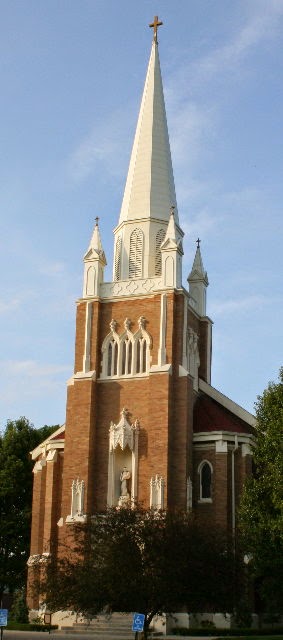
St. Vincent de Paul Catholic Church
Thomas took up his residence in a roughly-hewn log cabin situated near the Little Blue River, one mile east of Shelbyville.  In the fall of 1828, the first Catholic Mass in history of Shelby County, Indiana occured in this house.  At that time, the congregation numbered about 30 members.  On September 6, 1838, a contract was signed to build a church for $619.00 on two acres of land donated by Thomas Worland. The St. Vincent de Paul Catholic Church was built in 1839.

Two of Thomas' daughters, Mary Ann and Eleanor, entered convents. Eleanor became "Sister Mary Saint Paul"; Mary Ann became "Sister Mary Clara."  Sister Mary Clara later wrote a book entitled Lives Of the Saints, where she described the Worland family's influence on Catholicism in Shelby County.

Thomas Worland's youngest daughter, Eulilia, was "feeble-minded." According to Thomas' will, five hundred dollars (in addition to her portion of the estate) was to be set aside after his death for her support.  She only lived nine more years after her father died.

Thomas Worland died July 13, 1850 in Shelby County, Indiana.  He was buried at St. Vincent's Catholic Cemetery, on the land he donated to the church.