Showing posts with label Indianapolis. Show all posts

Saturday, July 18, 2015

Perry Green, a Hoosier Pioneer of Pasadena

Let others stay here and freeze if they wish; I’m going to California.
- Helen Elliott, an original member of the Indiana Colony in 1873[1]

The vibrant city of Pasadena, California, home of the Rose Parade and Caltech, has deep Indiana roots reaching back to the early 1870’s. The brutal winter of 1872-1873 pounded the Midwest with conditions unequaled in recorded history, which left many Indiana residents wishing for a more temperate climate.[2] Moreover, some believed that warmer weather would be beneficial to their health. A group of hopeful families migrated 2,000 miles west to form the quiet farming community that would later become Pasadena. As one of the original Indiana colonists determined to build a new life, Perry M. Green played a vital role in the establishment, growth, and culture of Pasadena, California.

In the spring of 1873, Perry first heard glowing accounts of life in California from a letter that was being passed around a group of his Indianapolis friends.[3] Many of the Hoosiers, including Perry himself, resolved that they would head to California as soon as possible. He joined the company in the hope of improving the health of his ailing wife, Hettie.[4] The small band of investors, calling themselves the “Indiana Colony,” immediately laid out their plans for departure.

However, their endeavors got off to a rocky start when the economy collapsed during the Panic of 1873. Perry Green described the devastating effect the financial depression had on the Indiana Colony:
Alas for the uncertainty of human calculations! The financial crash of 1873 fell upon the country like a clap of thunder from a clear sky, and failure, disaster, and bankruptcy swept like a tidal wave over the land, and the bright hopes of the “California Colony of Indiana” went down into the frightful vortex.[5]
Although they had lost much of their financial backing, Perry Green and those faithful to the cause rallied to form the San Gabriel Orange Grove Association.[6] In essence, their perseverance transformed a dream into reality.


In 1875, the association finally purchased land; Perry Green’s investment secured him 60 acres in the San Gabriel Valley. [7] Before building one of the first homes in the colony, Perry assisted in laying underground irrigation pipes, surveying the land, and planting grape cuttings.[8]  Then, Perry met with other community leaders to discuss a name for the new town. Someone suggested “Pasadena,” a Chippewa word that meant “of the valley.”[9] This name seemed to reflect the character of the beautiful landscape better than all the other proposals.

Many of Pasadena’s original citizens were educated professionals – doctors, lawyers, and journalists – with little to no agricultural experience. One visitor to Pasadena even remarked: “What a highly educated lot of farmers you have out here! Do they all talk so learnedly?”[10] In 1877, the celebrated naturalist, John Muir, wrote a letter which further illustrates this point:
There is nothing more remarkable in the character of the colony than the literary and scientific taste displayed. The conversations of most I have met here is seasoned with a smack of mental ozone, attic salt, which struck me as being rare among the tillers of California soil. People of taste and money in search of a home would do well to prospect the resources of this aristocratic little colony.[11]
Yet Pasadena clearly needed more than scholarly attainment. Those who had even a rudimentary knowledge of agriculture were a huge asset to the community. Perry Green was an educated attorney, but as a boy, he had been employed as a farm hand in rural Indiana.[12] His early familiarity with farming now equipped him to guide his struggling neighbors. Eager to help his fellow farmers succeed, Perry and several others formed a society for the purpose of developing the necessary skills to cultivate fruits such as oranges, figs, and apricots.[13]

The novice farmers soon came to realize that adequate irrigation was the key to their success. As one California pioneer put it: “Water here means gold.”[14] This need resulted in the formation of the Land and Water Company of Pasadena in 1877. Perry Green was on the company’s first board of directors and was selected to fill the position of vice president, a role he continued for 25 years.[15]

Another issue in the early years of Pasadena was the anti-liquor ordinance. In the beginning, the majority of the colony, including Perry Green, was strongly in support of the Temperance Movement, forbidding even the cultivation of certain grapes that could be used in the production of wine.[16] Notably, during the first nine years of the settlement, there was not one single criminal prosecution.[17] However, with the arrival of new settlers who did not share the same sentiments, it became harder to keep the founding principles enforced. In 1888, Perry Green served as chairman of a mass meeting of 1,000 concerned Pasadena citizens. The deliberation resulted in a set of anti-liquor resolutions and an “enforcement committee,” of which Perry was a member.[18]

Perry Green was the driving force in organizing many major financial and business institutions, particularly Pasadena’s first bank. Although he had no previous experience with banking, Perry saw the need for a bank and was willing to contribute his time and money to make the venture succeed. The bank prospered, and by 1886 it received a charter to become the First National Bank of Pasadena.[19] In addition to being the president of the First National Bank, Perry was involved in at least a dozen other civic establishments as a board member, trustee, or treasurer.

In the space of ten years, Pasadena had already outgrown its status as a quaint agrarian community and was well on its way to becoming a bustling city. As a result, it became necessary to create a better form of internal transportation. Perry Green embraced these changes and invested more of his time and money in streetcars and railroads, becoming reasonably wealthy in the process. He became both director and treasurer for the first streetcar company of Pasadena, as well as joining the Los Angeles and Pasadena Railway Company’s board of directors.[20]

With Pasadena’s central transportation system flourishing, Perry turned his attention to a new enterprise that would benefit his city. He had an idea to construct a railway into the Sierra Madre Mountains (now known as the San Gabriel Mountains), allowing adventurous tourists to experience the beauty of the landscape.[21] More importantly for Pasadena, the proposed railway would become a source of revenue. Perry provided some initial funds for the project and commissioned Thaddeus Lowe, a well-known engineer, to oversee the monumental task of building a track up the side of the steep mountain.[22]


On Independence Day 1893, a multitude of spectators attended the unveiling of the Mount Lowe Incline Railway, paying the substantial fee of $5 for a ride to the top of the mountain.[23] The completed railway was an incredible feat of engineering. Perry Green, as vice president of the Pasadena and Mount Wilson Railway Company, gave the opening remarks for the occasion: “The railroad is . . . such a triumph of engineering and construction and skill, as to challenge our unbounded admiration.”[24] Eventually, hotels were built at the top of the mountain, making Pasadena one of the most popular vacation spots of that era. Although the Mount Lowe Incline Railway no longer exists, it ultimately changed the character of Pasadena from an ordinary town into a well-known resort destination.

As an educated man, Perry Green naturally involved himself with the academic sector of Pasadena. The California Institute of Technology (also known as Caltech), was founded in 1891 as Throop Polytechnic Institute, a vocational and preparatory college. Perry Green, part of the initial board of directors, was elected as the institute’s first treasurer.[25] Furthermore, he took a philanthropic interest in the school, as shown in the following remarks made by his Throop colleagues:
Mr. Green has given the best that was in him for the advancement of this school. He yearned to help the young, frequently paying the tuition of deserving students who were unable to meet that expense, and following their career through the school with watchful interest.[26]
Over time, the California Institute of Technology has emerged as one of the most prominent scientific and engineering schools in the country.

Without a doubt, the Rose Parade is [27] The first parades consisted of horse-drawn buggies ornately decorated with locally-grown roses and orange blossoms.  But by the early twentieth century, some merchants who had previously sponsored the parade no longer saw its potential; they decided to withdraw funding that was crucial to the parade’s operation.[28] As treasurer of the Rose Parade committee, Perry appealed to the community for help. A group of supportive citizens responded by donating the needed $13,000.[29] Perry’s timely intervention was pivotal in preserving the city’s unique celebration.  Pasadena’s most iconic tradition. Even so, it is not widely known that the New Year’s celebration was created to boost morale after a financial depression. By showcasing the best of what sunny Pasadena had to offer, Perry Green and other community leaders also hoped to renew interest in investors from the Midwest.

Perry M. Green’s steadfast guidance was truly essential to the formation, progress, and character of Pasadena. He overcame many obstacles to fulfill the vision that he had for his adopted homeland. Through hard work and careful investing, Perry amassed a great amount of wealth, which he generously poured back into his community. Even toward the end of his life, as his health declined, Perry continued to serve his city in countless ways. On the day of his funeral, all of Pasadena’s businesses closed their doors as a tribute to the city’s beloved founder.[30] The beautiful city of Pasadena, California stands as a legacy of Perry Green’s leadership, dedication, and ingenuity.


[1] James H. Madison, “Taking the Country Barefooted: The Indiana Colony in Southern California,” California History, Fall 1990, 237.
[2] Michael Snyder, “Flower Power,” Indianapolis Monthly, Dec 1998, accessed January 15, 2015, 86. https://books.google.com/books?id=Fh0DAAAAMBAJ&printsec=frontcover#v=onepage&q&f=false
[3] R. W. C. Farnsworth, A Southern California Paradise (Pasadena: Farnsworth, 1883), 35. https://books.google.com/books?id=6XcUAAAAYAAJ&printsec=frontcover#v=onepage&q&f=false
[4] James Miller Guinn, Historical and Biographical Record of Southern California, (Chicago, Chapman Publishing Company, 1902), 227. https://books.google.com/booksid=3BU1AQAAMAAJ&printsec=frontcover#v=onepage&q&f=false
[5] Farnsworth, 35.
[6] Guinn, 226.
[7] “Appreciating Pasadena, Garden of the Californian Dream,” Kim Weir, accessed January 19, 2015, http://www.uptheroad.org/appreciating-pasadena-garden-of-the-california-dream
[8] Ann Scheid Lund, Historic Pasadena: An Illustrated History (Pasadena, HPN Books, 1999), accessed January 15, 2015, 20-21. https://books.google.com/books?id=3HLb4SY0uyEC&printsec=frontcover&source=gbs_atb#v=onepage&q&f=false
[9] Snyder, 92.                                                                                                                                       
[10] Lund, 25.
[11] Ibid, 25.
[12] Guinn, 227.
[13] Lund, 25.
[14] Madison, 240.
[15] Guinn, 227.
[16] Farnsworth, 39.
[17] Ibid, 46.
[18] Hiram Alvin Reid, A History of Pasadena, (Pasadena, Pasadena History Company, 1895), 256. https://books.google.com/books?id=uRU1AQAAMAAJ&printsec=frontcover#v=onepage&q&f=false
[19] J. W. Wood, Pasadena, California, Historical and Personal: A Complete History of the Organization of the Indiana Colony, (Wood, 1917), 246. https://books.google.com/booksid=YxQpAAAAYAAJ&printsec=frontcover#v=onepage&q&f=false
[20] Reid, 430, 434.
[21] Michael A. Patris, Mount Lowe Railway, (Arcadia Publishing, 2007), 8. https://books.google.com/books?id=IFEmrlwqgUIC&printsec=frontcover#v=onepage&q&f=false
[22] Ibid, 9.
[23] Ibid, 45.
[24] Reid, 448.
[25] Ibid, 191.
[26] “Honor His Memory – Citizens Pay Tribute To Late P. M. Green,”Los Angeles Herald, March 25, 1903, accessed January 19, 2015.  http://cdnc.ucr.edu/cgi-bin/cdnca=d&d=LAH19030325.1.10&e=-------en--20--1--txt-txIN------#
[27] Snyder, 92.
[28] Lee E. Johnson and C. W. Taylor, Eminent Californians 1953, (Palo Alto, C. W. Taylor Publishing, 1953), 15.
[29] Ibid, 15.
[30] “Last Honors Paid – Funeral of Late P. M. Green,” Los Angeles Herald, March 27, 1903, accessed January 19, 2015. http://cdnc.ucr.edu/cgi-bin/cdnc?a=d&d=LAH19030327.2.140

Thursday, April 16, 2015

52 Ancestors 2015: #15 Mary Green, Early Pasadena Pianist

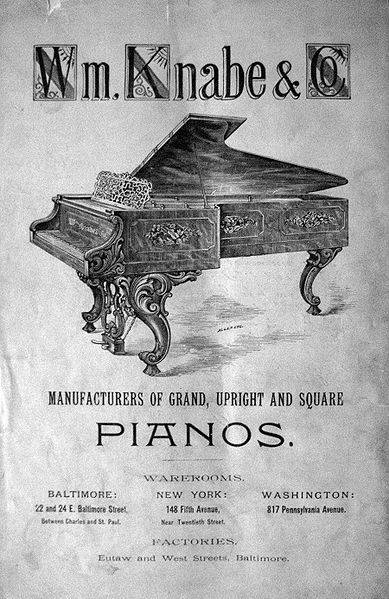
1889 Wm. Knabe & Co. piano advertisement
http://pianoartisans.com/piano-info/piano-history/knabe-piano-company/
What was to be a joyous birthday present from the late P. M. Green to his daughter now comes to her as a sweet but sad memorial to his love. Some months ago, the millionaire ... gave his order for a specially designed Art Grand Piano to be manufactured by the famous old house William Knabe and Co., Baltimore.  Such special work requires months of patient waiting before the finished product is ready for shipment and this order was no exception to the rule... The piano arrived only yesterday, and is now on display at the Pacific Music company's warerooms... Seldom, if ever, has any show window in this city been decorated by such a magnificent specimen of the piano maker's art.  (Los Angeles Herald, 9 Aug 1903) 

The recipient of that piano was Mary Green, my 1st cousin 4 times removed.  She was born in March 1863 in Shelby County, Indiana and was the only child of Perry M. Green and Henrietta "Hettie" Campbell.  Mary's mother had poor health, which influenced the family's decision to seek a better climate. When Mary was 10 years old, she and her parents, aunt, uncle, and cousins joined a migration of Indiana families to southern California. 

Mary was the founder of the Pasadena Symphony Club, which met for the first time at her parents' house on November 5, 1896.  The club's meetings included papers given on composers and musical forms, orchestral and piano rehearsals, and many public performances.  According to several newspaper accounts, Mary was a remarkable musician and a pianist of great technical ability.  (I wish there was a recording of her playing!)  Among the pieces she performed with the Pasadena Symphony Club were:

Dvorak's Symphony No. 5 in E minor "From the New World"
Saint-Sรคens' Dance Macabre "Dance of Death"
Raff's Symphony No. 5 in E Major "Lenore"
Schubert's "Death and the Maiden" 

After Mary's father died in March of 1903, her mother's health also began to decline.  Hettie, who for a while benefited from the climate change, eventually contracted severe bronchitis and passed away in 1908.  Two years later, on July 22, 1910, Mary Green died from heart failure at the age of 47.  She never married and has no descendants.  I wonder what happened to Mary's beautiful piano.  I like to hope that it is preserved in a museum somewhere.

Saturday, February 28, 2015

52 Ancestors 2015: #9 Ada Elizabeth Worland, World-Famous Incubator Baby

Ada Elizabeth Worland, age two.
The Indianapolis News, 24 Jun 1902, p. 3
Little Ada Elizabeth Worland, the 2-year-old daughter of of Edward and Nadia Worland ... enjoys the distinction of being the smallest child who has survived the incubator process.

At birth [she] weighed but one and one half pounds. She now weighs 16 pounds and is 28 inches tall. Her case is considered one of the most remarkable on record.  She was a 6-months child and so frail and delicate that it seemed that the least breath of air would blow her away.  There seemed no possiblility of saving her life.  The twin brother died at birth.
Source: http://www.uh.edu/engines/epi2279.htm

Dr. Conger... conceived the idea of trying the incubator plan.  A soap box was secured and a can containing one and one-half gallons of water was placed at the bottom.  A board was placed on top of the can and this was covered with cotton.  The top of the box was covered with a pane of glass and holes were bored in each end of the box for ventilation.  A sponge was hung inside to keep the atmosphere moist and a thermometer to regulate the temperature was suspended from the roof.

Nourishment was given the child by inunction [rubbing ointment or oil into the skin] and she lived on in spite of everything and grew stronger and stronger.  The water was changed frequently and the temperature kept at 90 degrees.  The incubator, which had been tried simply as an experiment, proved the means of saving the infant's life. (Indianapolis Sun, 31 Dec 1901, p. 5)

Ada Elizabeth Worland was born in Indianapolis on January 26, 1900 at a time when many premature babies did not survive.  Fortunately, Dr. Charles Conger knew something about infant incubation, a treatment that was not yet widely used.  Elizabeth Conger, Dr. Conger's wife, was also a trained medical doctor and assisted with the case.  Ada's parents expressed their gratitude to the Congers by using "Elizabeth" as their daughter's middle name.

By 1902, Ada was thriving.  About this time, however, Edward Worland contracted an illness that lasted for several months, rendering him unable to work.  To provide for the family, Nadia Worland sought employment.

Mrs. Worland is a pretty and gentle little woman, and not afraid to work...  A firm in the city supplied her with a wagon and horse, and she peddled oil about the streets until she had nearly 150 customers. About two weeks ago her husband was able to return to work, and the young woman abandoned her unusual vocation and is once more looking after household affairs.  (The Indianapolis News, 24 Jun 1902, p. 3)

Tragically, Nadia died of typhoid fever at the young age of 25, a few months after the above article was published.  Ada was not yet three years old.  After her struggle to survive, it is sad to think of Ada being deprived of her mother.  I don't know very much about Ada's life after this point -- I hope things got a little easier for her.  She eventually married, had three children of her own, and lived to be 84 years old.

Friday, January 23, 2015

52 Ancestors 2015: #4 Mary Ann Williamson, Who Knitted Her Way To Indianapolis

"Old Woman Knitting a Sock" by Ivan Khrutsky
Source: Wikimedia Commons
Polly [as Mary Ann was also called] decided to go to Indianapolis to trade one day.  So she climbed on her little mule with her knitting.  She rode and she rode and she knitted and she knitted.  Finally, she met a soldier and asked, "How much farther is Indianapolis?"  He answered, "You passed through Indianapolis two miles back!!"

I found this humorous story in One Man's Family, written by Olive Lewis Kolb.  The tale is attributed to Mary Ann's son, Stephen Theodore Worland.

Mary Ann Williamson was born on October 20, 1811 in Kentucky.  (My 4th great grandmother and I share a birthday and a fondness for knitting!)  I don't have any information about her parents. According to Kolb, she may have been an adopted child.

On March 4, 1833, Mary Ann married Stephen Dominic Worland in Marion County, Indiana.  Stephen came from a Catholic family with deep roots in the history of early Maryland.  By 1840, the Worlands had settled in Shelby County, Indiana.  Mary Ann was the mother of 12 children, the oldest of which was my 3rd great grandfather, John William Worland.  Sadly, Mary Ann's three youngest children did not live past infancy.

Sometime between 1859-1860, the Worlands moved to Millwood, Missouri.  At the outbreak of the Civil War, Missouri was divided on the issue of slavery.  By 1863, conditions there were tumultuous and unstable. The Worlands decided to move back to Indiana.  Tilson Vincent Worland, Mary Ann's grandson, recounted the Worland family's return to Indiana from Missouri:

I have heard my father, Stephen Theodore, tell of the trip back to Indiana.  The womenfolk returned by train, but grandfather [Stephen Dominic Worland] and his six sons drove through bringing six horses. They ferried the Missouri and Mississippi Rivers and followed the old National Trail from St. Louis through Terre Haute, Indiana, to Indianapolis.  It took a week to travel from St. Louis to Terre Haute and they never saw the sun all week.  They had a dog, and after reaching Indiana ... the dog disappeared and several weeks later showed up at the old Missouri home.  How the dog crossed the Mississippi and Missouri Rivers on his return home is still a mystery.   (One Man's Family by Olive Lewis Kolb, pages 1044-1045.)

In 1879, two of Mary Ann's children, 43 year-old Sarah Ann Oefelein and 35 year-old George Tilson Worland, died within the space of two months.  I wonder if there was an epidemic of some kind in Shelby County, Indiana at that time.

Mary Ann Williamson Worland died on December 23, 1894 at the home of her son Stephen and was buried next to her husband at St. Vincent de Paul Catholic Cemetery in Waldron, Shelby County, Indiana.

Monday, November 3, 2014

52 Ancestors: #44 Isaac Inlow, Undone by His Son

Taken from In Old Kentucky, a History of My Forbears
My 4th great-grandfather, Isaac Inlow, came from a large family.  His parents, James Inlow and Mary Wilson, had 15 children; Isaac was the 14th child.  In 1840, Isaac married Lucinda Bell in Fleming County, Kentucky.  Isaac, his wife, and their five children moved to Manilla, Rush County, Indiana about 10 years later.

Isaac was a respected farmer and a man of tireless energy; he was numbered among the wealthy and influential citizens of Rush County.  He helped to found the Christian Church at Manilla and remained a faithful member there throughout his life.  Isaac was also a member of the Knights of Pythias.  At two different times, he was tendered a nomination to the legislature of the Democratic party, but Isaac chose instead to live a quiet life in his Rush County home.

However, Isaac's second son, John William Inlow, was his undoing.  John was a man with big ideas... and a spendthrift. He had great visions of doubling his father's assets.  John invested a great deal of his father's money in real estate in Indianapolis.  According to the Indianapolis Journal, on March 14, 1871, John purchased a lot for $2,300. (That's roughly equivalent to $45,000 today!)   Then, his scheme backfired, and John lost his father's money. Isaac was forced to to sell the Manilla farm in 1879.  John ended up as a floorwalker at the New York Store (aka Pettis Dry Goods Co.) in Indianapolis, a position he held for many years.

After he lost his farm, Isaac and his wife moved 50 miles away to Alexandria, Indiana, where his oldest son, James Elliott Inlow, was practicing as a doctor.  When James relocated to Hancock County, Isaac and Lucinda returned to Manilla.  In 1894, Lucinda Inlow died.  At the time of her death, she was completely blind.  It then fell upon the youngest son, George Jefferson Inlow, to care for his elderly father.  George worked as both a carpenter and a druggist in Manilla.  Isaac Inlow died at George's home, at the age of 89, from a stroke.

(Much of the biographical information in this blogpost comes from the book In Old Kentucky, a History of My Forbears, Book 3 by William DePrez Inlow, published in 1950.)