Showing posts with label Arlington. Show all posts

Tuesday, April 7, 2015

52 Ancestors 2015: #12 and #13 The Twin Doctors Green

Left to right: William F. Green, Mr. Davis, Mr. Parrish, Thomas G. Green.
On the back of the picture is written "Davis and Parrish, from Illinois." 
This photograph of four young medical students was taken by Sally E. Garrity at her Louisville, Kentucky studio sometime between 1886 and 1889.  Miss Garrity was one of the first female photographers to achieve recognition and success. Often she photographed as many as 150 people a day, while also overseeing the development of every picture herself.  I've always been intrigued by this picture because of the strange way the men are positioned.  While researching Sally Garrity, I found that many of her pictures are charaterized by unusual poses. 

William Frame Green and Thomas Gary Green were identical twins, born on April 6, 1865 in Arlington, Rush County, Indiana.  Their father, James Wilkinson Green, was a doctor; four of their older brothers were doctors as well, including James C. Green and John D. Green.  William and Thomas graduated together from Louisville Medical College in Kentucky in 1889.  

For 10 years William and Thomas both practiced medicine in Shelbyville, Indiana, then William moved his practice to Indianapolis and eventually to Cambridge City, Indiana.  Thomas stayed in Shelbyville until he died in 1929 at the age of 63.  William died in 1931 in Cambridge City.

Both William and Thomas were interested in their family history. William wrote a history of his family that was used for SAR and DAR applications.  I have a letter that Thomas wrote to his fifteen-year-old nephew, James Cyrus Green (my great-grandfather), containing stories about the early Greens in America.  The following is a quote from the letter: "I have looked up the family history for you and will write you a brief copy, which if you will keep may be useful and valuable to you sometime."

Monday, March 16, 2015

52 Ancestors 2015: #10 A Tragic Accident at the Indiana Republican Convention

Dr. James C. Green, son Hugh, and wife Azzie, c. 1892
James C. Green was born March 10, 1860, in Arlington, Rush County, Indiana.  The son of Dr. James Wilkinson Green and Mary Jane Gowdy, he was the seventh of 13 siblings.  Six of those siblings became doctors, including James and his brother, John D. Green (my great great grandfather.)  James attended courses at the newly-formed Medical College of Indiana, which was a department of Butler University. Following his graduation in 1880, James began his practice as a physician alongside his father in Arlington.

On October 23, 1883, James was married to Azzie E. Winship, a young woman from Rushville, Indiana. The couple had two children -- an infant daughter who died in 1885 and a son, Hugh Clifford Green, born on December 31, 1886.

In 1892, James C. Green was chosen to be a delegate to the Indiana Republican convention.  The convention, which was held on June 28 at the Princess Rink in Fort Wayne, lasted for only one day. The event drew such a large crowd that officials threatened to clear the hall to make room for all the delegates waiting to get inside.  In the chaos, James was pushed against a door knob and critically wounded.  Sadly, he died from his injuries a few weeks later.

The Indianapolis Journal, July 17, 1892

Wednesday, December 31, 2014

52 Ancestors: #52 Fanny Gowdy and an American Romance in Paris

 Fanny Alice Gowdy
The Saint Paul Globe, 1903
Back of the prosaic announcement that Robert E. Mansfield, Consul at Valapariso, Chile, has petitioned his department at Washington for a transfer to France ... is an interesting little romance.  Consul Mansfield is in love.  And the object of his affection is ... Miss Fanny Gowdy, daughter of the United States Consul General in Paris.  

What is more, Miss Gowdy is also in love -- with Mr. Mansfield. And here Uncle Sam, after allowing them to be together for a long time, has separated them almost as far as he possibly could.  No wonder Mr. Mansfield wants to get back to France, and Miss Gowdy is anxious that he should be there.  ("Four New American Romances," The Saint Paul Globe, Saint Paul, Minnesota, 6 Dec 1903, page 30.)

The courtship of Fanny Gowdy and Robert Mansfield was a favorite topic in the gossip columns of many newspapers across the country and abroad.  It is not surprising; they were both young, attractive, and accomplished.

Fanny Alice Gowdy was born on March 6, 1870, in Arlington, Rush County, Indiana, to John K. Gowdy and Eve Eliza Gordon.   She was raised as an only child, since her brother died two weeks after she was born. In 1887, 17-year-old Fanny graduated from Rushville High School as valedictorian of her class with special honors in elocution and literature.  She went on to study literature, art, and linguistics at DePauw University in Greencastle, Indiana.
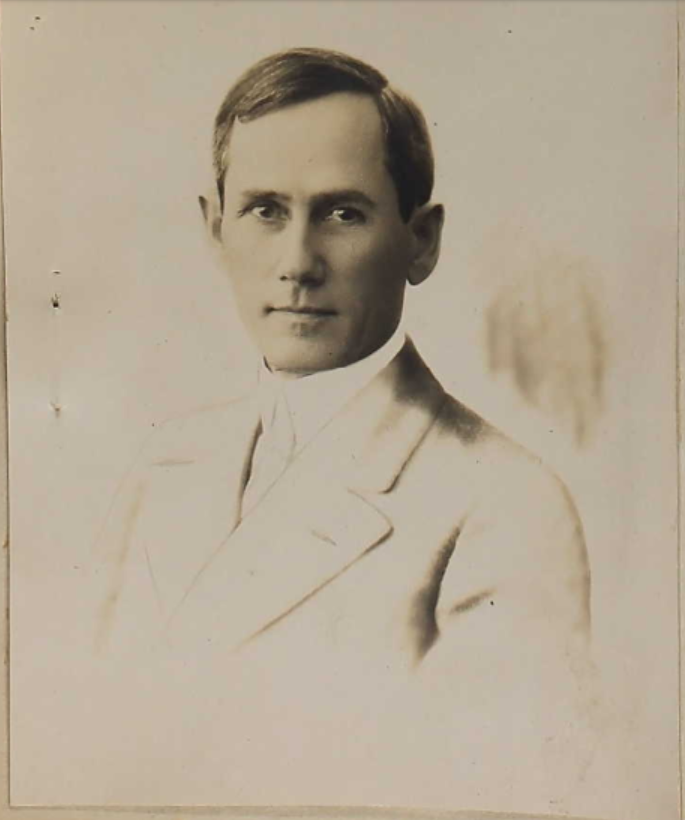
Robert Emmett Mansfield
Passport photo from Ancestry.com
Fanny Gowdy and Robert Mansfield first met in Rush County, Indiana. Robert was a journalist in Muncie and often visited her father on business. When John K. Gowdy accepted the post of Consul General to Paris, his wife and daughter accompanied him to France.  Naturally, Robert was delighted to receive the position of Gowdy's personal secretary.

However, Mansfield was soon called away to Valparaiso, Chile, on a political assignment. The consular position in Chile was a highly sought-after office, but Mr. Mansfield was determined not to stay longer than necessary.  He soon petitioned for a transfer.

With so many thousand miles of territory between the young people their happiness could not be complete and therefore Mr. Mansfield can certainly be pardoned for his anxiety to effect a transfer to Calais, which is within easy reach of Paris.  The members of the Indiana delegation, who have hearts as big as the side of a hill, certainly will do whatever is in their power to help Mr. Mansfield, who is popular with them.  (New Castle Daily Press, New Castle, Indiana, 24 Oct 1903, page 1.)

Fanny Gowdy, age 28, and her mother in Paris
Mr. Mansfield was not the only one who thought well of Miss Gowdy.  At one time, there were rumors that Fanny was to marry a French count. It was clear that Europeans and Americans alike admired her elegance and charming manners, and she quickly became a leading lady of Parisian society.

Several newspapers credit Fanny Gowdy with the establishment of a popular literary salon.  This is regarded as a wonderful achievement by the Europeans, who understand the great importance of these gatherings [are] ostensibly social, but also frequently political. ("Four New American Romances", The Saint Paul Globe, Saint Paul, Minnesota, 6 Dec 1903, page 30.)

In 1900, Tennessee artist Willie Betty Newman, who was living in Paris, painted a remarkable portrait of Fanny Gowdy.  "Portrait of Miss Gowdy" was heralded as one of the best portraits of the year and received an honorable mention at the 1900 Paris Salon.

"Portrait of Miss Gowdy" by Willie Betty Newman
The painting was again displayed in 2002 as part of an exhibit of Newman's pieces at the Parthenon in Tennessee.  A review of the recent exhibit describes the century-old portrait: Newman captures Fanny -- a lithe, Gwyneth Paltrow-style beauty -- as she lounges on a divan with a vase of white flowers at her elbow.  ("An Artist Reclaimed" by Angela Wibking, 14 Feb 2002)

Another publication mentions the painting's "exquisite color arrangement."  I would love to see the original color palette of the portrait; unfortunately, I have only found it reproduced in black and white. I'm not exactly sure where the painting is now, but it may be in storage at the Smithsonian. Perhaps it will be displayed again some day so I can see it in person!

Early in 1906, Fanny and Robert officially announced their engagement, putting an end to the constant rumors generated by newspapers throughout America and Europe.  Soon after, Consul Mansfield started his voyage home from Chile.  Then he ran into trouble.  On January 31, 1906, an earthquake, measuring 8.8 on the Richter scale, resulted in destructive tidal waves off the coasts of Ecuador and Colombia.
Washington Times, 14 Mar 1906 
Although Mr. Mansfield wasn't harmed in the disaster, the delay in his journey caused much anxiety for his family and friends.

San Fransisco Call. 12 Jul 1903
Robert and Fanny were married the 17th of April, 1906. If you were expecting to hear a grand account of an extravagant wedding ceremony, I'm sorry to disappoint you.   The popular couple chose to have a small, quiet ceremony at the Gowdy's home in Rushville.  They did not even make the wedding time known to their friends -- I suspect they were tired of being in the spotlight.  Apart from the immediate family, only two guests attended; Fanny's elderly aunt, Mary Jane Green, and Mrs. Posey, a neighbor.

In June of 1906, the Mansfields moved to Lucerne, Switzerland, where Robert served as consul.  After four years abroad, the couple returned home to Indiana for good.  During her lifetime, Fanny visited or resided in many countries including France, Switzerland, Germany, Italy, Holland, Belgium, Sweden, Denmark, and Canada.

Robert died at Methodist Hospital in Indianapolis on September 18, 1925 after a long illness.  Fanny died at the age of 67 in her hometown of Rushville on March 23, 1937.  The Mansfields never had any children, so there are no descendants.  Although I am only distantly related to Fanny (she is my 1st cousin 4 times removed), I felt compelled to recount her fascinating life.

Tuesday, December 16, 2014

52 Ancestors: #50 John Kennedy Gowdy and the Search for John Paul Jones

Consul General John Kennedy Gowdy
John Paul Jones was the founder of the American Navy, a prolific and eloquent writer, and a fluent speaker of several languages. Perhaps the most well-known aspect of his posterity was his reply to a demand for surrender: "I have not yet begun to fight."  

However, when the celebrated admiral died in Paris in 1792, his burial was poorly recorded and his funeral was attended by few. For 113 years, America's first naval hero lay in an unmarked tomb in France.  One of the chief detectives in the search for his burial place was my third great grand-uncle, John Kennedy Gowdy.

John K. Gowdy was born in the small town of Arlington, Rush County, Indiana on August 23, 1843 to Adam McConnell Gowdy and Nancy Oliver.  The Gowdy family migrated from Rush County to Jasper County in 1848. When Adam Gowdy died at the young age of 48, John became responsible for the farm.  He divided his time by working on the farm during the summer and returning to Arlington each November, where he lodged with his sister Mary Jane and attended the local school.

At the age of 18, John K. Gowdy joined the Fifth Indiana Volunteer Cavalry.  He helped pursue and capture General John Hunt Morgan, the only Confederate leader to pass through Indiana. Gowdy served under General Ambrose Burnside in the winter of 1863-64 and under General William Tecumseh Sherman during the Georgia campaign.  After the war, Captain John K. Gowdy became an active member of the Grand Army of the Republic.

On January 24, 1867, John married Eve Eliza Gordon in Rush County, Indiana.  The Gowdys had three children, but only one, Fanny Alice, survived past childhood.  Their two year-old son, Latta Theodore, died two weeks after his sister Fanny was born, on March 24, 1870.  Between the years of 1887 and 1888, John K. Gowdy built a fine brick house in Rushville, Indiana. His former residence is now home to the Rush County Historical Society and is listed on the National Register of Historic Places of Rush County.

John K. Gowdy's house.
Gowdy was twice elected sheriff of Rush County (the youngest in the history of the county at the time.) From 1890 to 1897, he served as chairman of the Indiana Republican State committee.  In recognition of his services to the party, he was appointed by President William McKinley as consul-general to Paris on March 20, 1897.  The news of his position was reported in many papers throughout the country, including this California publication:  He will take with him to France, his wife and charming daughter.  Mr. Gowdy has no knowledge of the French language, but thinks he can manage it.  (Sacramento Daily Union, Vol. 93, No. 51, 13 Apr 1897.)  Consul-General Gowdy also took his horses to France.  The horses, "Rush" and "Brooks," were bred and trained in Rush County, Indiana. While in Paris, the horses were involved in an unfortunate incident:

John K. Gowdy at far right, wife Eve and daughter Fanny in coach.
Chaffeur Stephen Hordsbath and the Rush County horses.
Paris, France, 1898.
[M]iscreants broke into the private stable of United States Consul Gowdy in Paris and cut off the manes and tails of the American-bred horses that he had taken over from Rush Co., Indiana ...  It is assumed that this action was designed as a hint to Mr. Gowdy that he should do in Paris as the Parisians do, and drive bang-tailed horses.  It is an outrage and the severest punishment should be visited on the perpetrators if they can be discovered.  (The Breeder's Gazette, Vol. 34, 1898.)

Nearly two years after Gowdy began his service in France, he wrote a letter urging for an investigation to locate the remains of John Paul Jones:

To Representative Charles B. Landis, January 2, 1899, Paris, France.

It does seem strange that we have not identified ourselves in gratitude to him who fought our battles at sea in our struggle for independence and who was the first to secure our recognition as a Republic.  His achievement of glorious deeds commends itself to the gratitude of the country.  Every thoughtful American citizen can not but feel the deepest regret that we have shown no interest in his resting place.  The graves of other heroes of the Revolution have been marked, and honor paid.  John Paul Jones' love of liberty and devotion to the United States Government, and its principles, were the strongest passions of his life.  Besides fighting our battles, he identified himself in many ways with our Government, that in the past century should have called forth, as for other heroes of the Revolution, the praise and admiration of a grateful people.
                                                                                                               John K. Gowdy 

John Paul Jones Monument, Washington, D.C.
The quest began in June of 1899.  Two search teams were formed, one headed by U.S. Ambassador Horace Porter, and the other directed by John K. Gowdy. Although Consul-General Gowdy later wrote that the two worked in "perfect harmony", it seems that there was a spirited competition between the two teams.  The exhaustive search was concluded on April 14, 1905, when Porter's men discovered the coffin shortly before Gowdy's team arrived at the spot.  On January 26, 1913, the remains of John Paul Jones were at last re-interred at the Naval Academy Chapel at Annapolis, Maryland.

According to a transcript of an unidentified American newspaper, Captain John K. Gowdy ... never received the credit that [was] due him for his part in the search for the body of John Paul Jones.  On his own initiative and at considerable personal expense, Gowdy, while consul-general at Paris, employed a searching party and directed its operations.  John K. Gowdy later said that he did not have any hard feelings that the Ambassador received full credit for the discovery.

Consul-General Gowdy was also instrumental in the purchasing the right to build the Panama Canal. As recognition for his extensive services to France, John K. Gowdy was awarded the Legion of Honor, the highest decoration in France, on September 30, 1905.

John K. Gowdy died at his Rushville home on June 25, 1918, at the age of 74.  On the day of his funeral, flags were lowered to half-mast and many local businesses were closed.  Scores of telegrams from old political friends were received by his family.  John K. Gowdy is buried at Arlington East Hill Cemetery in his birthplace of Arlington, Indiana.

Thursday, December 4, 2014

52 Ancestors: #49 Nancy Oliver, Who Waited 3 Years for Groceries

My 4th great-grandmother, Nancy Oliver, was born in Bourbon County, Kentucky on the first of June 1807 to John Oliver and his wife Jane Hill.  Sometime around 1821, the Oliver family moved to Rush County, Indiana.

At the age of 22, Nancy married Adam McConnell Gowdy, a blacksmith who was two years her junior. The couple had two daughters, named Mary Jane and Martha Ann, then three sons, Lewis Oliver, John Kennedy, and Adam Thomas.

General Store, shared under creative commons license on Flickr.
https://www.flickr.com/photos/jalan68/14769865418/in/photostream/
Nancy's husband died in 1857; their youngest son, Adam Thomas Gowdy, died two years afterwards at the age of ten. Three of the Gowdy children (Mary, Martha, and Lewis) were married by this time, which only left one son, John Kennedy Gowdy, at home to look after his widowed mother.  The two lived on a farm in Rensselaer, Indiana.

[John] was living with his mother near Jasper [Indiana] when the war broke out.  He was 17 years old.  His mother sent him one day to a grocery two miles distant for soap, molasses, and a broom.  He found an excited group about the store discussing war news, and there was a recruiting officer in the town seeking volunteers. Young Gowdy promptly enlisted without consulting his mother, knowing she would object. Three years later, he came marching home again in a blue suit, with an honorable discharge in his pocket and the title of captain stuck to his name, enough to make any patriotic mother forgive anything or everything and be proud all the rest of her days. [But] he brought more.  He stopped at the grocery and bought the supplies his mother sent for three years before.  His first words on reaching home were: "Here, mother, are the soap, molasses, and broom you told me to get."  (The Literary Digest, Vol. 15, No. 2, pg. 59)

This same son was twice elected sheriff of Rush County.  John Kennedy Gowdy later became a famous Hoosier politician and served as Consul General to Paris during the William McKinley administration.  He received the Legion of Honor for his great service to France.

In her later years, Nancy Gowdy lived with her daughter Mary's family in Arlington, Indiana.  She died there at the age of 75 on September 3, 1882 and is buried at Arlington East Hill Cemetery in Rush County, Indiana.

Thursday, May 1, 2014

52 Ancestors: #17 Mary Jane Gowdy and the Mysterious Oil Painting

Mary Jane Gowdy Green, 1876
English artist Edwin Farrer painted this now faded portrait of my 3rd great-grandmother, Mary Jane Gowdy.  For years, my family did not know who the subject of the portrait was, except that she was a relation of my grandfather's.  I discovered that the artist immigrated from England to Rush County, Indiana in 1870.  The portrait was dated 1876.  Trying to find out who the woman was, I reviewed the records on my grandpa's family in Rush County, and Mary Jane was the only one that fit.

Mary Jane was born on July 18, 1830.  She was the eldest child of Adam McConnell Gowdy, a blacksmith from Ohio, and Nancy Oliver of Kentucky.  Her brother, John Kennedy Gowdy, was the consul-general to Paris during the McKinley Administration.  Mary Jane had two other brothers, Lewis Oliver and Adam Thomas, and a sister, Martha Ann.

The Green residence, Arlington, 1988
On May 18, 1846, Mary Jane married the physician James Wilkinson Green in Rush County.  According to several sources for her birthdate, she was not yet sixteen when they were married.  She and James became the parents of thirteen children.  Out of nine sons, six of them became doctors, including my great-grandfather, John D. Green.  The Green family lived on a farm in Arlington, Rush County, Indiana.  In 1886, Mary Jane's brother-in-law, a physician in nearby Shelbyville, died and left his medical practice to his brother James.  They left Arlington behind and relocated to Shelbyville.

"Mrs. Green is what might be termed an extraordinary woman; she has raised a large family and is one of the best of wives, mothers, and companions; her home has always been noted for its generous hospitality." (Illustrated Historical Atlas of Rush County, Indiana, 1879.)

Mary Jane died on September 20, 1907.


Monday, April 21, 2014

52 Ancestors: #14 John D. Green, M. D.

John D. Green
John D. Green was born in Arlington, Indiana on January 9, 1864.  He was the ninth child of Dr. James Wilkinson Green and Mary Jane Gowdy.  His parents did not give him a middle name, so he later assumed the middle initial D.  I guess his parents ran out of naming ideas after nine children, although they later had four more children (with middle names.)

John married Lavanche Emarine Trees, a native of Rush County, in Manilla, Indiana on August 2, 1893.  Shortly after he and Lavanche were married, his father-in-law, Cyrus Trees, asked why he had not become a doctor like his five brothers.  John was working as a telegrapher on the B & O Railroad at the time.  He replied to his father-in-law that he guessed his father had run out of money and could not send him to medical school.  Cyrus said he would send him and did so.

The residence of Dr. Green at Manilla


John left Rush County, Indiana and went to school at Louisville Medical College in Kentucky while my great-grandfather, James Cyrus Green, was just a baby. When the family first lived in Louisville, Little James Cyrus had to sleep in a dresser drawer set across two straight back chairs as a makeshift crib.  John graduated in 1896, then moved back home to Rush County to begin his practice.

John D. and Lavanche Green


Two more children were added to the family: Mary Catherine (1896), and Maurice Thomas (1903).  Mary died from the measles a month before her sixth birthday in 1902; she never met her brother Maurice.  Maurice struggled with asthma all his life and also died relatively young at the age of 26, from tuberculosis.

Dr. Green built up a large medical practice in Rush and Shelby Counties and also became involved in several fraternities and lodges.

After returning home one day from a house call, the doctor went outside to feed the chickens.  His wife found him in the yard, unable to get up.  He lost consciousness and died of a stroke the next morning, February 26, 1921. He was 57. 

Monday, February 24, 2014

52 Ancestors: #3 James Wilkinson Green, Country Doctor

James Wilkinson Green, M.D.
My grandfather recounted the following story about James Wilkinson Green, his great grandfather. 

Late one evening during the Civil War, Dr. Green was returning from his home making house calls.  He was on horseback.  As he approached the town of Arlington, Indiana from the south, he had to pass through a clearing adjacent to the banks of the Little Blue River. As he came closer, he observed a bonfire with many people gathered around.  No greeting came from the group, and the Doctor silently rode through the assembly.

Dr. Green recognized nearly every face he could see.  Not a word passed between them, and it was then that the realization came to him that he had chanced upon a meeting of Rush County's southern sympathizers, The Knights of the Golden Circle.

It was years later that Dr. Green told this story to his family.  There were never any problems created by his discovery of the group, but after that night the country doctor always carried a pistol with him until the war's end.

James Wilkinson Green was born February 5 1825 in Rush County, Indiana, to Squire Lot Green and Anna Cooper.  He was the eldest of eight children.  He and his younger brother, William Frame Green, attended Rush Medical College in Illinois.  He also studied at the Indiana Fifth Dist. Medical Institute, where he graduated in 1846.  James began his medical practice the same year in Arlington, Indiana.  On May 18, 1846, he married Mary Jane Gowdy.  Together they had 13 children; ten survived to adulthood.

The family lived on a farm in Posey Township, Arlington, Indiana.


From 1856 to 1886, he practiced medicine in Arlington, Indiana.  Dr. Green enjoyed a wide acquaintance in his community and over the 50 years in his practice he had delivered nearly all the babies in the area.  While the country doctor did not serve in the Civil War, a biography made notice of his care of the wives, widows, and children of the Union soldiers. "During the four years of the late war, the Doctor was more than a father to many families in his neighborhood; never in one instance did he make a charge for professional service against those who were from home defending our country's cause." (From a biographical sketch in the Illustrated Historical Atlas of Rush County, Indiana, 1879.) 

Six of Dr. Green's sons became doctors themselves: Lot, Preston, James, John, and William and Thomas, who were twins.  They all practiced medicine in Indiana.  Some of James Wilkinson Green's grandsons also continued the family tradition and became doctors.

Dr. J. W. Green in front of his Shelbyville, Indiana office.

After the death of his brother William in 1886, James relocated to Shelbyville and took over his brother's practice.

He died on July 27, 1896 in Shelbyville.  His death certificate, which was completed by his son William, states that he died of "physical exhaustion." He is buried at East Hill Cemetery in Rushville, Indiana.