Showing posts with label Trees. Show all posts

Wednesday, June 14, 2017

Jacob B. Mull, Whiskey Merchant of Manilla

Jacob B. Mull (1803-1861), taken, c. 1860
From In Old Kentucky: The Story Of My
Forbears by William DePrez Inlow
My 5th great-grandfather, Jacob Mull, was born on July 12, 1803 in Loudoun County, Virginia.  Jacob was the fourth of seven children of George Washington Mull, a veteran of the War of 1812, and his wife Mary Katherine Long. Well before the Revolutionary War, Jacob's German grandfather, David Muhle, came to America as an indentured servant at the age of nine.  David Mull (he later adopted the Scottish spelling of his surname despite being German) married a woman named Eva Margaret Boothe.  Margaret outlived her husband by seven years, and possibly ran a distillery. Interestingly, this association with liquor sale was a source of income in her grandson Jacob's life as well. Margaret died in 1801, two years before Jacob was born.

At the age of ten Jacob moved with his parents to Warren County, Ohio.  There Jacob married Margaret Richinson, a New Jersey native of Scotch descent, around 1823.  Their first daughter, Catherine (my 4th great grandmother), was born in Ohio the following year.  But Jacob Mull moved yet again, coming to Rush County, Indiana in the spring of 1826. (Centennial History of Rush County by Abraham Lincoln Gary, 1888). Two of Jacob's brothers, twins Frederick Mull and George Mull Jr., also immigrated to Rush County around the same time.  Sometime during 1835, Jacob sold his stock of goods with the intent of farming, but gave it up the following year and returned to being a merchant.

After arriving in Rush County, the Mulls had three more children: George (in 1827), Cyrus (1829), and Mary Ann (1831).  Catherine and Mary Ann both grew up to marry doctors, and their homes, two of the most prominent brick houses in Manilla, were next door to each other. Sadly, their brother George died of an unknown cause before reaching the age of eight.  In 1847, a school for higher learning was established in Farmington, near Rushville; Jacob Mull's youngest son Cyrus was notably one of the first two students enrolled.  (Sketches of Rush County, pg. 25)  The school took place in a rented tavern.  Cyrus Mull later assumed full management of a farm that adjoined his father's in Rush County.

The Rushville Jacksonian, 5 Oct 1859
The town of Manilla, originally named Wilmington, was organized on January 4, 1836. Jacob Mull was one of the four settlers who founded the town, the others being Elias Murphy, Jonathan Murphy, and J. Edward.  He was the first merchant in the town, and kept his store in a small house.

During this time, whiskey was heavily marketed as a beverage for medicinal benefit, rather than as a hard liquor.  Jacob branded himself as a whiskey merchant, specializing in such medicinal concotions as "Ayer's Cherry Pectoral." Essentially, this cherry pectoral was a cough medicine that merely treated symptoms, but was not effective in curing advanced diseases like consumption, as advertised.  Ayer's recipe for his patent medicine, incidentally, included 3 grams of morphine, along with other herbal ingredients.

Jacob Mull, along with his son Cyrus and son-in-law James W. Trees, operated a mercantile venture in Manilla called J. & C. Mull and Trees.  As a prominent businessman in the small community, Jacob was elected to several municipal positions and was an early philanthropist to the town.  He donated $18,000 for the first railroad to pass through Rushville, Indiana, finally emerging in 1857 as the Sandusky, Indiana, and Louisville Railroad.  Jacob died in 1861 at the age of 57, leaving a wife, three children, and seven grandchildren.  The Centennial History of Rush County refers to Jacob Mull as a Manilla pioneer "to whose enterprise and public spirit does that town owe much."

Wednesday, April 8, 2015

52 Ancestors 2015: #14 Little Napoleon

James Cyrus Green, c. 1898
H. S. Stephens, Rushville, Indiana
This is my great-grandfather when he was about four years old.  I wonder how he felt about wearing this outfit.  The enormous bow tie and the tall button boots must have been very uncomfortable for him, but perhaps it made him feel special to be all dressed up.  The riding crop and bicorne hat seem unusual to me -- maybe they are props from the photographer.  I think they make him look like a little Napoleon Bonaparte.

James Cyrus Green (called Cyrus) was born on September 12, 1894 in Arlington, Indiana.  His parents were John D. Green, M.D. and Lavanche Emarine Trees.  He had two younger siblings, a sister named Mary Catherine and a brother named Maurice Thomas.  As a young man, Cyrus attended Sewanee Military Academy in Tennessee.  On June 12, 1916, Cyrus married Mary Ida Sefton in Greensburg, Indiana.  He died June 25, 1964 in Rushville, Indiana.

Tuesday, November 25, 2014

52 Ancestors: #47 James Whitlow Trees, Still a Democrat

Portrait taken from 1888 History of Rush County
J. W. Trees, of Manilla, was in town today on his way to Indianapolis.  He is still a democrat.  (Columbus Daily Herald; Columbus, Indiana; 5 Apr 1892)

I was amused when I ran across this article about my 4th great grandfather, and I can only guess at what the writer was implying.  A biographical sketch of James W. Trees also mentions that "he was ever a democrat." (History of Rush County, Part II)  It seems that he readily expressed his political views.

James Whitlow Trees was born March 21, 1818 in Clermont County, Ohio.  Adam Trees and Mary Ann Hill were his parents.  His middle name came from his Irish grandmother, Elizabeth Jane Whitlow.  James migrated with his family to Rush County, Indiana on March 27, 1823.

At the age of 20, James decided to pursue a career of medicine.  He went to the small town of Milroy, Indiana and studied under Dr. Samuel Barbour, who was one of the earliest physicians of Rush County.  While he underwent medical training, he also was a clerk at a dry goods store. James received his physician's license from the Indiana Medical Institute in May of 1841.  A few months later, James set up his own medical practice in Manilla, Indiana.

He married Catherine Mull on September 18, 1842 in Rush County, Indiana.  The couple had six children together, but only three sons lived to adulthood: Ethan Allen, Leander Mull, and Cyrus Ebon.  The three youngest children -- Lavanche, Maggie, and Marshall -- all died at a young age.

Around 1852, James W. Trees entered into a mercantile partnership with Jacob and Cyrus Mull, his father-in-law and brother-in-law.  According to William DePrez Inlow, author of In Old Kentucky, "It was common at the time for physicians to engage in business in addition to their profession."

By 1864, Dr. Trees had sold his medical practice to his son-in-law, Dr. J. J. Inlow, and was operating his own dry goods store in Manilla. "By strict attention to his profession, he amassed a goodly fortune.  He and his two sons, Ethan A. and Cyrus E., were of the staunchest business men in the county." (The History of Rush County, Part II)  According to the Indianapolis Journal, the store was robbed in 1875; the burglars got away with $500.

An early map of the town of Manilla, Indiana.  The land Dr. Trees owned is highlighted. 
In 1872, the small town of Manilla received state-wide attention when James W. Trees discovered several fossilized bones of a mastodon on the farm of his neighbor, A. J. Westerfield. (You can see the farm in the map shown above.)  The Indianapolis Journal reported that the fossils "were in a remarkable state of preservation."

The residence of Dr. James W. Trees in Manilla, Indiana.
On April 25, 1895, a Shelbyville newspaper stated that James W. Trees was dangerously ill. He died a short while later, on May 4, 1895, and was buried at Forest Hill Cemetery in Shelbyville, Indiana.

Recently, I made an interesting discovery.  There is a subdivision in Manilla, Indiana named after James W. Trees!  Looks like I need to make a trip to Manilla so I can see his house (shown at right) and his subdivision!  {Update:} I visited the Trees house in Manilla on July 5, 2015 with my family.  The current owners told us that when they renovated the building, they found an underground passageway that connected the house to the doctor's office across the street.  One of the front rooms in the house was fitted out for a funeral parlor.  When a patient died, the body was discreetly brought into the house via the tunnel.

July 5, 2015.  My brother and I in front of James W. Trees' house in Manilla, Indiana.
SaveSave

Thursday, October 30, 2014

52 Ancestors: #43 Mary Ann Hill, Born on the Atlantic Ocean

Mary Ann Hill was born aboard a ship on passage from Ireland to America on June 6, 1790.  This is confirmed by 1880 census reports from four of her children.  Her birth at sea is also mentioned in a biographical sketch of her son, James Whitlow Trees. (The sketch is from the History of Rush County, Part II.)

Like many Irish immigrants of that period, Mary Ann's parents, John Hill and Elizabeth Jane Whitlow, came from Ulster.  John Hill was a weaver in trade.

After the Hills arrived in America, they located somewhere in Pennsylvania.  I don't know exactly when they left that state, but Mary Ann spent most of her early years in Bracken County, Kentucky.

In 1811, Mary Ann married another first-generation American, John Adam Trees, in Clermont County, Ohio.  After spending well over 10 years in Clermont County, Adam and Mary Ann decided to move to Indiana.  For 10 days, they traveled over almost impassable roads, crossing the White and Miami Rivers. Their youngest child, John Kell Trees, was barely two months old at the time. The family arrived in Richland Township, Rush County, Indiana on March 27, 1823. The Trees raised ten children, who all lived to adulthood.

Mary Ann Trees died on July 23, 1863 in Shelby County, Indiana, less than a year after the death of her husband.  She was 73 years old.  Her father, John Hill, outlived her by a few years.

Saturday, September 13, 2014

52 Ancestors: #32, Catherine Mull and Her Sister

Mary Ann
Catherine
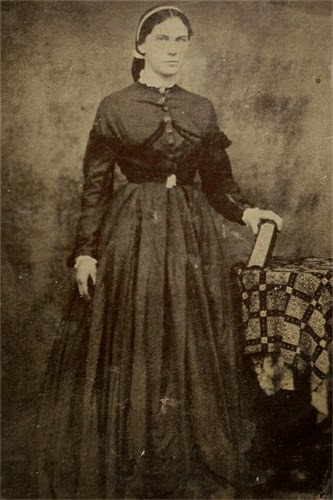
My four times great- grandmother, Catherine Mull, and her sister, Mary Ann, "were about as close as it was possible for sisters to be."  Living as next-door neighbors, they were together daily.  Often they could be seen walking together, attired in "elegant dresses, long and full, with many petticoats, with spring bonnets bedecked with flowers tied under their chins, holding their skirts on one side."


Catherine and Mary Ann's father, Jacob Mull, was a pioneer of the town of Manilla and a whisky merchant.  Their mother was a stern-faced Scot named Margaret Richinson.  Catherine was the eldest of four, being born in 1824; Mary Ann was the youngest child, born in 1831.  They had two brothers, Cyrus and George.  

On September 18, 1842, Catherine married a Manilla doctor, James W. Trees.  Mary Ann followed suit in 1853 and was also wedded to a physician, John James Inlow.  Doctors J. W. Trees and J. J. Inlow even practiced medicine together for a short time.  James and Catherine had six children: Ethan Allen, Leander Mull, Cyrus Ebon, Lavanche, Margaret, and Marshall.

The sisters lived in very similar houses; in fact, one was a copy of the other.  In about 1858, Jacob Mull built his house in Manilla, "which though not the largest house to be ever constructed in Manilla, was nevertheless at the time the best, and architecturally speaking, the most distinctive. Soon after they were married, Mary Ann and her husband, Dr. J. J. Inlow, built their house next to Jacob's house. They were obviously similar, however, it was built in wood instead of brick. Doubtless, the young couple could not afford to spend the sum that the father could.  When Jacob Mull died in 1861, his home became the residence of his daughter Catherine, and her husband, Dr. J. W. Trees.  From that point on, the two sisters lived side by side in the most prominent location in the town."

Dr. Trees' residence, where Catherine lived.
Dr. Inlow's residence, where Mary Ann lived.
Catherine and Mary Ann "spent a lot of their time conversing with the neighbors and with people who came into town to see the doctor. [Catherine], for instance, if while sweeping out her front room she should see someone with whom she wanted to speak would throw up the window and call, stopping her work and leave it for the maid to finish."

Catherine died on November 5, 1884 in Manilla; Mary Ann died in 1902.

All quotations and pictures are from the book In Old Kenucky, a History of My Forbears by William DePrez Inlow.

Thursday, July 31, 2014

52 Ancestors: #24 Cyrus Ebon Trees, Once the Wealthiest Man in Rush County

Cyrus Trees' birthplace in Manilla, Indiana.  The house was built by his grandfather, Jacob Mull, who was one of the founders of Manilla.  (Photo was taken from the book, In Old Kentucky, a History of My Forbears, written by William DePrez Inlow.)

My great-great-great grandfather Cyrus Ebon Trees was born August 4, 1848 in Rush County, Indiana, the third son of James Whitlow Trees and Catherine Mull.  His father was a physician for a short while, but later became a dry goods merchant.  He received a common education in nearby schools and went on to attend Northwestern University in Illinois.

Cyrus Trees was married to Annie Inlow in Manilla, Indiana on May 4, 1869. They had only one child, Lavanche.  But when their daughter was only six years old, Annie suddenly died of an unknown illness.  Cyrus remained a widower for nearly two years, then he remarried in 1877.  His second wife, Charlotte Macy, was just eleven years older than his young daughter.  Cyrus and Lottie had two children, Lee and Mary Catherine.

Shelbyville Democrat published May 21, 1881
In his early career, Cyrus was unusually prosperous, always thinking of ways to expand and progress. Associated with his father in the grain business,  he built a name for himself and also helped to make Manilla one of the best grain markets in Indiana.  By 1883, he was running his grain elevator night and day.  Cyrus was also a merchant in both the livestock and the lumber trades.  I'm sure his lumber company (Trees and Mohler) used his befitting last name to drum up business.

In addition to all of these business ventures, Cyrus Trees was actively involved in politics.    One Shelbyville, Indiana newspaper described "Cy" as "a red hot Democrat."  He held his beliefs firmly and was slow to change his views.

In the 1880's, Cyrus engaged in land investments in Kansas, and encouraged everyone he knew to do the same.  He became the vice president and director of the Kiowa Land Investment Company.  And if all this wasn't enough,  Cyrus started something completely new; he organized the First Manilla Bank in 1895.  Eventually, the strain of all this responsibility caused serious repercussions and robbed him of his sanity and health.

Land investors in Haskell County, Kansas.
The beginning of his troubles started in the late 1890's.  Cyrus had invested largely in land ($80,000 to be exact) in Haskell County, Kansas.  It appeared to be a great success. New settlers were enticed by the glowing accounts and came in throngs with hopes of becoming successful ranchers.  But with the influx of settlers and the breaking of sod, it soon became apparent that the range would be spoiled.  Adding to the rancher's problems were the discouraging prices and the long drive to market.

Although Haskell County had enjoyed a boom in the 1880's, it suffered an even larger bust in the 90's.  The county's population plummeted, and Cyrus' investments were gone.  When he received the news that the whole enterprise had collapsed, Cyrus underwent a nervous breakdown.  In September of 1899, Cyrus, now seriously ill, was admitted to a sanitarium in Martinsville, Indiana.

The Indianapolis Journal published February 10, 1901
On Christmas Day, 1900, Cyrus Trees was declared of unsound mind and was committed to a private sanitarium in Indianapolis.   The Manilla bank had to be closed for six weeks until someone could take it over.  A relative, John Blessing, was chosen as guardian for the unfortunate ex-banker.  To pay off Cyrus' debts, which amounted to $66,000,  Blessing sold his ward's land in several counties and also sold the Manilla bank.

However, not all of the debts were paid off.  Dr. John D. Green, son-in-law of Cyrus, filed a complaint against Blessing, asking $8,000 for services rendered as a physician to Cyrus and his family.  The doctor stated that, in 1897, his father-in-law had become so ill that he required someone to look after him constantly.  Cyrus proposed that his son-in-law might abandon his practice as a general physician and devote his entire time and attention to himself and his wife and daughter, promising to pay him what his services were reasonably worth.  Dr. Green agreed to the plan, but was not reimbursed.  Cyrus, now a resident of the Richmond Insane Asylum, was powerless to pay him.  A settlement was reached, and the doctor accepted payment of $3,500.

In 1901, Cyrus was transferred for the third time to a sanitarium in Oxford Ohio, his last residence.  He died in the asylum on February 18, 1902, at the age of 53.

"Cy was one of those warm hearted, generous, whole souled persons whom it is always a pleasure to meet, of a most sociable disposition, honest and faithful to his friends.   He was enterprising, shrewd, and progressive.  In his death his family is called upon to mourn the loss of a kind hearted and affectionate husband and companion." (From his obituary in the Shelbyville Democrat)


Tuesday, April 29, 2014

52 Ancestors: The Family Jewels (Supplement to #15 and #16)

Hester Florence Latham (1878-1951)

Hester's topaz necklace was given to my mom by my grandmother before I was born.  My mom put it away in her jewelry box for many years, although she did wear it on one occasion.

I remember looking through my mom's jewelry when I was a little girl and trying the necklace on.  I even found some clip on topaz earrings that I wore together with the necklace.


Lavanche Emarine Trees  (1870-1960)


A few years ago, my parents and I were helping my grandfather sort through his things.  We discovered many treasures, including old coins from the Philippines. (My grandpa was there during WWII.)

When my grandpa pulled out a topaz bracelet that belonged to his grandmother, Lavanche, my mom thought it looked familiar to her. She brought out Hester's necklace. We were all amazed at how closely they matched!


What a coincidence that my maternal great-great grandmother and my paternal great-great grandmother had the exact same taste in jewelry!

52 Ancestors: #16 Lavanche Emarine Trees, A Very Unusual Name

Lavanche (H. S. Stephens Studio, Rushville, Ind.)
I have always thought that my great great-grandmother, Lavanche Emarine Trees, had a very unusual name.  I believe she was named after her aunt Lavanche, who only lived for four years.  The name Emarine came from her great-grandmother, who was probably of English descent.  The Trees surname was an anglicized form of Driess, a German name.

Lavanche was born March 26, 1870 in Manilla, Indiana. Her father was Cyrus Ebon Trees, a very wealthy businessman from Manilla.  Her mother, Annie Elizabeth Inlow, a native of Fleming County, Kentucky, died when Lavanche was only six years old.  A year later, her father married again.  Lavanche's new stepmother was a young woman named Lottie Macy; there were eleven years of age difference between them.  Lavanche's half siblings, Lee Mull and Mary Catherine, were born in 1881 and 1884.

On August 2, 1893, Lavanche married John D. Green in her hometown of Manilla.  The couple had three children: James Cyrus, Mary Catherine, and Maurice Thomas.

When John and Lavanche were newly married, her father offered to send John to medical school in Louisville, Kentucky.  He graduated in 1896 and started his practice in Rush County. Lavanche completed two years of college herself and was a practical nurse, according to the 1940 census. She often was a hostess to her husband's patients.  Lavanche liked to crochet, knit, and sew.  She made a crazy quilt in 1899, which is still in the family.  I also have a topaz bracelet that belonged to her.

Tragedy came to the household when John and Lavanche's daughter Mary died from the measles before the age of six.  The youngest son, Maurice, had severe asthma.  Lavanche travelled with him to a hot springs resort in the south in the hope of improving his health.  He was only 26 years old when he died of tuberculosis, leaving behind a young widow.

After her husband died in 1921, Lavanche moved to Oxford, Ohio, to work as a housekeeper for an elderly couple.  In 1941, her daughter-in-law died, so she came back to Indiana to help take care of her grandson (my grandpa).

My grandpa wrote these words about her:  "She was a grand lady, yet not afraid of hard work; and she was a good businesswoman.  I had a terrible time accepting the loss of my mother.  Grandma's faith, strength, and example of self-reliance gave me purpose.  I grew to appreciate her love and what she was doing for me."

Lavanche died on November 11, 1960 in Greensburg, Indiana at the age of 90.

Monday, April 21, 2014

52 Ancestors: #14 John D. Green, M. D.

John D. Green
John D. Green was born in Arlington, Indiana on January 9, 1864.  He was the ninth child of Dr. James Wilkinson Green and Mary Jane Gowdy.  His parents did not give him a middle name, so he later assumed the middle initial D.  I guess his parents ran out of naming ideas after nine children, although they later had four more children (with middle names.)

John married Lavanche Emarine Trees, a native of Rush County, in Manilla, Indiana on August 2, 1893.  Shortly after he and Lavanche were married, his father-in-law, Cyrus Trees, asked why he had not become a doctor like his five brothers.  John was working as a telegrapher on the B & O Railroad at the time.  He replied to his father-in-law that he guessed his father had run out of money and could not send him to medical school.  Cyrus said he would send him and did so.

The residence of Dr. Green at Manilla


John left Rush County, Indiana and went to school at Louisville Medical College in Kentucky while my great-grandfather, James Cyrus Green, was just a baby. When the family first lived in Louisville, Little James Cyrus had to sleep in a dresser drawer set across two straight back chairs as a makeshift crib.  John graduated in 1896, then moved back home to Rush County to begin his practice.

John D. and Lavanche Green


Two more children were added to the family: Mary Catherine (1896), and Maurice Thomas (1903).  Mary died from the measles a month before her sixth birthday in 1902; she never met her brother Maurice.  Maurice struggled with asthma all his life and also died relatively young at the age of 26, from tuberculosis.

Dr. Green built up a large medical practice in Rush and Shelby Counties and also became involved in several fraternities and lodges.

After returning home one day from a house call, the doctor went outside to feed the chickens.  His wife found him in the yard, unable to get up.  He lost consciousness and died of a stroke the next morning, February 26, 1921. He was 57. 

Sunday, April 13, 2014

52 Ancestors: #12 Annie Elizabeth Inlow's Tintype

Annie Inlow Trees, Tintype c. 1869
I feel incredibly lucky to have this old tintype of my 3rd great grandmother.  The picture is an unusual size for the time period; 4x6".  The tintype had been cut down and glued into a scrapbook. A yellowed piece of paper, penned by her daughter, attached to the tintype reads "My Mother, Annie E. Inlow Trees."
 
Annie Elizabeth Inlow was born June 21, 1849 in Fleming County, Kentucky, to parents Isaac Inlow and Lucinda Bell.  She was the only daughter of a family of four boys. One sister, Mary Emarine, died young.  Her family had moved to Rush County, Indiana by 1860.

On May 4, 1869, at the age of 19, Annie married Cyrus Ebon Trees, a very successful business man from Manilla, Indiana.  They had one daughter, Lavanche Emarine Trees.  I assume Lavanche was named for her two aunts who died young, Lavanche Trees (Cyrus' sister) and Mary Emarine Inlow (Annie's sister).

Annie died January 8, 1876, in Manilla, Rush County, Indiana.  She was just 26 and left behind her six year old daughter.  I don't know how she died; Rush County didn't start to keep death records until 1882.

She was buried at Forest Hill Cemetery in Shelbyville, Indiana.

Friday, March 21, 2014

52 Ancestors: #8 Little Mary Catherine Green


Mary Catherine Green, Age: 3 yrs.
Three year-old Mary Catherine Green received a gift from her mother on Christmas Day of 1899.  It was Lewis Carroll's Alice In Wonderland. The light green cover had gilded lettering and dark green vines mingling with red berries. 

Book inscription
Lavanche, Mary's mother, wrote an inscription on the front page of the book.  Underneath her message, a child copied the word "Xmas."  Perhaps it was little Mary who did it.

Mary Catherine Green was born on July 18, 1896 in Rush County, Indiana. She was probably named after her aunt, Mary Catherine Trees.  Mary had one older brother, James Cyrus (my great grandfather).   Her family lived in a big brick house in Manilla, Rush County, Indiana.  On June 15, 1902, Mary died from the measles, just one month before her sixth birthday.  It must have been devastating for her father, who was a doctor.


Mary and her brother, James Cyrus Green.  Don't you love her dress?
 
Mary's Alice In Wonderland

Several years ago, my grandpa gave Mary's book to me.  A note was written by my grandpa and tucked inside Mary's book:  

 Mary C. Green was "little Mary," daughter of John D. and Lavanche E. Green.  She died when she was about six years of age.  She would have been my Aunt.

I recently read Mary's book.  Many of the pages have scribbles in the margins, and some are torn.  Maybe it wasn't the best idea to use such a tattered copy, but I enjoyed reading it.  I wonder if Mary Catherine liked her Christmas present.