Tuesday, November 25, 2014

52 Ancestors: #47 James Whitlow Trees, Still a Democrat

Portrait taken from 1888 History of Rush County
J. W. Trees, of Manilla, was in town today on his way to Indianapolis.  He is still a democrat.  (Columbus Daily Herald; Columbus, Indiana; 5 Apr 1892)

I was amused when I ran across this article about my 4th great grandfather, and I can only guess at what the writer was implying.  A biographical sketch of James W. Trees also mentions that "he was ever a democrat." (History of Rush County, Part II)  It seems that he readily expressed his political views.

James Whitlow Trees was born March 21, 1818 in Clermont County, Ohio.  Adam Trees and Mary Ann Hill were his parents.  His middle name came from his Irish grandmother, Elizabeth Jane Whitlow.  James migrated with his family to Rush County, Indiana on March 27, 1823.

At the age of 20, James decided to pursue a career of medicine.  He went to the small town of Milroy, Indiana and studied under Dr. Samuel Barbour, who was one of the earliest physicians of Rush County.  While he underwent medical training, he also was a clerk at a dry goods store. James received his physician's license from the Indiana Medical Institute in May of 1841.  A few months later, James set up his own medical practice in Manilla, Indiana.

He married Catherine Mull on September 18, 1842 in Rush County, Indiana.  The couple had six children together, but only three sons lived to adulthood: Ethan Allen, Leander Mull, and Cyrus Ebon.  The three youngest children -- Lavanche, Maggie, and Marshall -- all died at a young age.

Around 1852, James W. Trees entered into a mercantile partnership with Jacob and Cyrus Mull, his father-in-law and brother-in-law.  According to William DePrez Inlow, author of In Old Kentucky, "It was common at the time for physicians to engage in business in addition to their profession."

By 1864, Dr. Trees had sold his medical practice to his son-in-law, Dr. J. J. Inlow, and was operating his own dry goods store in Manilla. "By strict attention to his profession, he amassed a goodly fortune.  He and his two sons, Ethan A. and Cyrus E., were of the staunchest business men in the county." (The History of Rush County, Part II)  According to the Indianapolis Journal, the store was robbed in 1875; the burglars got away with $500.

An early map of the town of Manilla, Indiana.  The land Dr. Trees owned is highlighted. 
In 1872, the small town of Manilla received state-wide attention when James W. Trees discovered several fossilized bones of a mastodon on the farm of his neighbor, A. J. Westerfield. (You can see the farm in the map shown above.)  The Indianapolis Journal reported that the fossils "were in a remarkable state of preservation."

The residence of Dr. James W. Trees in Manilla, Indiana.
On April 25, 1895, a Shelbyville newspaper stated that James W. Trees was dangerously ill. He died a short while later, on May 4, 1895, and was buried at Forest Hill Cemetery in Shelbyville, Indiana.

Recently, I made an interesting discovery.  There is a subdivision in Manilla, Indiana named after James W. Trees!  Looks like I need to make a trip to Manilla so I can see his house (shown at right) and his subdivision!  {Update:} I visited the Trees house in Manilla on July 5, 2015 with my family.  The current owners told us that when they renovated the building, they found an underground passageway that connected the house to the doctor's office across the street.  One of the front rooms in the house was fitted out for a funeral parlor.  When a patient died, the body was discreetly brought into the house via the tunnel.

July 5, 2015.  My brother and I in front of James W. Trees' house in Manilla, Indiana.
SaveSave

Thursday, November 20, 2014

52 Ancestors: #46 Malachi Cooper, 13 Year-Old Patriot

My fifth great-grandfather, Malachi Cooper, was barely 13 years old when he enlisted for service under General Nathanael Greene (who is also a relation of mine) in Guilford County, North Carolina.
Malachi was born on the 14th of April, 1762 in Pasquotank, North Carolina, to David Cooper and his wife Elizabeth Wilder.  Both Malachi and his father served in the War for Independence. Some Cooper descendants claim that the Battle of Cowpens was fought near David Cooper's plantation in Spartanburg, South Carolina.

"Battle of Guilford Courthouse" from Wikipedia
On March 15, 1781, Malachi fought at the Battle of Guilford Court House, a pivotal battle in the Revolutionary War's Southern Campaign. After two hours of intense fighting between General Nathanael Greene's forces and the British troops under Lord Cornwallis' command, Greene withdrew his weary soldiers.  His retreat preserved the strength of his army, while Cornwallis' frail victory cost him over a quarter of his men.  Cornwallis was later heard to say about the battle: I never saw such fighting since God made me.  The Americans fought like demons.

Although I don't know of any other battles he participated in, Malachi served in the militia for six more years.  At the close of the war, Malachi was still a young man of 20 years.  He made his way to Edenton, North Carolina, and there he married 17 year-old Anna Wilkinson.  The couple had a total of 12 children; all except one lived to reach adulthood.  Their eighth child, Anna Cooper Green, was my fourth great-grandmother.

Around 1795, Malachi, his wife, and their small children migrated to the new state of Kentucky. Malachi's younger brother Edward and his bride Susanna traveled with them.  According to a family history written by Clyde Toland, the Cooper clan made the journey by pack train, crossed Daniel Boone's Wilderness Trail, and settled in the foothills beyond Cumberland Gap.  Malachi and Edward are described as "a pair of tall, silent brothers."

Malachi Cooper served on the first grand jury in Pulaski County, Kentucky in 1797.  The jury returned indictments for retailing liquor without license, profanity, and gambling.  When the jury retired to consider their verdicts, they were compelled to go outside since there was no room to meet inside.

In 1806, Malachi was granted 135 acres of land on Fishing Creek.  As an ordained Baptist minister, Malachi Cooper established the Old Fishing Creek Church in Pulaski County and ministered there for many years. Two of his sons, Levi and James Cooper, also became Baptist ministers.

After the death of his wife in 1820, Malachi began to disperse his land holdings in Pulaski County. Records of these transactions are found in Pulaski County deed books.  In 1825, he "sold" 100 acres to his son Milton Cooper for $1 "in consideration of love and natural affection he entertains for his son."  However, two years later Malachi sold 235 acres of land to his son Asa, for $700.  (Pulaski County, Kentucky Deed Books)  I wonder why he practically gave land to Milton, but expected Asa to pay a substantial amount.

This is the only known signature of Malachi Cooper, an endorsement on a 1782 currency certificate.
Malachi's name has been spelled a number of ways: "Malleki" in his father's will, "Malikiah" in D.A.R. records, "Malikah" as a member of the Pulaski County grand jury, "Malekiaha" in probate records of his son Asa's estate, and finally as "Malicha" in a family history written by his grandson James Wilkinson Cooper.  Malachi himself signed his name as "Malicha." Perhaps this is how he spelled and pronounced it. However, he may have copied someone else's writing, since he signed other documents with his mark. I've decided to use the common Biblical spelling of "Malachi."

Malachi Cooper's monument erected by the DAR
Photo taken by James Arnold of the Daniel Guthrie Chapter SAR in June of 2006.
Malachi Cooper was living at the home of his grandson, Dr. Stanley Cooper, in Rush County, Indiana when he passed away in the fall of 1843.  (A few sources say he died in February of 1845.)

In the summer of 1978, a local DAR chapter erected a monument for Malachi and held a dedication ceremony at Pleasant Run Cemetery in New Salem, Rush County, Indiana. Unfortunately, his first and last name have been reversed on the plaque.  I have a copy of some correspondence that discusses the error. Some effort has been made to correct the mistake, but nothing has been done yet.  More than 30 years have passed since the plaque was installed, and I would really like for it to finally be corrected.  Malachi Cooper should be honored with an accurate monument.

Thursday, November 13, 2014

52 Ancestors: #45 Maria Dent, Who Lost a Very Important Paper

Maria Bird, age 82, upon her oath declares that she was granted a pension under the Act of March 9,1878 as the widow of William Bird, who was a Private in Capt. Robert's Co. of Ky Militia, War of 1812. And that in June 1883, she lost her pension certificate in some way, she does not know just how, whether it has been misplaced or lost in some way.  She has made diligent search for the same and has been unable to find the same.  She asks that she be given a new certificate in lieu of the one lost. (War of 1812 Pension and Bounty Land Warrant Application Files, 11 Sept 1883)

At the time Maria appeared in court, she was living with her son Edward's family, which included eight children. (That might explain how something could be lost.)  I assume she was given a new certificate, since "certificate on file" was scribbled on the statement recorded by the notary public.

Maria Dent, my fourth great-grandmother, was born on November 7, 1801 in Stafford County, Virginia.
According to her obituary, she became an orphan at the age of three.  Her father was lost at sea; her mother died soon after. She came to Kentucky in 1811 with her uncle, James Smith.  The only information I have about her uncle is that he was listed as a bondsman on her marriage license.

Maria married William Bird on November 7, 1822 in Nicholas County, Kentucky on her 21st birthday. The couple soon settled in Decatur County, Indiana, where they raised nine children.  She lived there the rest of her life.  In January of 1888, Maria slipped on some ice and broke her leg.  She never recovered from the accident and died on the 27th of January.  She had outlived her husband and four of her children.

There was none more kind as a neighbor, more devoted as a wife, more loving as a mother, and more dearer as a grandmother than she.  In the days of her widowhood, her every aim and interest was centered in her children and her grandchildren.  Very few visits did she make to any of them that she did not leave some token of remembrance, or some deep kindness done by her dear old hands, to tell them that her presence had been there. (Excerpt from Maria's obituary in the Saturday Review, Greensburg, Indiana, 14 Feb 1888)

Monday, November 3, 2014

52 Ancestors: #44 Isaac Inlow, Undone by His Son

Taken from In Old Kentucky, a History of My Forbears
My 4th great-grandfather, Isaac Inlow, came from a large family.  His parents, James Inlow and Mary Wilson, had 15 children; Isaac was the 14th child.  In 1840, Isaac married Lucinda Bell in Fleming County, Kentucky.  Isaac, his wife, and their five children moved to Manilla, Rush County, Indiana about 10 years later.

Isaac was a respected farmer and a man of tireless energy; he was numbered among the wealthy and influential citizens of Rush County.  He helped to found the Christian Church at Manilla and remained a faithful member there throughout his life.  Isaac was also a member of the Knights of Pythias.  At two different times, he was tendered a nomination to the legislature of the Democratic party, but Isaac chose instead to live a quiet life in his Rush County home.

However, Isaac's second son, John William Inlow, was his undoing.  John was a man with big ideas... and a spendthrift. He had great visions of doubling his father's assets.  John invested a great deal of his father's money in real estate in Indianapolis.  According to the Indianapolis Journal, on March 14, 1871, John purchased a lot for $2,300. (That's roughly equivalent to $45,000 today!)   Then, his scheme backfired, and John lost his father's money. Isaac was forced to to sell the Manilla farm in 1879.  John ended up as a floorwalker at the New York Store (aka Pettis Dry Goods Co.) in Indianapolis, a position he held for many years.

After he lost his farm, Isaac and his wife moved 50 miles away to Alexandria, Indiana, where his oldest son, James Elliott Inlow, was practicing as a doctor.  When James relocated to Hancock County, Isaac and Lucinda returned to Manilla.  In 1894, Lucinda Inlow died.  At the time of her death, she was completely blind.  It then fell upon the youngest son, George Jefferson Inlow, to care for his elderly father.  George worked as both a carpenter and a druggist in Manilla.  Isaac Inlow died at George's home, at the age of 89, from a stroke.

(Much of the biographical information in this blogpost comes from the book In Old Kentucky, a History of My Forbears, Book 3 by William DePrez Inlow, published in 1950.)

Thursday, October 30, 2014

52 Ancestors: #43 Mary Ann Hill, Born on the Atlantic Ocean

Mary Ann Hill was born aboard a ship on passage from Ireland to America on June 6, 1790.  This is confirmed by 1880 census reports from four of her children.  Her birth at sea is also mentioned in a biographical sketch of her son, James Whitlow Trees. (The sketch is from the History of Rush County, Part II.)

Like many Irish immigrants of that period, Mary Ann's parents, John Hill and Elizabeth Jane Whitlow, came from Ulster.  John Hill was a weaver in trade.

After the Hills arrived in America, they located somewhere in Pennsylvania.  I don't know exactly when they left that state, but Mary Ann spent most of her early years in Bracken County, Kentucky.

In 1811, Mary Ann married another first-generation American, John Adam Trees, in Clermont County, Ohio.  After spending well over 10 years in Clermont County, Adam and Mary Ann decided to move to Indiana.  For 10 days, they traveled over almost impassable roads, crossing the White and Miami Rivers. Their youngest child, John Kell Trees, was barely two months old at the time. The family arrived in Richland Township, Rush County, Indiana on March 27, 1823. The Trees raised ten children, who all lived to adulthood.

Mary Ann Trees died on July 23, 1863 in Shelby County, Indiana, less than a year after the death of her husband.  She was 73 years old.  Her father, John Hill, outlived her by a few years.

Saturday, October 25, 2014

52 Ancestors: #42 Thomas Worland's Wheel Chart

Thomas Worland's Wheel Chart, which includes 75 grandchildren.
I descend from Thomas' son Stephen, then from Stephen's son John.
One of most useful and interesting genealogical treasures I have inherited is a book about the Worland family.  One Man's Family, written by Olive Lewis Kolb with the help of two Worland descendants, is well over 1000 pages long, including maps, biographical sketches, wills, and family pedigrees.  Hidden within its many pages is this wheel chart of Thomas Worland's family. The wheel chart makes it easy to see how often family names are reused.

Thomas Worland was the eldest son of John Worland III and Mary Brady.  He was born June 11, 1774 in Maryland, probably in Prince George's County.  He assumed responsibility very early in life.  His father's will, written just before Thomas' 16th birthday, named him as co-executor with his mother. (One Man's Family by Kolb)

Thomas married nineteen year-old Virlinda Hardy on December 8, 1799 in Emmitsburg, Maryland. Thomas and his wife raised a large family of 13 children, who all reached adulthood.  Barnabas, a younger brother of Thomas, married Virlinda Hardy's sister, Theresa.

Thomas, Barnabas, and most of the Worland family joined with about 60 other Catholic families in a compact to migrate to Kentucky between 1785 and 1807. This migration was inspired by the great poverty being endured in Maryland and the promise of a better life in Kentucky. By 1810, almost all of the Worland known to be living at that time were in Kentucky.  (One Man's Family by Kolb)

Thomas and Barnabas Worland [were] worthy and respectable citizens, always in active and useful occupation. (The History of Pioneer Lexington, Kentucky by Charles R. Staples)  Thomas and his brother Barnabas seem to have been very closely associated until Thomas decided to leave Kentucky in 1828 and begin a new life in Indiana.  They likely never saw each other again, since Barnabas later gathered up his family and permanently settled in Missouri.

St. Vincent de Paul Catholic Church
Thomas took up his residence in a roughly-hewn log cabin situated near the Little Blue River, one mile east of Shelbyville.  In the fall of 1828, the first Catholic Mass in history of Shelby County, Indiana occured in this house.  At that time, the congregation numbered about 30 members.  On September 6, 1838, a contract was signed to build a church for $619.00 on two acres of land donated by Thomas Worland. The St. Vincent de Paul Catholic Church was built in 1839.

Two of Thomas' daughters, Mary Ann and Eleanor, entered convents. Eleanor became "Sister Mary Saint Paul"; Mary Ann became "Sister Mary Clara."  Sister Mary Clara later wrote a book entitled Lives Of the Saints, where she described the Worland family's influence on Catholicism in Shelby County.

Thomas Worland's youngest daughter, Eulilia, was "feeble-minded." According to Thomas' will, five hundred dollars (in addition to her portion of the estate) was to be set aside after his death for her support.  She only lived nine more years after her father died.

Thomas Worland died July 13, 1850 in Shelby County, Indiana.  He was buried at St. Vincent's Catholic Cemetery, on the land he donated to the church.

Thursday, October 23, 2014

52 Ancestors: #41 Jacob Kimmel, Oldest Voter in Kearney, Nebraska

Jacob Kimmel, left, with his daughter Catherine and her family.
Jacob Kimmel of Fourth Ward Votes at 86 Years of Age.

The statement in the Hub Tuesday that Rev. C.R. Ford was probably the oldest voter in the city has brought out the fact that there is at least one voter, who cast his vote on election day, who could boast more years than Mr. Ford.  This is Jacob Kimmel.  Mr. Kimmel is 86 years of age.  He is a carpenter and mill wright by trade and is still able to do some work every day.  The fact that there was a voter 86 years of age in the city was kindly brought to the attention of the Hub by S.M. Forney, and it is probable that there may be some other voters who are as old or older. (The Kearney Daily Hub, published November 8, 1906.)  

My 4th great grandfather, Jacob Kimmel, was born on May 27, 1821 in Canton, Stark County, Ohio. His parents were Samuel Kimmel and Catherine Mory.  On October 9, 1842, Jacob married Nancy Tombaugh. Sometime before 1850, Jacob and Nancy migrated to Richland, Illinois, along with Jacob's brother William and his sister Elizabeth and their families.  Together Jacob and Nancy had at least seven children.  Jacob's wife Nancy and his sister, Elizabeth Shook, were midwives in the area. Nancy died in 1879.  

In 1880, Jacob lived with his newly-married daughter Mary and her husband Noah Michaels. Sometime before 1885, Jacob, his son Lewis, and the Michaels family decided to leave Illinois and and travel over 500 miles to live in Hutchinson, Kansas.  Jacob, Lewis, and Noah were all carpenters and probably worked together.


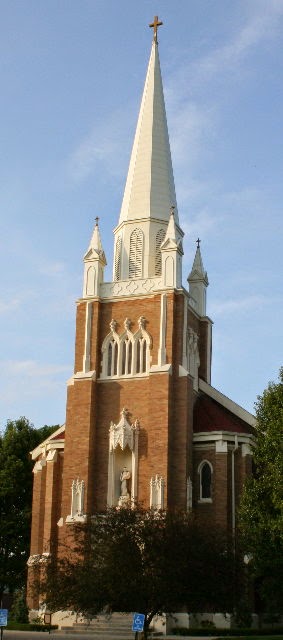
The Wood River Mission Church in Kearney, Nebraska.
In 1896, Jacob Kimmel moved one more time to Kearney Nebraska to join his daughter, Catherine Forney, and her family.  Jacob opened a carpenter shop at the back of Catherine's house.  

Catherine's husband, Samuel Michael Forney, was the minister of the Wood River Mission Church in Kearney, Nebraska, which was affiliated with the Dunkard Brethren.  During a special council on the afternoon of June 26, 1897, the Wood River Church reinstated "Brother Jacob Kimmel."  (I wonder why he had to be reinstated.)  By December 31, 1898, the church had 40 members.

Jacob died in Kearney on March 10,1910  at the age of 88 from cardiac failure. According to his obituary, he had made his own coffin before he died.

Jacob Kimmel with four generations of descendants, c. 1908.