Saturday, February 28, 2015

52 Ancestors 2015: #9 Ada Elizabeth Worland, World-Famous Incubator Baby

Ada Elizabeth Worland, age two.
The Indianapolis News, 24 Jun 1902, p. 3
Little Ada Elizabeth Worland, the 2-year-old daughter of of Edward and Nadia Worland ... enjoys the distinction of being the smallest child who has survived the incubator process.

At birth [she] weighed but one and one half pounds. She now weighs 16 pounds and is 28 inches tall. Her case is considered one of the most remarkable on record.  She was a 6-months child and so frail and delicate that it seemed that the least breath of air would blow her away.  There seemed no possiblility of saving her life.  The twin brother died at birth.
Source: http://www.uh.edu/engines/epi2279.htm

Dr. Conger... conceived the idea of trying the incubator plan.  A soap box was secured and a can containing one and one-half gallons of water was placed at the bottom.  A board was placed on top of the can and this was covered with cotton.  The top of the box was covered with a pane of glass and holes were bored in each end of the box for ventilation.  A sponge was hung inside to keep the atmosphere moist and a thermometer to regulate the temperature was suspended from the roof.

Nourishment was given the child by inunction [rubbing ointment or oil into the skin] and she lived on in spite of everything and grew stronger and stronger.  The water was changed frequently and the temperature kept at 90 degrees.  The incubator, which had been tried simply as an experiment, proved the means of saving the infant's life. (Indianapolis Sun, 31 Dec 1901, p. 5)

Ada Elizabeth Worland was born in Indianapolis on January 26, 1900 at a time when many premature babies did not survive.  Fortunately, Dr. Charles Conger knew something about infant incubation, a treatment that was not yet widely used.  Elizabeth Conger, Dr. Conger's wife, was also a trained medical doctor and assisted with the case.  Ada's parents expressed their gratitude to the Congers by using "Elizabeth" as their daughter's middle name.

By 1902, Ada was thriving.  About this time, however, Edward Worland contracted an illness that lasted for several months, rendering him unable to work.  To provide for the family, Nadia Worland sought employment.

Mrs. Worland is a pretty and gentle little woman, and not afraid to work...  A firm in the city supplied her with a wagon and horse, and she peddled oil about the streets until she had nearly 150 customers. About two weeks ago her husband was able to return to work, and the young woman abandoned her unusual vocation and is once more looking after household affairs.  (The Indianapolis News, 24 Jun 1902, p. 3)

Tragically, Nadia died of typhoid fever at the young age of 25, a few months after the above article was published.  Ada was not yet three years old.  After her struggle to survive, it is sad to think of Ada being deprived of her mother.  I don't know very much about Ada's life after this point -- I hope things got a little easier for her.  She eventually married, had three children of her own, and lived to be 84 years old.

Tuesday, February 24, 2015

52 Ancestors 2015: #8 Gowdy's Good Deed

My 3rd great-grand uncle, John K. Gowdy
A Family History Comprising the Surnames of Gowdy
and the Variant Forms
 by Mahlon Myron Gowdy, 1919, p. 537.
John K. Gowdy's son was born on the last day of November 1867 in the little town of Arlington, Indiana. Given the rather unusual name of Latta Theodore, he was the pride of his father, the joy of his mother, and their first born -- a beautiful and sprightly child.

On March 24, 1870, little Latta Gowdy died.

He was only two years, three months and twenty-four days of age.  Those, who have wept, and still weep over a loss like this -- the death of a first born -- can best sympathize with those who weep.  His [father], mother and sister survive.  (Rushville Republican, 22 Aug 1931, p. 4)

It must have been a terrible shock to the Gowdy family, especially since their daughter Fanny had been born just two weeks earlier. I'm sure that John never got over the loss of his beloved son, yet he found a way to ease his grief and help someone else in the process. Sometime around 1876, John Gowdy took in a boy from the Cincinnati Children's Home.

For three years, the Gowdys provided a caring home for this new son.  Then something completely unexpected happened...

Last week the boy's father, living at Lawrenceburg, heard of his whereabouts, came and claimed him, and they reluctantly gave him up. (Rushville Republican, 16 Oct 1879, p. 3.)

I really wish I knew what the boy's name was so that I could find out more about him.  Hopefully, his father treated him well.  I like to think that John Gowdy's kindness had a lasting impact on the boy's life.

Saturday, February 14, 2015

One Year Blogiversary!

One year ago today I started my blog!  Thank you to everyone who has taken the time to read my posts.  Here are a few from the past year that are my favorites.

First post:  Mary Ida Sefton and Her 29 Roses

Most viewed post: Carrie C. Fields, Red Skelton's Aunt

Favorite post:  Fanny Gowdy and an American Romance in Paris

Longest post:  The Wartime Diary of Captain Willis E. Hedgecock

Shortest post: Nancy Tombaugh, Midwife of Richland County

Saddest post: Little Mary Catherine Green

Funniest post:  Nancy Oliver, Who Waited 3 Years For Groceries

And finally, the post with my favorite picture:

Dola M. Worland, Gold Star Mother

Thursday, February 12, 2015

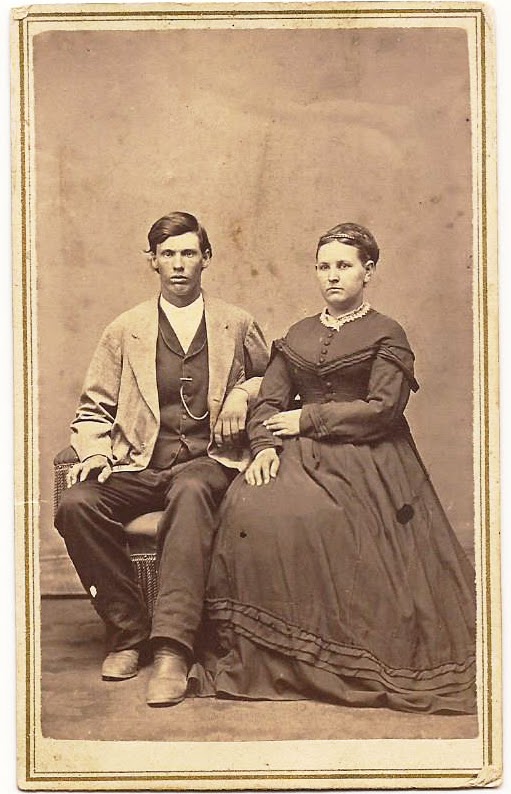
52 Ancestors 2015: #7 Columbus Couple - a CDV Mystery


This carte de visite (CDV) is in a photo album that was owned by my third great grandmother, Sarah Ann Lane Bird (1836-1873.)  The album itself was given to her in 1865 as a Christmas present by a farmer from Greensburg, Indiana named Thomas George Hamilton.  A story has been handed down through my family that Sarah was an orphan and that the Hamilton family raised her. I think the couple pictured might be part of the Hamilton family.

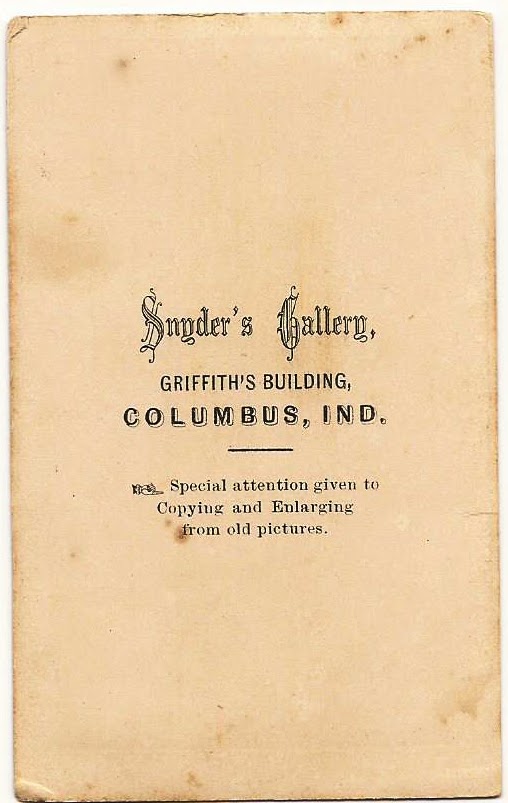
The back of the photograph is undated, listing only the name of the photography studio. I sent a scan of the photo to a librarian from the Decatur County Public Library who was doing some research on the photographer, R.W. Snyder.  She told me that Snyder only operated his gallery in Columbus, Indiana between 1870 and 1879; therefore, the picture had to be taken in that time frame.

Another clue to consider:  Sarah died in June of 1873.  Yet it seems likely that she would have selected at least the first few pictures of her album, and this photo was placed in the third page of the album. So I believe the portrait was taken before her death.

The picture can be further dated by looking at the woman's clothing, so I researched fashions from the 1860's and 1870's.  By the late 1870's, a narrow silhouette coupled with exaggerated bustles, fitted sleeves, and squarish necklines began to take over.  This woman has more of a full-skirted dress, relaxed sleeves, and a v-shaped bodice, which are aspects more in line with the style of the late 1860's.

After piecing together all these clues, I would guess that this picture was taken around 1870-1873, during the beginning of R.W. Snyder's photography career. The man and woman, who both look very young, were probably no older than their early to mid twenties when they sat for this portrait.  That places their birthdates, more or less, around 1850-1853. I think it's reasonable to assume that this picture was taken for their wedding or engagement.

In the 1860 census, a 23 year-old Sarah "Maine" was a domestic servant in the Decatur County household of William Warder Hamilton, the brother of Thomas George Hamilton. Also in the same household with Sarah were William's two sons, Robert Cassius and William Brutus Hamilton. With further research, I found that William Brutus was born in 1847 and was married in December of 1870 -- just the right time frame to fit this photograph.  His wife, Catherine Cunningham,was born in 1851 in Ohio. The part that doesn't quite fit the puzzle is that they were married in Mason, Ohio ... over 100 miles from Columbus, Indiana. However, William and Catherine lived in Greensburg, Indiana after they were married, which is only 30 miles from Columbus.

Of course, much of this is speculation.  If you can help me identify anything about this photo or if you have any idea who the couple might be, please leave a comment -- I would love to know!

Monday, February 9, 2015

52 Ancestors 2015: #6 Robert Mansfield, U.S. Consul for 19 Years

Consul Robert E. Mansfield
Passport photo
I am experiencing a feeling of relief that comes from the giving up of a very strenuous life, of a public career, for the more quiet, less extracting, home life. I am a Hoosier born, and it is gratifying to feel that after nineteen years spent in other countries, that I have returned to my native state, to live among old friends and associations that are more to be desired than are the varied experiences that are a part of a public career. (Robert E. Mansfield, "Resigns Post at Stockholm", The Daily Republican, Rushville, Indiana, 6 Jan 1917, page 1)

Robert Emmet Mansfield was far away from home quite often.  He served for nearly 20 years as a U.S. consul, beginning with his first appointment by President McKinley in 1899 to Zanzibar.  In 1901, he was transferred to Valparaiso, Chile, where he spent five years.  During that time, he wrote a book, Progressive Chile, about his observations and impressions.

From 1906-1913, Robert Mansfield served as consul in three different locations in Switzerland.  His wife Fanny, whom he married in 1906, lived in Switzerland with him for much of this time.  In 1913, he was given a new post in Vancouver, British Columbia, Canada, where he remained until 1916, when he was transferred to Stockholm, Sweden.  Robert finally retired from his consular career in 1917.

Robert's wife, Fanny Gowdy Mansfield
The Indianapolis News 2 Feb 1901, p. 16
Fanny and Robert quickly settled into their new life in Fanny's hometown of Rushville, Indiana.  Before his consular career, Robert had been a newspaper editor for the Muncie Times, the Indianapolis Journal, and the Marion News.  Soon he began writing articles for the Daily Republican (Rushville), including an article about his personal friend, poet James Whitcomb Riley.

Mansfield became very involved in the civic affairs of his community and was in great demand as a public speaker. He also promoted the work of the Red Cross in Rushville during the first world war.  In the spring of 1924, he sponsored a public speaking contest at the Rushville high school, called the Mansfield Declamation Contest.

Robert Mansfield died on September 18, 1925 at Methodist Hospital in Indianapolis, Indiana at the age of 59 after a long illness involving his heart.  Although he had only been a resident of Rushville for eight years, he made a great impact on the small town.  The following is part of a lengthy tribute written by a group of Rush County teachers after his death:

Born with unsual capacities for serving his country and his neighbors...he always accepted honor as duty and brought to such duties his very highest energies and talents, whether serving as foreign representatives of his government or making an inspirational address in a remote community.  Although accustomed to move with natural ease in the ranks of high social standing, Mr. Mansfield never lost the common touch, which enabled him to win the confidence of even the most timid school-child. His broad-mindedness, his constant  and unceasing effort to understand and appreciate the people with whom he associated, in whatever hemisphere of the world, have been often noted. 

An attempt to enumerate the worthy qualities of this good and genial man would, for their very number, be difficult.  His death calls to mind the truth that the characters of the great are, after all, only a composite of the plainest and simplest virtues.  This group of teachers therefore joins with the entire community and also with the host of friends even in distant parts of the world who are saddened by the death of this gentleman and scholar. ("R.E. Mansfield Funeral Sunday," The Daily Republican, Rushville, Indiana, 21 Sept 1925, page 2)

Robert Mansfield's house in Rushville, Indiana.  

Thursday, January 29, 2015

52 Ancestors 2015: #5 William Holzlider, Plowing Through "Chunks"

William Holzlider, center.  On either side of him are his children, Stella and Russell.
Also pictured is Stella's husband, Mason McCammon, and their dog Fanny.
Photo taken about 1920, along Bear Creek in Jennings County, Indiana.
My great-great grandfather, William Holzlider, was born on January 26, 1855 in Cincinnati, Ohio. His parents, George and Mary Gertrude, were recent immigrants to America.  (Family tradition is that George was a stowaway from Luxembourg.)  William had one older sister, Anna Mary, and three younger siblings: Edward, Julia, and Lena.  I'm not sure when his family moved to Indiana, but the Holzliders were in Jennings County, Indiana by the time the Civil War broke out.  William was working as a farm laborer on someone else's farm in Decatur county when he was 15.

The Holzlider house in Pierceville, Jennings County, Indiana.
On January 30, 1887, William married Ella Dorothy Smith in Jennings County, Indiana. He was 32, and she was 20.  William and Ella lived in Sandcreek Township, Indiana.  They had a family of six children: three boys and three girls.

William purchased 40 acres of woodland for $700 in Pierceville, Indiana in 1902 or 1903. I'm sure it was quite a job to clear the land of trees.  According to a letter written by William's daughter Bertha, the ground was all in "chunks." William and his young sons, Omer and Clyde (my great grandfather), worked hard plowing the land to make it tillable.

William's grandaughter
Martha Holtzlider in 1937.
One day in 1907, William bought a supply of lumber so that he could expand his house. Somehow, the house caught on fire that very night.  The family Bible was destroyed.  The two youngest Holzlider children, Russell and Bertha, were placed outside on a mattress that was saved from the burning house. The following day, neighbors came over and helped rebuild the house.

Ella Holzlider died in 1917 at the age of 51.  In 1920, William was still running a farm at the age of 64, with Russell and Bertha living at home.  William had retired from farming by 1930 and was living with his son Russell and his wife in Indianapolis.

My grandmother, Martha Holtzlider (pictured at right), wrote a letter in 1985 to her uncle Russell Holzlider, describing her only memory of her grandfather William:

I do remember singing to Grandpa Holzlider during what I believe was his last illness.  I was about 6 years old and it was an awesome experience for one so young and I have never forgotten standing by his bed and singing.  I don't remember the name of the song. That is the only recollection I have of Grandpa Holzlider.

William died from heart disease on July 22, 1934, at the home of his son Clyde in Greensburg, Decatur County, Indiana.  He and Ella are buried at Brewersville, Jennings  County, in Bear Creek Cemetery.

Sunday, January 25, 2015

Urgent! Indiana Genealogy Department In Danger

Taking the advice of Amy Johnson Crow of No Story Too Small, I wrote the following letter to my local representative:

I am writing to you as an Indiana resident, a high school student, and as one who would be affected by the proposed state budget for 2015.  I am very interested in genealogy and the history of the state of Indiana.  For a number of years, I have participated in the 4-H genealogy project, along with many other young Hoosiers.   By engaging in genealogy research, I’ve felt more connected to the history of our state, learning aspects of history I would never have come across in my history curriculum.  

As I understand, House Bill 1001 would cut funds for the Indiana State Library and eliminate the Genealogy Department as well.   This redistribution of funds, if it takes effect, will be a huge loss for genealogists like myself.   In researching my family, I have requested information from the Indiana State Library, and they have been very helpful.  The Indianapolis Public Library has already made it known that they will not spend resources on maintaining a genealogy collection.   Many records have not been digitized.  For a small portion of the budget, the history of the people of Indiana can be preserved and kept safe. 

The Indiana State Library and the Genealogy Department are not just valuable resources to Indiana residents.  Many researchers come from out of state to view unique records at the state library, generating revenue for our state through their travel expenses.

Indiana’s bicentennial is next year.  With such an important anniversary as this, there should be an effort made in regard to showcasing and making accessible our state’s history.   How would that happen if the Indiana State Library funding is cut and the Genealogy Department is eliminated?

Please vote to restore funding for the Indiana State Library and the Genealogy Department.  We must preserve our history for generations to come.

Sincerely,

Brenna G.

Please consider contacting a representative and expressing your opinion on the proposed budget.