Thursday, March 19, 2015

52 Ancestors: #11 Henry Sefton of County Antrim

Giant's Causeway, County Antrim, 2011.
Photo taken by my brother.
Four years ago, my brother spent a whole semester in Ireland.  He even celebrated St. Patrick's Day in Dublin!  I am still jealous.

At the time, I didn't know about my Irish 5th great grandfather, Henry Sefton.  If I had known, I would have asked my brother to do some research for me.  He was probably too busy anyway ... climbing hills and bodhran-drumming and step-dancing and eating at pubs (and maybe studying).

Although I didn't get to travel to Ireland, I was lucky enough to inherit some notes about the Sefton family that were handwritten by Henry Sefton's 2nd great grandaughter, Nettie Ryan Hamilton.

According to Nettie, Henry Sefton was born in Ireland on November 10, 1767.  His father, John Sefton, a Protestant, had fled England due to religious persecution and afterwards became an officer in the Army of Ireland.  Henry married Elizabeth Boyes in 1799 in County Antrim, now part of Northern Ireland.  In 1803, Henry, along with his wife and two children and his brother William, left Ireland to come to America, settling in Butler County, Ohio.  Over the next decade, the Sefton clan grew to include eight more children, including my 4th great grandfather William O. Sefton.

In the early 1830s, a cholera epidemic swept across the midwest.  Henry's young daughter, Charlotte French, and her husband Jeremiah died in June 1834, leaving their infant son an orphan.  Then, on July 27, 1834, Henry Sefton fell victim to the dreaded disease.  He was buried at New Haven Cemetery in Cincinnati, Ohio.

Monday, March 16, 2015

52 Ancestors 2015: #10 A Tragic Accident at the Indiana Republican Convention

Dr. James C. Green, son Hugh, and wife Azzie, c. 1892
James C. Green was born March 10, 1860, in Arlington, Rush County, Indiana.  The son of Dr. James Wilkinson Green and Mary Jane Gowdy, he was the seventh of 13 siblings.  Six of those siblings became doctors, including James and his brother, John D. Green (my great great grandfather.)  James attended courses at the newly-formed Medical College of Indiana, which was a department of Butler University. Following his graduation in 1880, James began his practice as a physician alongside his father in Arlington.

On October 23, 1883, James was married to Azzie E. Winship, a young woman from Rushville, Indiana. The couple had two children -- an infant daughter who died in 1885 and a son, Hugh Clifford Green, born on December 31, 1886.

In 1892, James C. Green was chosen to be a delegate to the Indiana Republican convention.  The convention, which was held on June 28 at the Princess Rink in Fort Wayne, lasted for only one day. The event drew such a large crowd that officials threatened to clear the hall to make room for all the delegates waiting to get inside.  In the chaos, James was pushed against a door knob and critically wounded.  Sadly, he died from his injuries a few weeks later.

The Indianapolis Journal, July 17, 1892

Monday, March 9, 2015

The Slaves of Barnaby Worland of Monroe County, Missouri

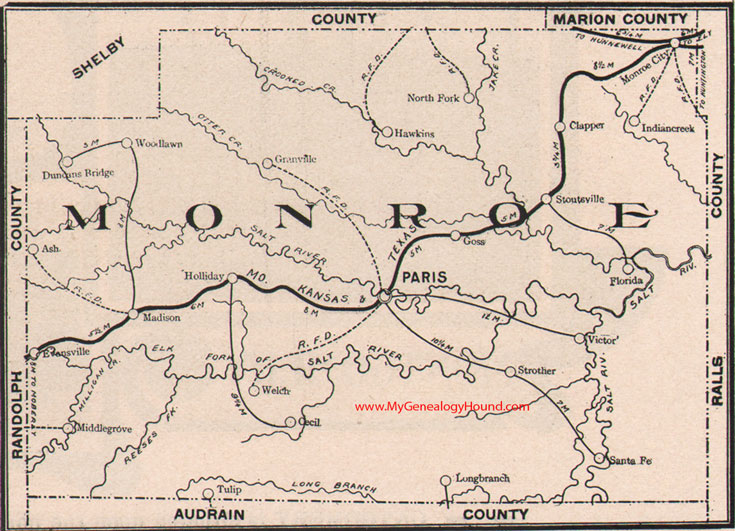
In the 1840's Barnaby owned land near an area called Old Clinton and Jonesburg.
The town was renamed North Fork and is shown at the top of this 1904 map.
http://www.mygenealogyhound.com/maps/missouri-maps/mo-monroe-county-missouri-1904-map.html
Schalene Dagutis of Tangled Roots and Trees has initiated a new genealogy project: The Slave Name Roll Project.  It provides a way for genealogists to trace their enslaved ancestors during a time when very little documentation of these people existed.  By digitzing and recording information about ancestors who owned slaves, others can help piece together their ancestor's lost stories.

Barnabas Worland (also called Barnaby) was born on January 5, 1777 in Maryland.  From there he migrated with his brother Thomas to Kentucky, settling in the Lexington area.  Sometime after 1828, Barnaby and his family relocated to Monroe County, Missouri.  Barnaby Worland married three times and was the father of 15 children.  His first wife was Theresa Hardy, and they had seven children: Matilda, Stephen, Theodore Sebastian, Vincent, Mary Theresa, Verlinda C., and George.  After Theresa died in 1816, Barnaby married Cecelia Gough and they had three children: John Henry, James Guy, and Mary C.  This second wife lived only ten years after their marriage.  Barnaby's third wife was Catherine Theresa Deerling.  Their children were Cecelia Agnes, Anna Gabriella, Sarah Catherine, Elizabeth Lewellen, and Barniellen (who was born after his death.)

The following is an excerpt from Barnaby's will, dated May 26, 1842, which I found in One Man's Family by Olive Lewis Kolb.

In the name of God, Amen:  I, Barnaby Worland of Monroe County and state of Missouri, being of sound mind and perfect memory have made this my last will and testament in manner and form viz:

After my just debts and funeral expenses shall have been paid, I give and bequeath to my beloved wife, Catherine Worland, the whole of the land I purchased of James and George Gough and the land I afterward purchased of James Gough, containing three hundred and thirty acres during her life time with an exception herein contained.  This farm shall be for her home and a residence for my unmarried daughters free of charge as long as they may live with her.  I also give to my beloved wife all my slaves viz -- Britt, Granville, Maria and her three children, Henry, George and William, together with every species of my personal property consisting of stock, agricultural implements, house hold and kitchen furniture together with all money in hands and all bonds not collected out of the uncollected funds as above appropriated.  I will and direct that my executrix shall invest the sum of two thousand five hundred dollars in Lands for the use and benefit of my two daughters Cecelia and Gabrilla, the title of which land shall be made to them and their children forever.  Furthermore it is my will and desire that my executrix or executor shall as soon as practicale purchase a Negro girl between the age of ten and thirteen years, the title of which girl shall be invested in my wife forever.

My further will is that at the death of my wife and youngest child being of full age my executor shall then proceed to sell all my personal estate; my slaves, and household and kitchen furniture excepted, of every description and divid the proceeds between my daughters Therese Combs, Verlinda Smith and Mary Worland.  As to my slaves at that time I give to my four daughters by my present wife viz - Cecelia - Gabrilla, Sarah Catharine and Lieu Ellen my negro woman Maria, together with her three children and any increase she (Maria) may in future have -- which slave are to be equally divided between my four daughters as before mentioned.  The remainder of the slaves viz -- Britt and Granville shall be equally disposed of as practicable without public sale between John H. Worland, Therese Combs, Verlinda Smith and Mary Worland, to them and their heirs forever.

On June 19, 1842, the day before he died, Barnaby Worland wrote an addition to his will:

Whereas, I, Barnaby Worland, upon reflection deem it proper to make some alterations in my will hereunto annex in manner and form as hereinafter mentioned viz . . . My further will and desire is that in the event of any of my heirs or legatees making any effort to prevent my will taking effect different from my intention every provision to them in my will shall be withdrawn and they shall be cut off with six and one fourth cents each, their interest or portion in this will to be divided among the other legatees. 

Tuesday, March 3, 2015

The Slaves of Abraham Inloes of Fell's Point, Baltimore, Maryland

Fell's Point, Balitmore, Maryland, as it appeared in 1800.
According to his will, Abraham's property faced
Ann Street and reached back halfway to Argyle Alley
Schalene Dagutis of Tangled Roots and Trees has initiated a new genealogy project: The Slave Name Roll Project.  It provides a way for genealogists to trace their enslaved ancestors during a time when very little documentation of these people existed.  By digitizing and recording information about ancestors who owned slaves, others can help piece together their ancestor's lost stories.

For my first contribution to the project, I chose to write about Abraham Inloes, a collateral relative.  I found a transcription of his will in a three-volume family history book about the Inlow/Inloes family, entitled In Old Kentucky, A History of My Forbears.

Born about 1736, Abraham Inloes was the grandson of a Dutch immigrant.  He lived in Fell's Point, Baltimore, Maryland and was one of the first in his family (if not the first) to own slaves.  Fell's Point is the oldest neighborhood in the city of Baltimore.  During and after the Revolutionary War, it became one of the leading harbors in the country. Between 1774 and 1821, over 800 ships were constructed at the Fell's Point shipyards.  In 1835, Frederick Douglass, while still enslaved, worked for a ship builder in Fell's Point.  It was here that he taught himself how to read and write, by copying and memorizing the letters with which the shipyard men labeled boards.

On December 28, 1790, Abraham Inloes died.  He was about 54 years old.  The following is a portion of Abraham's will, dated November 18, 1790.
I give and bequeath unto my Loving Wife [Elizabeth] all my negroes to wit Negro Joshua, Sarah, Thomas, and Ann with their increase to her, her heirs and assigns forever, as it was my Intention to have Manumitted my negroes aforesaid, but by my present Indisposition hinders the same. I have given them to wife to do with them as she pleases, Yet having confidence in her that she will by a sufficient deed of Manumission make them free after my decease, and I look upon them as making no part of my Estate. My Will and desire is that if any of my children hereafter named should or shall hereafter lay any claim to them or any part of their appraisement or by suit or other ways disturb my wife or my Executor or the Slaves themselves in claiming them or any of them or any part of them, then it is my will that such child or children shall take no part in my Estate hereinafter bequeathed unto them and that their part, his or her part so offending shall be divided amongst my other children who obey, and keep my Will.
Further on, Abraham lists his ten children by name: Anthony, Abraham, Elizabeth, Joshua, James, John, Eleanor, Temperance, William, and Margaret.  It seems that in his later years he firmly believed that owning slaves was wrong, since he threatened to disinherit his children if they tried to contest his will.  I don't know what actually happened to Joshua, Sarah, Thomas, and Ann after Abraham Inloes died, but I hope they were given their freedom.

Saturday, February 28, 2015

52 Ancestors 2015: #9 Ada Elizabeth Worland, World-Famous Incubator Baby

Ada Elizabeth Worland, age two.
The Indianapolis News, 24 Jun 1902, p. 3
Little Ada Elizabeth Worland, the 2-year-old daughter of of Edward and Nadia Worland ... enjoys the distinction of being the smallest child who has survived the incubator process.

At birth [she] weighed but one and one half pounds. She now weighs 16 pounds and is 28 inches tall. Her case is considered one of the most remarkable on record.  She was a 6-months child and so frail and delicate that it seemed that the least breath of air would blow her away.  There seemed no possiblility of saving her life.  The twin brother died at birth.
Source: http://www.uh.edu/engines/epi2279.htm

Dr. Conger... conceived the idea of trying the incubator plan.  A soap box was secured and a can containing one and one-half gallons of water was placed at the bottom.  A board was placed on top of the can and this was covered with cotton.  The top of the box was covered with a pane of glass and holes were bored in each end of the box for ventilation.  A sponge was hung inside to keep the atmosphere moist and a thermometer to regulate the temperature was suspended from the roof.

Nourishment was given the child by inunction [rubbing ointment or oil into the skin] and she lived on in spite of everything and grew stronger and stronger.  The water was changed frequently and the temperature kept at 90 degrees.  The incubator, which had been tried simply as an experiment, proved the means of saving the infant's life. (Indianapolis Sun, 31 Dec 1901, p. 5)

Ada Elizabeth Worland was born in Indianapolis on January 26, 1900 at a time when many premature babies did not survive.  Fortunately, Dr. Charles Conger knew something about infant incubation, a treatment that was not yet widely used.  Elizabeth Conger, Dr. Conger's wife, was also a trained medical doctor and assisted with the case.  Ada's parents expressed their gratitude to the Congers by using "Elizabeth" as their daughter's middle name.

By 1902, Ada was thriving.  About this time, however, Edward Worland contracted an illness that lasted for several months, rendering him unable to work.  To provide for the family, Nadia Worland sought employment.

Mrs. Worland is a pretty and gentle little woman, and not afraid to work...  A firm in the city supplied her with a wagon and horse, and she peddled oil about the streets until she had nearly 150 customers. About two weeks ago her husband was able to return to work, and the young woman abandoned her unusual vocation and is once more looking after household affairs.  (The Indianapolis News, 24 Jun 1902, p. 3)

Tragically, Nadia died of typhoid fever at the young age of 25, a few months after the above article was published.  Ada was not yet three years old.  After her struggle to survive, it is sad to think of Ada being deprived of her mother.  I don't know very much about Ada's life after this point -- I hope things got a little easier for her.  She eventually married, had three children of her own, and lived to be 84 years old.

Tuesday, February 24, 2015

52 Ancestors 2015: #8 Gowdy's Good Deed

My 3rd great-grand uncle, John K. Gowdy
A Family History Comprising the Surnames of Gowdy
and the Variant Forms
 by Mahlon Myron Gowdy, 1919, p. 537.
John K. Gowdy's son was born on the last day of November 1867 in the little town of Arlington, Indiana. Given the rather unusual name of Latta Theodore, he was the pride of his father, the joy of his mother, and their first born -- a beautiful and sprightly child.

On March 24, 1870, little Latta Gowdy died.

He was only two years, three months and twenty-four days of age.  Those, who have wept, and still weep over a loss like this -- the death of a first born -- can best sympathize with those who weep.  His [father], mother and sister survive.  (Rushville Republican, 22 Aug 1931, p. 4)

It must have been a terrible shock to the Gowdy family, especially since their daughter Fanny had been born just two weeks earlier. I'm sure that John never got over the loss of his beloved son, yet he found a way to ease his grief and help someone else in the process. Sometime around 1876, John Gowdy took in a boy from the Cincinnati Children's Home.

For three years, the Gowdys provided a caring home for this new son.  Then something completely unexpected happened...

Last week the boy's father, living at Lawrenceburg, heard of his whereabouts, came and claimed him, and they reluctantly gave him up. (Rushville Republican, 16 Oct 1879, p. 3.)

I really wish I knew what the boy's name was so that I could find out more about him.  Hopefully, his father treated him well.  I like to think that John Gowdy's kindness had a lasting impact on the boy's life.

Saturday, February 14, 2015

One Year Blogiversary!

One year ago today I started my blog!  Thank you to everyone who has taken the time to read my posts.  Here are a few from the past year that are my favorites.

First post:  Mary Ida Sefton and Her 29 Roses

Most viewed post: Carrie C. Fields, Red Skelton's Aunt

Favorite post:  Fanny Gowdy and an American Romance in Paris

Longest post:  The Wartime Diary of Captain Willis E. Hedgecock

Shortest post: Nancy Tombaugh, Midwife of Richland County

Saddest post: Little Mary Catherine Green

Funniest post:  Nancy Oliver, Who Waited 3 Years For Groceries

And finally, the post with my favorite picture:

Dola M. Worland, Gold Star Mother